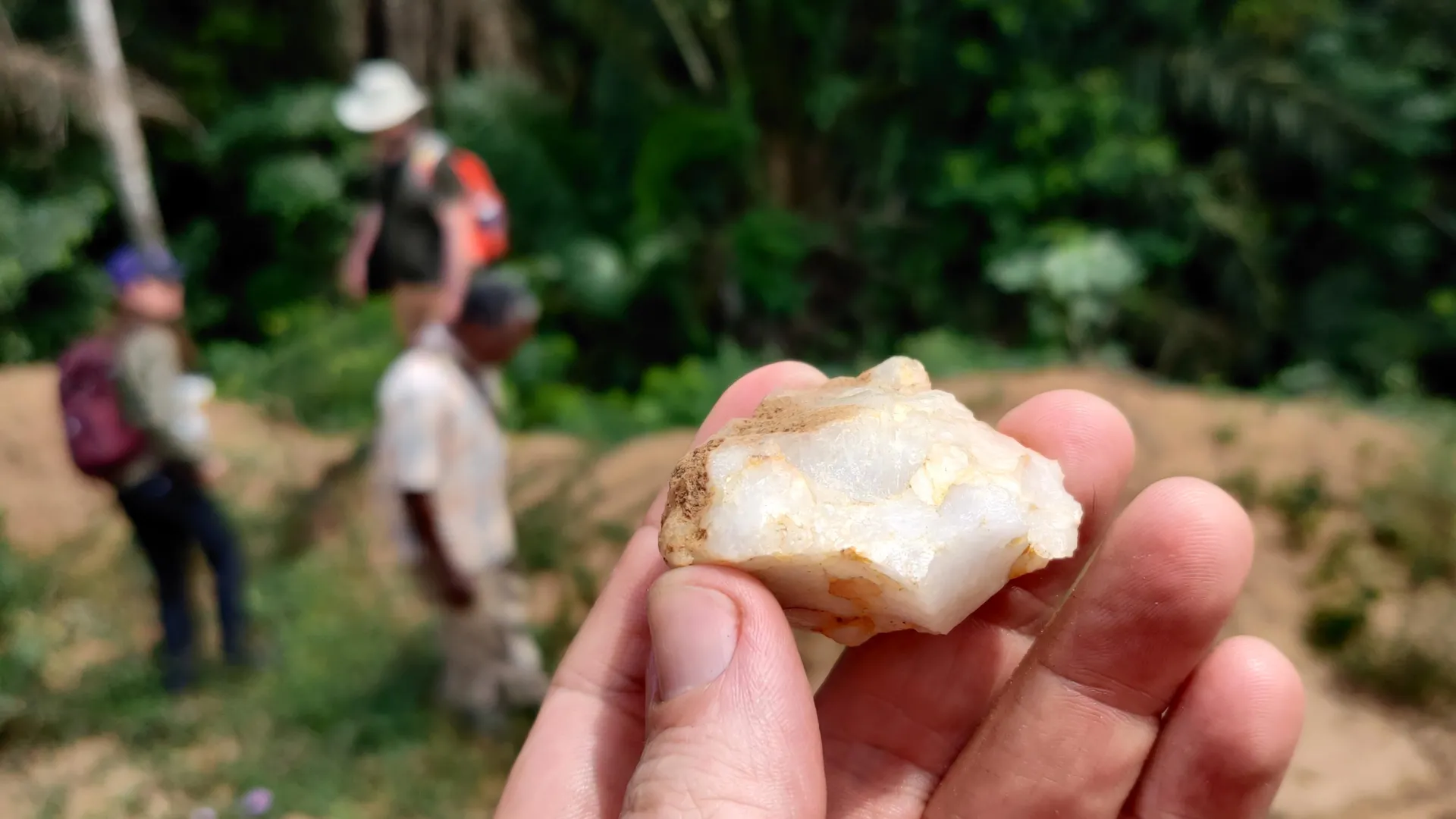
Deep beneath the canopy of a West African rainforest, archaeologists have unearthed evidence that rewrites the story of when humans first learned to thrive in Earth's most unforgiving ecosystems. At Bété I in Côte d'Ivoire, researchers discovered stone tools buried in soil that tells the story of Homo sapiens living in dense tropical forest roughly 150,000 years ago—more than double the oldest previously known record of humans inhabiting rainforests anywhere in the world.
For decades, a stubborn assumption constrained how scientists understood human evolution: our ancestors were creatures of open grasslands and coastlines, avoiding the thick forests of Africa until much later in history. Dense tropical rainforests seemed inhospitable, environments where early humans simply could not survive. That conviction has now crumbled in the face of rigorous evidence.
The discovery begins with an old excavation. In the 1980s, Professor Yodé Guédé of l'Université Félix Houphouët-Boigny led a joint Ivorian-Soviet research mission that uncovered layers of stone tools at Bété I. At the time, the technology needed to accurately date these artifacts simply didn't exist. Decades later, an international team led by Dr. James Blinkhorn of the University of Liverpool and the Max Planck Institute of Geoanthropology returned to the site with tools unavailable when the original work was done. They relocated the original trench and applied modern dating methods—Optically Stimulated Luminescence and Electron-Spin Resonance—that pointed conclusively to human occupation around 150,000 years ago. The timing proved crucial: since the new excavation, mining activity has destroyed the site entirely, making the recovered data irreplaceable.
The evidence of rainforest conditions is equally compelling. Scientists analyzed pollen, phytoliths (tiny silica structures left behind by plants), and chemical traces preserved in the sediments. The results painted a picture of a landscape heavy with humidity and dense woodland—not a thin strip of forest but genuinely wet tropical rainforest. The samples contained pollen and plant waxes characteristic of humid West African rainforests, while very low levels of grass pollen confirmed that humans were thriving in genuine forest density, not savanna margins.
Before this discovery, the oldest secure evidence of humans living in African rainforests dated to only about 18,000 years ago. The previous global record came from Southeast Asia and stretched back approximately 70,000 years. This new finding more than doubles that timeline, forcing scientists to confront a more nuanced picture of human adaptability than they had previously imagined.
The implications ripple far beyond archaeology. The discovery adds compelling evidence to a growing scientific consensus: Homo sapiens were ecological generalists capable of surviving in vastly different habitats—deserts, coastlines, and dense forests alike. This flexibility, researchers now believe, may have been the secret advantage that allowed our species to spread successfully across the world while other human relatives disappeared. The study also raises profound new questions about human influence on tropical ecosystems. Did ancient rainforest populations shape their environment through hunting, fire use, and plant management far earlier than anyone suspected?
"Several additional sites in the region remain largely unexplored," Dr. Eslem Ben Arous noted, raising the tantalizing possibility that even older evidence of rainforest-dwelling humans awaits discovery. As one researcher reflected on the broader pattern, "Ecological diversity sits at the heart of our species—reflecting a complex history in which different populations lived in different regions and habitat types." The West African rainforest, it seems, holds many more secrets still.