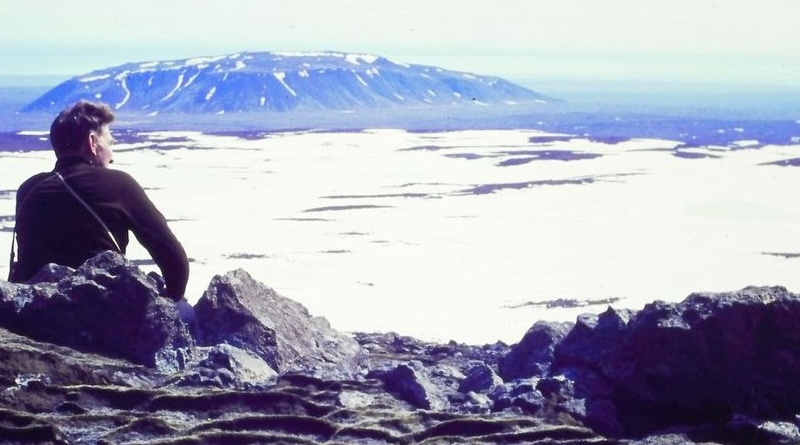
In 2019, Icelanders gathered at a glacier in Borgarfjörður to hold a memorial service—not for a person, but for Okjökul, a sheet of ice that had vanished from the map. Once spanning 16 square kilometers when first charted in 1890, Okjökul had shrunk to just 0.7 square kilometers by 2012, until glaciologist Oddur Sigurðsson officially declared it "dead ice" two years later. It was Iceland's first glacier lost entirely to climate change, a loss now immortalized in the new National Geographic documentary Time and Water, directed by Sara Dosa and featuring renowned Icelandic author Andri Snær Magnason.
The 2019 ceremony, attended by the Icelandic Hiking Society, local residents, scientists, and Magnason himself, was sparked by earlier work by Rice University anthropologists Cymene Howe and Dominic Boyer, who had released a 2018 documentary about Okjökul narrated by former Reykjavík Mayor Jón Gnarr. That memorial moment transformed grief into action. Howe and Boyer have since organized ongoing memorial events and launched an online tracker to draw attention to the cultural and environmental significance of glaciers worldwide. The inscription on the Okjökul memorial, where the full name has been shortened to "Ok" in acknowledgment that the word jökul—Icelandic for glacier—is now lost, carries an urgent warning: within 200 years, all of Iceland's main glaciers are expected to follow the same path.
Yet Iceland's story is not one of loss alone. Even as it mourns its glaciers, the nation has emerged as a global leader in climate innovation, pivoting decisively from imported fossil fuels to a renewable energy economy grounded in its vast geothermal resources. The country is leveraging that abundant heat for everything from vertical farming to decarbonization systems, while simultaneously serving as a testing ground for climate tech startups from around the world.
One of those startups is Syntholene, a U.S.-based company that has developed a high-temperature electrolysis system capable of synthesizing sustainable aviation fuel, or SAF. In April, Syntholene announced plans to construct a demonstration facility at the Husavik geothermal energy plant in Norðurþingi—a facility that had stopped producing energy in 2010 but whose core systems remained intact. Syntholene expressed confidence that Husavik could be revived within weeks, and just six weeks later, the company reported that construction was already proceeding ahead of schedule, with plans to have the facility operational by late summer.
The project represents a watershed moment in renewable energy innovation: the first company to demonstrate the integration of geothermal heat with high-temperature electrolysis for synthetic fuel production. It's the kind of audacious problem-solving that characterizes Iceland's response to climate crisis—not paralysis in the face of loss, but a determination to build solutions from the resources at hand.
Director Sara Dosa captured this tension perfectly in her artist statement for Time and Water: "Too much hope can lull us into complacency, while too much dread can convince us the future is already lost. Uncertainty, however, invites agency." That sentiment is etched into the bedrock of Iceland's response. The nation knows what is being lost. It also knows what needs to be done. The question, as the Okjökul memorial asks, is whether we will do it.