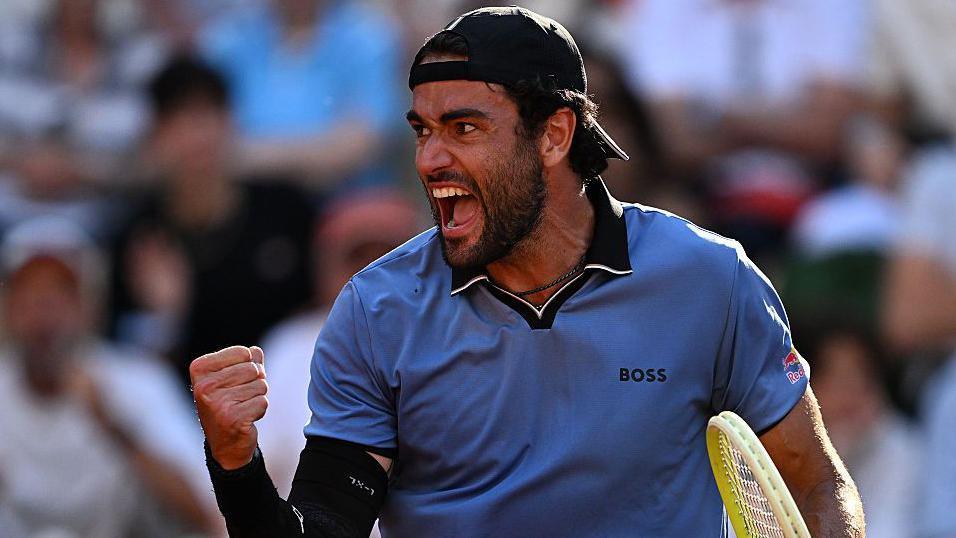
Matteo Berrettini stepped onto Court Philippe Chatrier knowing that tennis had nearly let him go, and that he had almost let it go too. The Italian, his ranking once as low as 105th after injuries had ravaged his career, beat Argentina's Juan Manuel Cerundolo 6-3, 7-6, 7-6 to reach the French Open quarter-final for the first time in almost four years. In doing so, he became the lowest-ranked Roland Garros quarter-finalist since Igor Andreev in 2007—a statistic that barely begins to capture what this moment means.
Berrettini had tasted the top of tennis before. In 2022, he reached a career-high ranking of number six in the world. He had made a Wimbledon final in 2021, falling to Novak Djokovic, and reached the Australian Open semi-finals the following January. Then injuries arrived, persistent and punishing. He missed six of the last thirteen Grand Slam tournaments. His last quarter-final appearance at a major had come at the 2022 US Open, leaving a void of nearly four years in his resume.
What made this deep run at Roland Garros even more remarkable was the grueling path to get here. In the previous round, Berrettini had won the longest match of his career—five hours and sixteen minutes—saving two match points in a five-set thriller. Few players could recover from such exhaustion. Berrettini came through it without a trace of fatigue, dismantling Cerundolo in straight sets with crisp, commanding tennis.
Against Cerundolo, Berrettini raced through the opening set. The second and third went to tie-breaks, where he showed the composure and precision that had once ranked him among the world's elite. When Cerundolo threatened to break back in the third set at 3-2, Berrettini struck immediately for 5-5, then saved three match points before winning the final tie-break. Each moment was a choice to keep fighting.
When asked what had kept him going through four years of setbacks, Berrettini was clear: "Tennis is the love of my life. If it wasn't I wouldn't be here." He spoke of the uncertainty that had shadowed his return—the moments when his confidence was fragile, when he wasn't sure his body would cooperate, when the path back seemed too long. "There were moments where it was really tough to come back and play," he said, "because I wasn't ready and I wasn't sure about my confidence—now I feel great."
What awaits him in the quarter-final is a match against either Frances Tiafoe or Matteo Arnaldi. But regardless of what comes next, Berrettini has already completed the most important victory—the one against himself, against injury, against the whisper that perhaps it was time to let go. He has 10 ATP Tour titles to his name, and now he has something else: proof that persistence and genuine love for a craft can forge a second coming. He is 30 years old and playing some of his best tennis, not in spite of what he has endured, but somehow because of it.