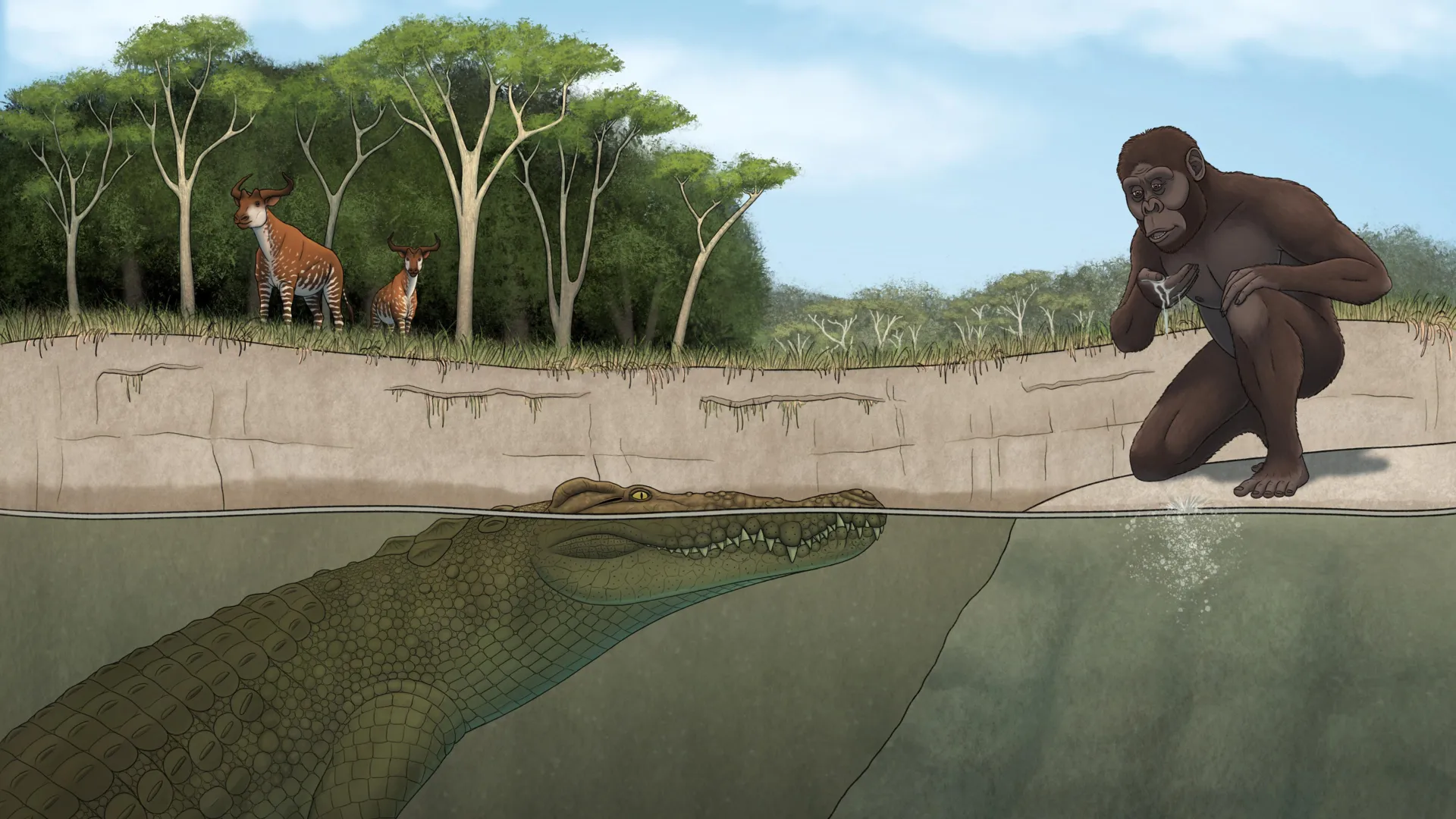
More than 3 million years ago in the waterways of what is now Ethiopia, Lucy and her relatives walked a dangerous landscape where a massive crocodile lurked beneath the surface, waiting. Now, researchers have given that prehistoric predator a name: Crocodylus lucivenator—Lucy's hunter.
The story of this discovery begins in a museum in Addis Ababa in 2016, when Christopher Brochu, a University of Iowa professor who has spent 35 years studying ancient crocodilians, examined fossils that struck him immediately as unusual. "I was just blown away because it had this really weird combination of character states," Brochu recalls. What made this crocodile so distinctive was not just its size—measuring 12 to 15 feet long and weighing between 600 and 1,300 pounds—but its anatomy. A prominent hump rose from the middle of its snout, a feature found in modern American crocodiles but absent in Africa's Nile crocodiles. Researchers believe this hump may have served a purpose during courtship displays, with males lowering their heads to show off the feature to females. The crocodile also possessed an elongated snout that extended farther beyond its nostrils than those of other crocodile species living during the same period.
The formal identification of Crocodylus lucivenator appears in the Journal of Systematic Palaeontology and is based on an analysis of 121 cataloged fossil remains—skulls, teeth, and jaw fragments from dozens of individuals—all recovered from the Hadar Formation in Ethiopia's Afar region. This landscape, designated a UNESCO World Heritage site in 1980, has long been one of the most important sites for understanding human origins. Lucy, the famous Australopithecus afarensis skeleton discovered in 1974, lived in this same region between 3.4 million and 3 million years ago. At the time of her discovery, Lucy's skeleton was the oldest and most complete early human ancestor ever found, and it helped demonstrate that bipedalism—walking upright on two legs—evolved before larger brain size.
In the ecosystem of ancient Hadar, with its rivers, lakes, shrublands, and tree-lined waterways, Crocodylus lucivenator reigned as the apex predator. "It was the largest predator in that ecosystem, more so than lions and hyenas, and the biggest threat to our ancestors who lived there during that time," Brochu says. "It's a near certainty this crocodile would have hunted Lucy's species." The crocodile was an ambush hunter, spending much of its time concealed in water, waiting for animals to approach for a drink—a survival strategy that made it vastly more dangerous than the other predators sharing the landscape.
One fossil specimen provides a window into the violent world these ancient crocodilians inhabited. Several partially healed jaw injuries suggest the animal had fought with another crocodile, engaging in the kind of face-biting behavior documented throughout the crocodile family tree. The injuries healed, meaning this particular animal survived its encounter, but the story of the victor remains locked in the fossil record.
What makes Crocodylus lucivenator's dominance particularly striking is that although at least three other crocodile species inhabited the Eastern Rift Valley farther south, this species had the Hadar region largely to itself. Christopher Campisano, an Arizona State University researcher and study co-author, notes that the Hadar environment shifted over time, with open woodlands, gallery forests, wet grasslands, and shrublands coming and going. Yet Crocodylus lucivenator persisted throughout these changes, a testament to its remarkable adaptability and the terror it must have inspired in any early human ancestor venturing too close to the water's edge.