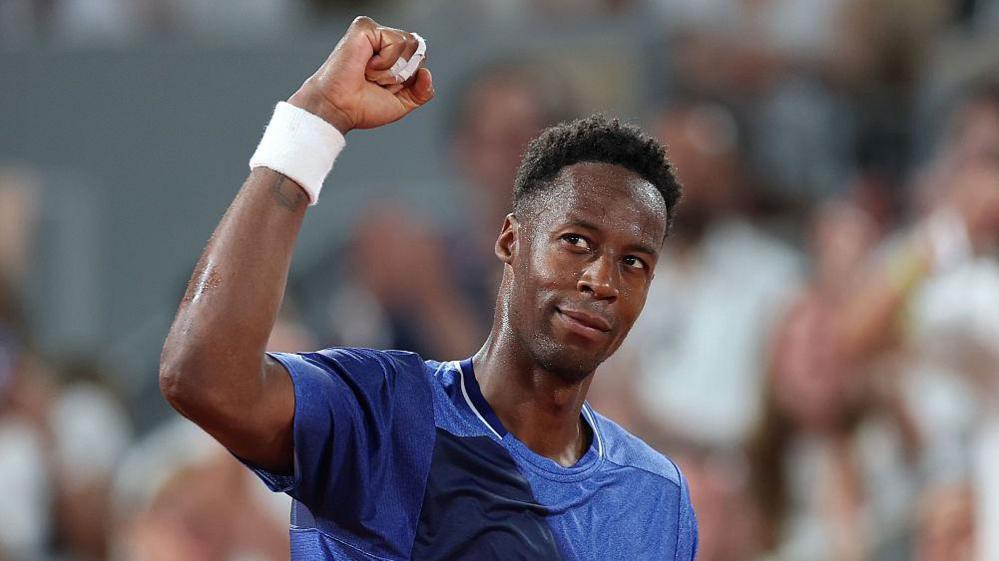
On Court Philippe-Chatrier under the Paris sun, Gaël Monfils took one last bow at Roland Garros after 23 seasons in professional tennis, losing in five sets to world number 185 Hugo Gaston but departing to waves of "Gaël, Gaël, Gaël" echoing through the stadium. At 39, the French showman had already said goodbye to his home Grand Slam before stepping on court—but Monday proved the moment when the tennis world could formally bid farewell to one of sport's most beloved characters.
Down two sets early, Monfils fought back with the flamboyance that has defined his career: tweeners, baseline slides, and the kind of dogged determination that brought the crowd to its feet. He forced a deciding set but ultimately exhaustion prevailed, the scoreline reading 6–2, 6–3, 3–6, 2–6, 6–0. Yet the loss barely mattered. What followed was a cascade of tributes that spoke to something far deeper than rankings or titles: the impact Monfils has had on the game simply by being himself.
Rafael Nadal, Roger Federer, and Novak Djokovic all recorded messages for the occasion. Djokovic, who has known Monfils since they were both 13 years old, called him "one of my favourite players to watch" and praised what he'll leave behind. "The legacy he'll leave behind is how nice of a human being he is, how good of a guy. He's always smiling, always bringing positive vibes." Yannick Noah, France's last men's champion at Roland Garros in 1983, also appeared on the big screen.
Over his 23-year career, Monfils won 13 ATP titles and recorded 38 victories over top-10 ranked players, including multiple wins against both Federer and Nadal. He reached the semi-finals at the French Open in 2008 and quarterfinals three times at Roland Garros, plus quarterfinals at Wimbledon and the US Open. He achieved a career-high ranking of number six in the world and reached at least the last eight at three of the four majors. This was his 70th Grand Slam main draw appearance and 19th at the French Open—a record for most Slam match wins by a male French player in the Open era, though a major title eluded him.
Yet Monfils has insisted his real achievement runs deeper. "I was never quite good enough to win a Grand Slam," he reflected before the tournament. "But maybe I won something more important than that—a tennis career I'm proud of." His wife, world number seven Elina Svitolina, wrote in The Players' Tribune that his true gift was his ability to transcend sport itself. "In just one shot, one moment, he could achieve what I think few athletes ever achieve. He could make people feel something. Almost like at a concert and there's a perfect song or at the movies and there's a perfect line. It takes your breath away."
Perhaps most importantly, Monfils has been a trailblazing role model for young Black players. Naomi Osaka hailed his significance on the women's side, noting how vital representation has been for her career. Frances Tiafoe and others have similarly credited Monfils with showing them the way. As a wave of young Black French talent emerges on the tour, his path-breaking presence will reverberate long after his final serve.