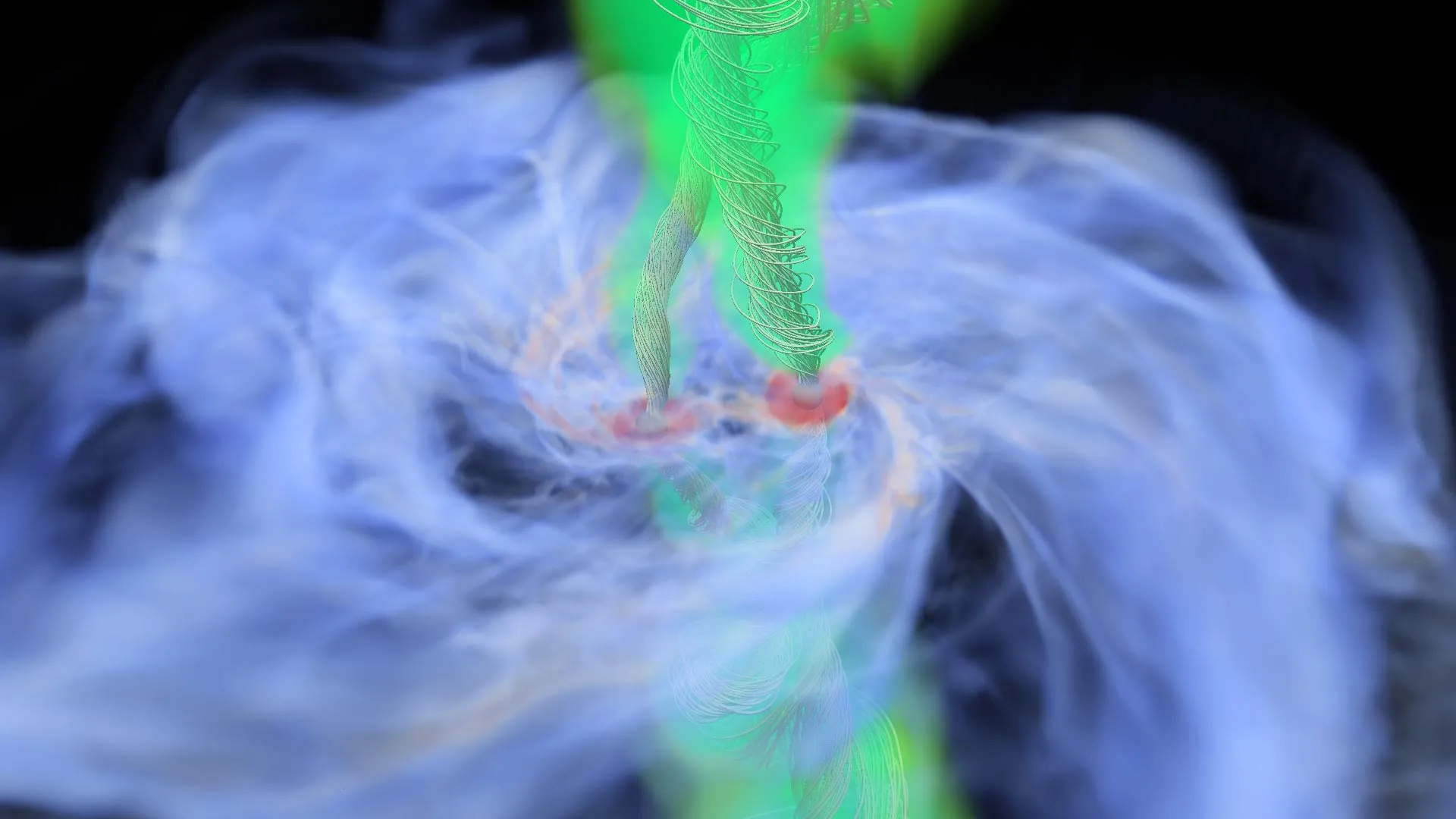
Deep inside the vast clouds of gas and dust where stars are born, two protostars spiral closer and closer together, drawn by forces that have puzzled astronomers for decades—until now. Using Japan's most powerful astronomical supercomputers, including the National Astronomical Observatory of Japan's ATERUI III system, researchers have discovered that magnetic fields are the missing piece in one of astronomy's enduring mysteries: how binary stars form so quickly.
The puzzle has long vexed the field. When parts of a molecular cloud core collapse under their own gravity, dense regions form where newborn stars can take shape. Observations show that many binary star systems—pairs of stars gravitationally bound to each other—form remarkably early in a star's life, before either protostar has even fully developed. The problem is geometric: the calculations simply don't work. With the angular momentum available in a young system, two protostars should not be able to move close enough together in the available time to become gravitationally linked.
The breakthrough came from simulations that revealed magnetic fields threading through the surrounding gas act like invisible bridges, pulling the two protostars inward. As the magnetic fields interact with the gas surrounding each protostar, they gradually remove angular momentum from the system—the rotational energy that would otherwise keep the pair at a distance. With that angular momentum stripped away, the two objects can spiral inward and form a stable binary system within a realistic timescale, transforming an astrophysical impossibility into observed reality.
The evidence for magnetic fields' crucial role emerged starkly when researchers ran a test without them. In simulations that excluded magnetic fields entirely, the protostars moved farther apart instead of closer together. This stark contrast underscores just how essential these invisible forces are to binary formation.
What began as an investigation into stellar nurseries has implications that reach far beyond them. The researchers discovered that similar magnetic mechanisms could operate in systems billions of times larger: the massive binary black holes lurking at the centers of newly formed galaxies. If magnetic fields can strip angular momentum from black hole pairs just as they do from protostars, they could help explain one of the universe's deepest mysteries—how supermassive black holes form.
When two galaxies collide, their central black holes eventually merge into one, potentially creating a supermassive black hole. But the path from two separate black holes to a single merged one faces the same problem as binary star formation: the angular momentum barrier. Without a mechanism to remove rotational energy, the two black holes should get stuck in a decaying orbit that takes an inconceivably long time to complete. Magnetic field interactions might be the solution.
However, simulating those cosmic-scale mergers remains computationally daunting. The timescales involved stretch across billions of years, making direct simulation impractical with current technology. Researchers acknowledge that further studies will be needed to fully determine how magnetic fields influence the behavior and eventual merger of these extreme objects.
For now, the answer to how stars find their partners appears to lie in the invisible architecture of magnetism. As these simulations deepen, they hint at a universe where magnetic fields orchestrate some of its most dramatic encounters, from the nurseries where stars are born to the violent collisions of galaxies themselves.