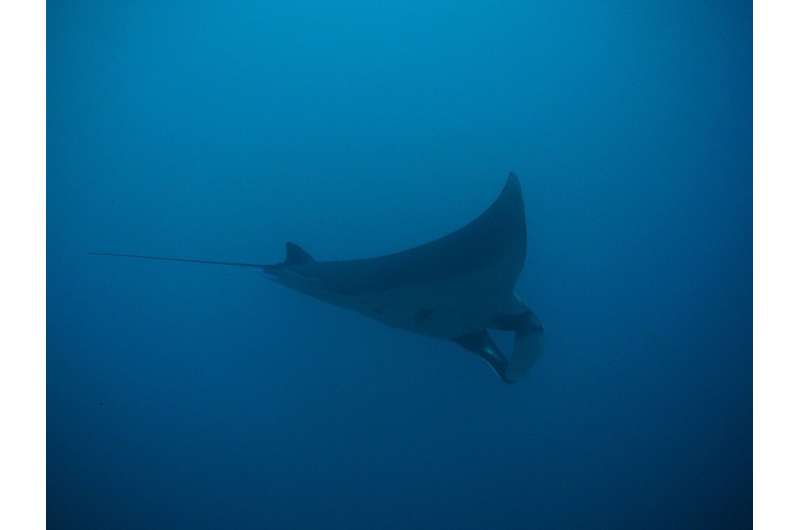
When monsoon seasons batter the waters around Papua New Guinea's Samarai Islands, the enormous reef manta rays that call this region home don't flee to safer seas—they dive deeper. New research tracking these magnificent creatures over three years reveals a remarkable survival strategy: rather than abandon their coastal habitat, the rays plunge through the water column to find food and weather the storms, staying connected to the place they depend on most.
This discovery matters for a species already facing extinction pressures. Manta rays are listed as vulnerable, threatened by overfishing and bycatch worldwide. Understanding how they adapt to environmental challenges could be the key to protecting them in an era of climate change and human impact. The Samarai Islands in Milne Bay have emerged as a critical stronghold for the species, and learning how these animals actually use their habitat is the first step toward genuine conservation.
Lead researcher Anna Knochel, a Ph.D. student at the University of the Sunshine Coast, and her team tagged and tracked reef manta rays—Mobula alfredi—via satellite to map their movements during monsoon seasons. The results surprised everyone. Despite the storm events and the oceanographic upheaval that comes with distinct monsoons, 75% of the tracked group remained within just 10 kilometers of the tagging site. The furthest traveled only 87 kilometers, remarkably short for animals capable of far greater distances. Instead of migrating away, the mantas expanded their vertical use of the water column, diving deeper to find the zooplankton—tiny prey animals—that made up their meals. This behavioral flexibility, the research shows, allows them to adapt to changing ocean conditions while staying close to home.
"The fact that these animals remain closely associated with the Samarai Islands and surrounding waters highlights just how important this habitat is for the species," said Dr. Guy Stevens, co-founder and CEO of The Manta Trust and Knochel's Ph.D. supervisor. "By identifying the areas that manta rays rely on most, we can better inform conservation measures and support the long-term protection of these vulnerable animals in Papua New Guinea."
The reef manta rays studied are colossal animals—weighing up to 850 kilograms with wingspans reaching 4.5 meters. They're found across tropical and subtropical waters of the Indian and Pacific oceans, yet little was known about how they actually behave and use the waters around Papua New Guinea. This research, published in PLOS One, is believed to be the first detailed study of the species' ecology and behavior in the region.
The implications stretch beyond science. Knochel notes that the findings can inform the development of sustainable, economically valuable manta ray tourism practices and a management plan that benefits both the species and local communities. When conservation efforts align with economic opportunity, they tend to endure. Here, protecting these vulnerable animals could strengthen both the marine ecosystem and regional livelihoods. As World Environment Day reminds us each June 5th, hope for endangered species comes from understanding how they live—and the Samarai Islands have just told us an important part of their story.