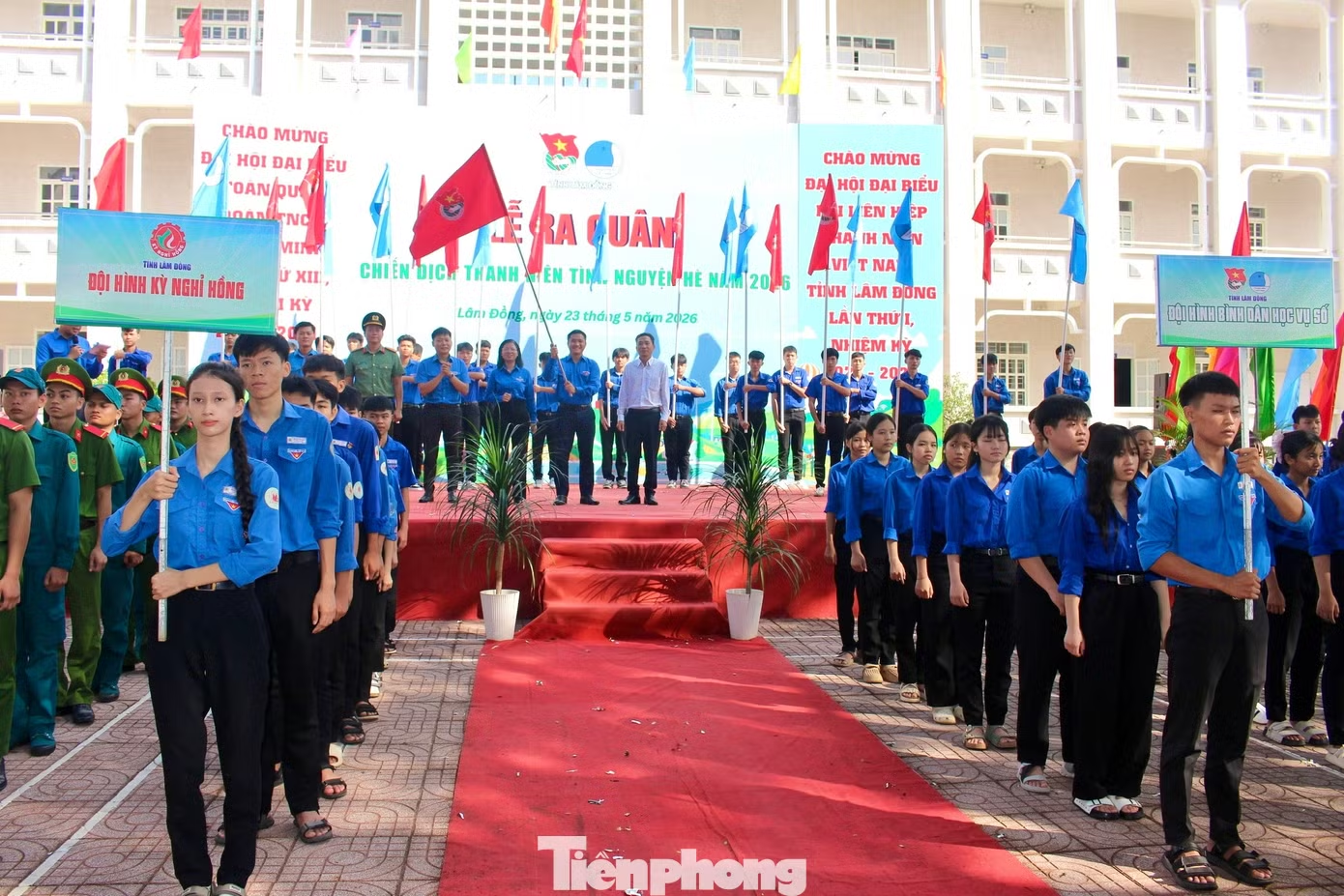
On May 23rd in Hoai Duc commune, more than 500 young volunteers gathered for the launch of Lam Dong Province's 2026 Summer Youth Volunteer Campaign—and immediately set to work. Within hours of the ceremony's opening, scholarship presentations were underway, construction crews broke ground on charitable homes for families in need, and volunteer teams fanned out across villages to clean up environmental hotspots and build something new. This wasn't a celebratory event that ended with speeches; it was a working day designed to demonstrate the scale and immediacy of youth action.
The campaign arrives at a pivotal moment for the province. Ms. H'Hong, Deputy Secretary of the Provincial Youth Union and President of the Vietnam Youth Union of Lam Dong, framed the initiative as part of a broader movement—young people across the region are mobilizing to mark major political gatherings including the Party Congress, Youth Union Congresses, and the inaugural Congress of the Vietnam Youth Union of Lam Dong. But the framing matters less than the work itself. H'Hong's remarks emphasized that volunteer activities must be "strongly oriented towards the grassroots," with special attention to remote areas and communities inhabited by ethnic minorities where resources are scarce and needs are greatest.
The practical projects launched that day reveal a philosophy of connected, sustained action. Volunteers committed to building toilets for children, installing lighting on rural roads, and creating national flag-lined roads—visible markers of care and investment in local spaces. Equally important is the push toward digital inclusion: H'Hong stressed the need to leverage "Digital Literacy Teams" to help residents access online public services and government platforms, recognizing that rural isolation extends beyond infrastructure into digital access. "We need to focus on applying technology and effectively utilizing 'Digital Literacy Teams' to help people access online public services and digital platforms in their lives," she said—a modern challenge requiring modern solutions.
Mr. Hoang Manh Thang, Deputy Head of the Propaganda and Mass Mobilization Department of the Lam Dong Provincial Party Committee, echoed this vision of practical sustainability, urging volunteers to implement projects "in a practical and sustainable manner." His priorities mapped closely to H'Hong's: environmental protection, new rural development, social welfare, healthcare access, digital skills training, and support for online service uptake.
The ceremony itself demonstrated this commitment immediately. A "Library of Love" project was formally transferred to Phan Boi Chau Secondary School, establishing a resource for young readers in the community. Construction began on a charitable house for the Le Cong Vinh family, who face severe economic hardship. Volunteer teams swept through Vo Dat village to eliminate environmental hazards. The delegation visited and presented gifts to Pham Thi Huu, a Heroic Vietnamese Mother, honoring the elders who hold communities together. And volunteers staffed "zero-cost" stalls—a creative initiative that drew crowds, likely offering support or services free of charge to residents who might otherwise go without.
What emerges is not charity as spectacle, but solidarity as a continuous practice. More than 500 young people showed up ready to work, already organized around specific needs in specific places. The campaign's success will be measured not in ceremony but in completed schools, new homes, electrified roads, and villagers connected to digital resources they couldn't access before. For a province often overlooked in national narratives, that kind of sustained youth commitment offers something invaluable: the message that people here matter, and that the country's young generation intends to prove it through action.