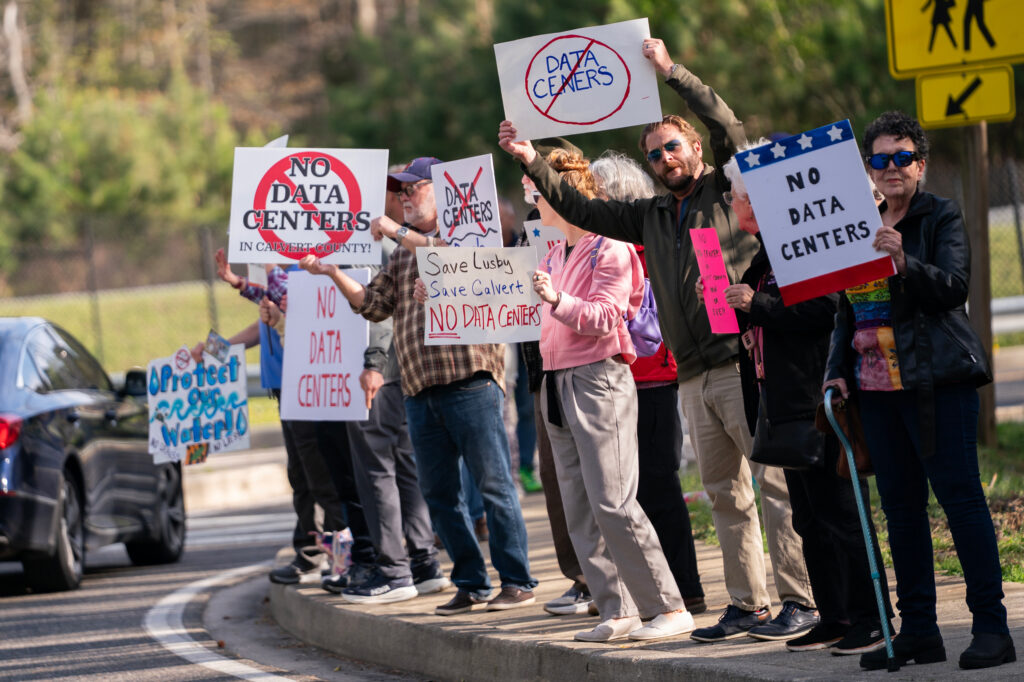
When residents in Prince George's County, Maryland heard about plans to turn the old Landover Mall into a massive server farm, they pushed back hard. Now, their county has become the most restrictive place in the state for data centers.
Prince George's County — Maryland's second largest — voted Tuesday to pause all new data center construction for two years. It's the longest such ban in the state. Council Chair Krystal Oriadha sponsored the resolution, though she made clear she'd prefer a full ban instead.
"I support a full ban. That's what I've always supported, and the two-year moratorium was what the council could agree on because there's varying opinions right now," Oriadha said.
Data centers are huge buildings packed with servers that store information and run AI programs. They use enormous amounts of electricity — so much that they've been driving up utility bills for regular people across the country. These power-hungry facilities have sparked a wave of local restrictions as communities ask: should everyday households help pay for the energy these tech companies need?
The push for a moratorium in Prince George's County grew from a citizen task force formed after the Landover Mall proposal drew protests. Residents learned what having a "hyperscale" data center in their neighborhood could mean — not just the electricity draw, but noise, visual impact, and strain on local infrastructure.
"The push to turn the Landover Mall into a data center campus 'awakened everyone,'" Oriadha said. "Turning a national debate into a local issue as residents understood that such a facility could be in someone's backyard."
The task force's final report, delivered in November, recommended that any future data centers include community input, formal benefit agreements with local residents, and zoning rules keeping facilities away from neighborhoods and sensitive natural areas.
Prince George's County is now joining several neighbors. Montgomery, Frederick, and Baltimore County have also paused data center development in recent weeks.
David Lapp, who represents ordinary utility ratepayers as Maryland's People's Counsel, said these moratoriums are buying precious time. "Anytime data center development is moved back, it provides more time for us to fill in regulatory gaps that expose regular households to cost impacts of data centers," he said.
Maryland is working on two tracks of protection. The state Public Service Commission is writing rules for electric distribution costs, while federal regulators are ordering changes to how transmission and energy costs are handled. A state-commissioned study on data centers' impact on air, water, the Chesapeake Bay, and the power grid is due September 1.
But some experts say local bans can only go so far. Prince George's County sits on the same regional electric grid as Virginia's famous "data center corridor" — meaning residents feel the effects of their neighbor's buildings, even across state lines.
"This really has to be handled on the national level, because the grid doesn't know what jurisdiction you're in," Oriadha said. She argued that federal rules are needed to make sure the burden of powering AI is shared fairly across the country — not pushed onto communities like hers.
State Senator Katie Fry Hester, who's been leading Maryland's legislative response to data centers, said people are worried the industry is expanding faster than governments can keep up. "People are scared because things are happening fast," she noted.
For now, Prince George's County has hit pause — giving lawmakers time to write rules that might protect residents from costs they never asked to bear.