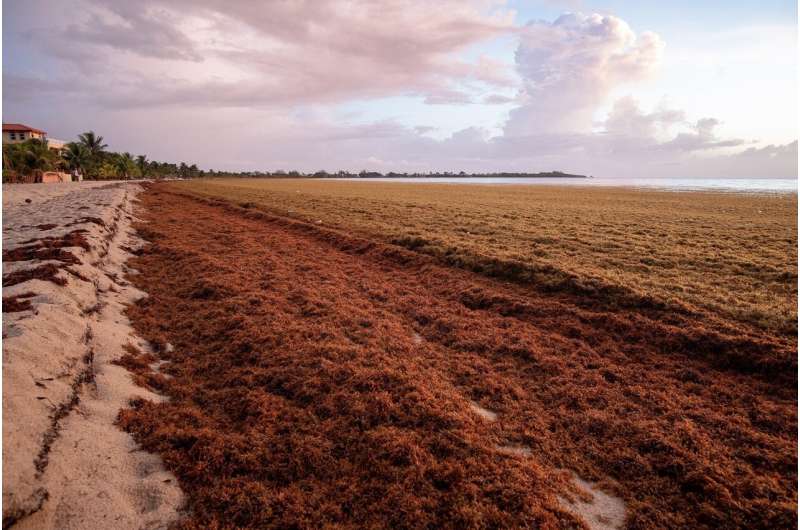
For over a decade, massive seaweed blooms have been washing up on beaches from the Caribbean to South Florida, smothering coastlines and disrupting ecosystems. Scientists long suspected the Sargasso Sea—a region in the North Atlantic—as the source of these towering mats. But new research from the University of Miami has turned that assumption on its head. Using sophisticated ocean modeling, a team led by research professor Francisco Beron-Vera has traced the blooms back to their true origin: the Gulf of Guinea off West Africa, forming up to two years before satellites ever spotted them.
The discovery, published in PNAS Nexus, came from combining two independent analytical approaches. The first, called Bayesian inversion, estimates the most likely source region based on where and when blooms appear. The second, transition path theory, identifies the most efficient pathways ocean currents use to ferry seaweed across thousands of miles. Both methods pointed unmistakably toward coastal West Africa. "Our results provide strong evidence that these blooms begin in the eastern tropical Atlantic, not in the Sargasso Sea as previously thought," Beron-Vera said.
The timing of the first major bloom aligns with unusual conditions in 2009–2010. A strong Dakar Niña-like event brought cooler sea surface temperatures and nutrient-rich upwelling to West African waters—exactly the conditions Sargassum needs to thrive. Additional nutrients from Saharan dust and increased river runoff may have further fueled explosive growth. The seaweed then drifted westward on ocean currents, eventually forming the Great Atlantic Sargassum Belt that began appearing in satellite imagery around 2011. The findings are reinforced by biological evidence: the dominant Sargassum type found in the tropical blooms differs from the variety native to the Sargasso Sea.
What makes this discovery so significant is its practical application. "Understanding the origin of these blooms gives us a much stronger foundation for predicting future events," said co-author María Josefina Olascoaga. By knowing the source region and the environmental conditions that trigger growth, researchers can now work toward improved forecasting models that give coastal communities more time to prepare. The research team modeled the seaweed as floating "rafts" influenced by currents and winds, then ran thousands of simulated trajectories through a probabilistic framework to reconstruct the bloom's journey. This approach could eventually help communities from Ghana to the Caribbean anticipate impacts on fisheries, tourism, and marine ecosystems before the seaweed reaches their shores.