After two decades of halting experiments, the US Army is quietly returning to a question it nearly abandoned: can electric vehicles do the work of war? The answer, it turns out, may depend on a gas tank.
The Army's long and uncertain journey with electrification traces back to the early 2000s, gaining little traction until federal energy policy shifted last year. But a new approach—pairing electric powertrains with gas-powered range extenders—is rekindling interest in a field that military strategists once wrote off. The stakes are substantial. Defense Department vehicles sit idle roughly three-quarters of the time, burning between 30 and 60 percent of their fuel while stationary, engines running to power auxiliary systems. Finding a way to cut that waste could transform military logistics.
The Army's path to electric vehicles has taken an unconventional route, starting not with passenger cars but with practical engineering: anti-idling kits. These battery packs power auxiliary systems, allowing operators to shut down noisy diesel engines instead of keeping them running. Testing on medium-class tactical vehicles showed promise, delivering fuel savings of 10 to 20 percent. That success has led the Army to plan broader adoption across its vehicle fleet.
The momentum is building toward something more ambitious: integrated power kits capable of delivering high voltage DC power. According to Maj. Gen. Michelle Donahue, commander of Combined Arms Support Command, these systems could have dramatic ripple effects across military operations. The kits could support on-board missile defense, mobile command posts, directed energy weapons, and vehicle-centric microgrids. Most strikingly, Donahue told National Defense Magazine that integrated power kits could eliminate 12 fuel truck companies from the Army's current roster of about 40 companies—a reduction of nearly one-third.
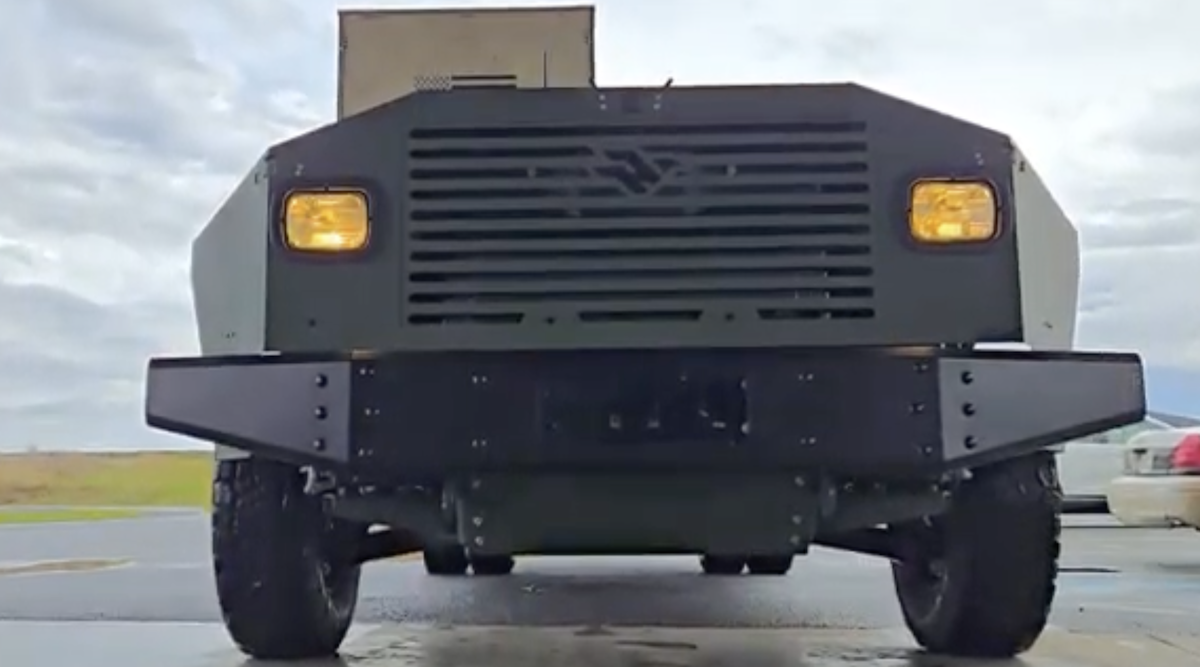
Private industry is now seizing on this opening. Harbinger, a US electric truck maker, has partnered with Rheinmetall, the American branch of a major global defense supplier, to pursue military electrification. The two companies are focusing on cabless, uncrewed robotic vehicles—the type of autonomous platforms the Army increasingly relies on for contested logistics and resupply missions.
Harbinger's approach mirrors what has gained traction in the civilian market: an extended-range electric vehicle, or EREV. The company pairs its proven electric chassis with a gas-powered range extender that recharges the battery during operations. This hybrid design delivers what military operations demand—silent watch capability, reduced thermal and acoustic signatures, and extended operational endurance in demanding environments. Unlike the range extenders common in civilian EVs like the Scout Motors platform from Volkswagen, military applications operate under entirely different constraints, where stealth and sustained power matter as much as fuel efficiency.
The partnership has already submitted a joint autonomous tactical wheeled vehicle in response to the Army's Sustainment Other Transactional Authority effort, citing an Office of the Under Secretary of Defense guidance issued in July 2023 as the regulatory foundation for their push.
What's striking is not that the Army is turning to electric vehicles—it's that it's arriving there through the back door, via fuel savings and logistics optimization rather than environmental mandates. By focusing on idle-time efficiency and extended operations, the Army may finally be cracking a puzzle it has wrestled with for twenty years.