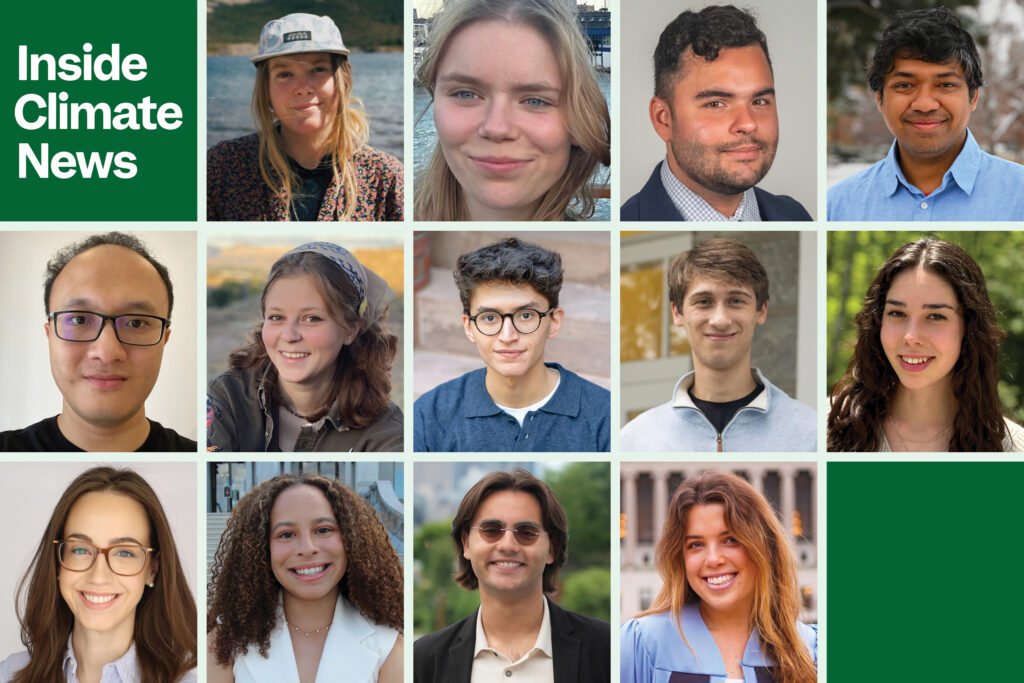
Thirteen young journalists are getting their start covering one of the most important issues of our time: the climate crisis.
Inside Climate News, an independent nonprofit newsroom, welcomed its largest-ever class of summer fellows this week. These 13 reporters — undergrads, grad students, and recent graduates — come from eight states including California, New York, Montana, Colorado, Massachusetts, Pennsylvania, Florida, and the District of Columbia. They represent schools like Stanford, Columbia, Harvard, Georgetown, Northwestern, NYU, Swarthmore, and the University of Montana.
The fellowship program, which started in 2020, has now trained more than 90 environmental journalists. This year's class will dive into real reporting on topics like overseas mining, China's growing role in climate leadership, environmental justice issues in Florida, wetlands protection in New York state, and conservation of public lands in the Mountain West.
"We're taking advantage of their unique talents by plugging them into some of our highest-profile reporting," said Vernon Loeb, ICN's executive editor. He called the new cohort "incredible" and said they're coming from "America's best universities."
The program does more than just train writers. It's designed to build a pipeline of skilled reporters who can cover climate and environment issues for years to come. Environmental journalism has struggled in recent years as many newspapers cut science and climate reporters. Organizations like ICN are working to fill that gap by creating new voices in the field.
The fellows will work alongside experienced ICN reporters and editors. ICN itself was founded in 2007 and became the oldest and largest dedicated climate newsroom in the country. It even won a Pulitzer Prize for National Reporting in 2013 — a major achievement that shows the quality of journalism the organization produces.
The fellowship is made possible thanks to support from the Clif Family Foundation, Outrider, the Institute for Nonprofit News, the Dow Jones News Fund, and the fellows' own universities.
For these 13 journalists, the summer will mean real bylines, real stories, and real experience covering a planet in transition. And for readers, it means more eyes watching how communities adapt, how policies unfold, and how nature responds to a changing climate.
If you want to learn more about the fellowship program or support nonprofit climate journalism, visit insideclimatenews.org.