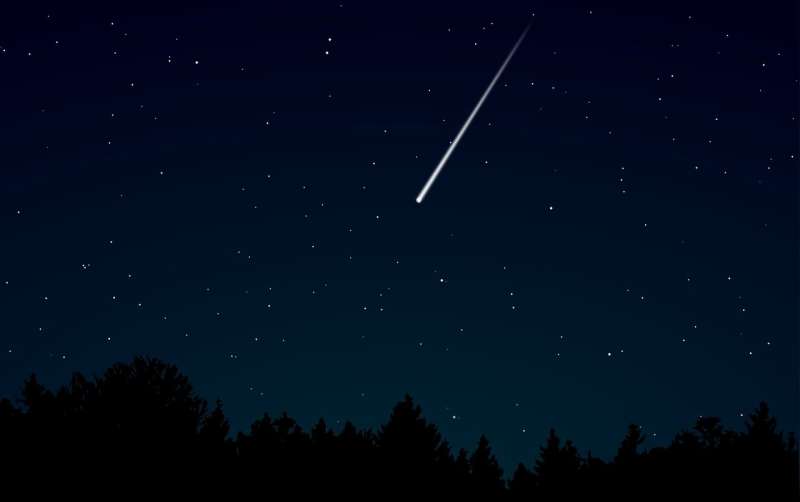
A 3-foot meteor streaking through the sky at 75,000 miles per hour turned Saturday afternoon into a moment of mystery across New England, as a double boom shook buildings from Massachusetts to Rhode Island and sent emergency services scrambling to identify an unexplained explosion.
The American Meteor Society quickly solved the puzzle: a natural space rock, roughly the size of a yard stick, had entered Earth's atmosphere around the New Hampshire-Massachusetts border north of Boston at 2:06 p.m., fragmenting about 40 miles above the ground with the force of 300 tons of TNT. NASA officials confirmed the material was indeed a meteor—not satellite debris or other human-made objects—bringing swift reassurance to anxious residents across the region.
The event cascaded across New England's consciousness in ways both dramatic and mundane. Robert Lunsford, program monitor for the American Meteor Society, reported that his organization received dozens of eyewitness accounts stretching from Delaware to Montreal. Some people heard the distinctive double sonic boom. Others felt their homes tremble. A fortunate few glimpsed the fireball itself—a brilliant streak that looked like an oversized shooting star in the daytime sky. "It was definitely bigger than a normal fireball, about a yard wide," Lunsford said, describing the phenomenon that left such a vivid impression on observers.
The shaking was real enough that several residents filed reports with the U.S. Geological Survey's National Earthquake Information Center, concerned that the tremors might signal seismic activity. The volume of "Did you feel it?" reports prompted the agency to open an event page. But the USGS quickly clarified that seismographs registered nothing unusual—the ground disturbance came not from tectonic plates shifting beneath the earth, but from a visitor from space announcing its arrival with a pair of concussive booms.
NASA spokesperson Allard Beutel explained the physics behind the dramatic display. Traveling at approximately 120,700 kilometers per hour, the meteor compressed the air around it as it descended, fragmenting from the intense heat and pressure. That breakup released energy equivalent to 300 tons of TNT—enough to shake buildings across multiple states but not enough to send seismologists to their instruments. Videos captured on social media documented the booms: two sharp cracks with no visible fire or smoke, just the raw acoustic signature of a cosmic intruder meeting atmosphere.
Despite the dramatic arrival, Lunsford suggested that the meteor likely never reached the ground. "Most of them do burn up before they hit the ground," he noted. While the trajectory data isn't conclusive enough to say with absolute certainty, if the meteor survived its atmospheric plunge, it almost certainly splashed down in the Atlantic Ocean—a fitting end for a space rock that announced itself so spectacularly to the entire northeastern corner of North America. For residents from Delaware to Montreal, the double boom will linger as a reminder of how close we all are to the cosmos, and how a piece of it occasionally drops in to say hello.