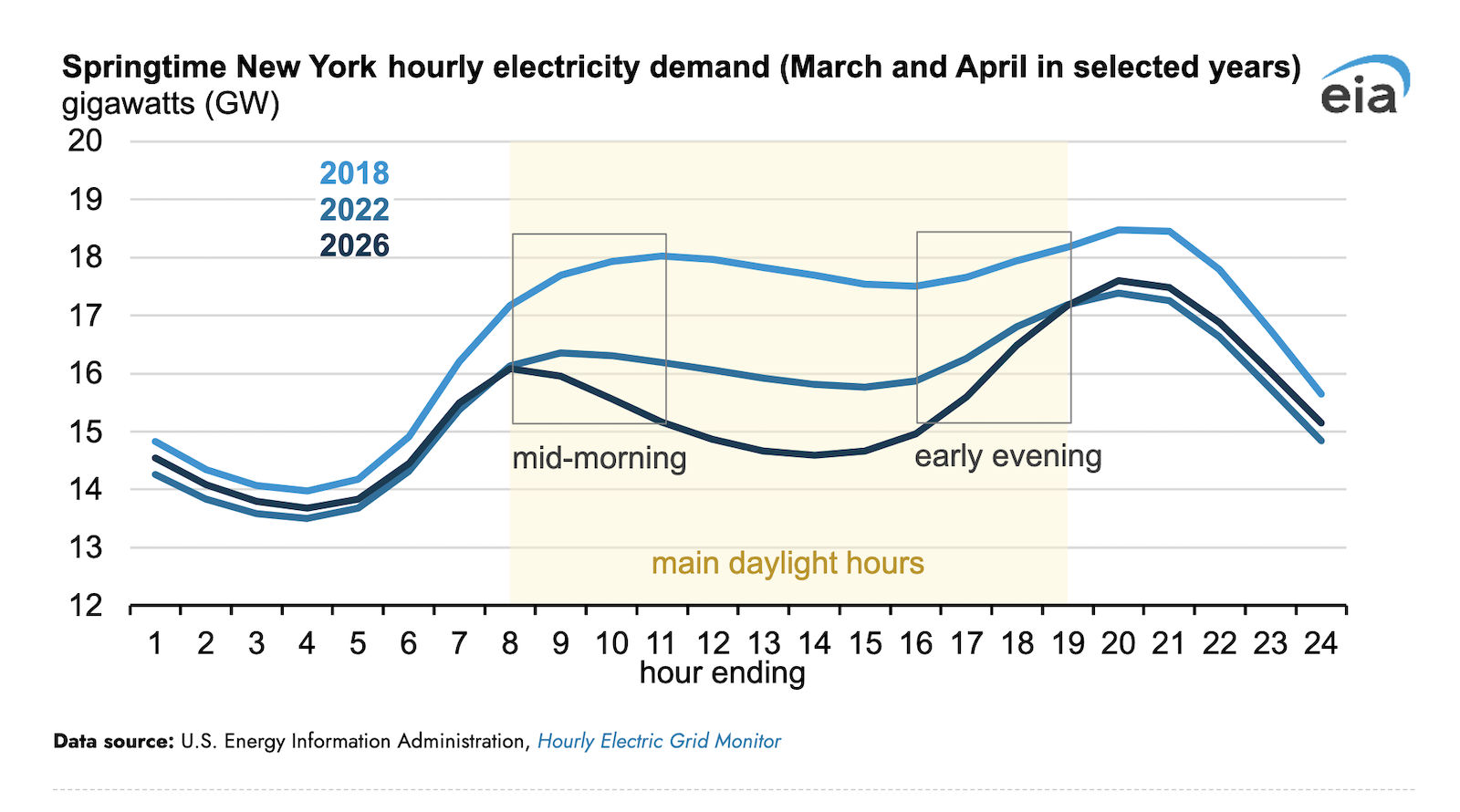
On spring mornings in New York, something remarkable is happening on the state's power grid — and it's getting harder to miss. Rooftop solar panels, community solar gardens, and small-scale photovoltaic systems are so thoroughly reshaping when New Yorkers draw electricity from the grid that state utilities are seeing the midday demand curve flip entirely.
The shift is most dramatic in March and April, when sunshine is abundant but heating demand has dropped. According to the U.S. Energy Information Administration, between 8 a.m. and 11 a.m. during these spring months, New York's metered electricity demand rose by an average of 850 megawatts in 2018. By 2026, that same three-hour window now shows a decline of 923 megawatts — a swing of nearly 1,800 megawatts as small-scale solar floods the grid with free daytime power.
Total solar capacity in New York has grown by 5.6 gigawatts since 2018, with roughly half of those additions coming from small-scale systems — installations typically under 1 megawatt that are often not individually metered by utilities. Because this generation isn't separately tracked, it shows up not as a supply source but as reduced demand on the grid.
The evening tells a different part of the story. When the sun sets, solar generation drops off and New Yorkers return home, crank up air conditioning, and start dinner. In spring 2018, electricity demand between 4 p.m. and 7 p.m. climbed by 681 megawatts on average. By 2026, that same window sees demand surge by 2,221 megawatts — more than triple the increase.
"Because utility grid operators generally dispatch solar generators first, they must ramp up or down other generation types to meet and balance electricity demand," the EIA noted.
For grid operators, this morning-to-evening shift means learning to manage a new kind of load curve. For everyone else, it represents something more fundamental: a cleaner, quieter power plant sitting on rooftops across the state, quietly turning sunlight into electricity at the exact moments demand used to be highest. The 5.6 gigawatts added since 2018 is just the beginning — if the trend holds, those spring mornings may keep getting brighter, in every sense.