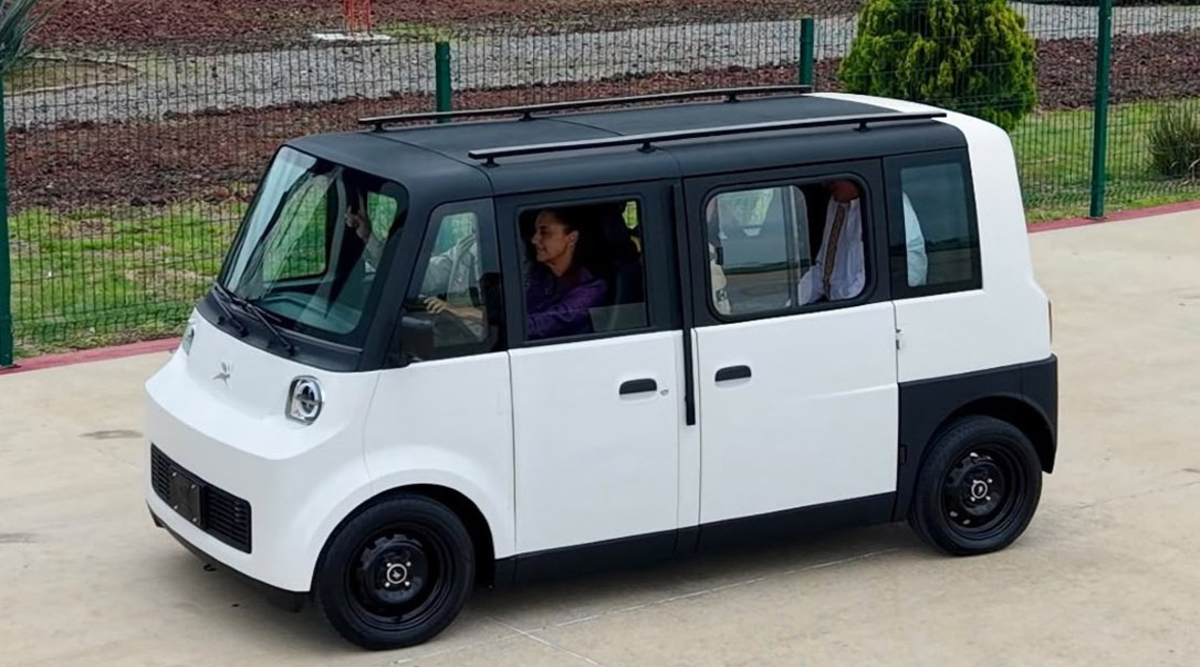
In 2003, the last Volkswagen Beetle rolled off the assembly line in Puebla, Mexico—ending nearly seven decades of manufacturing the car that had once defined affordable mobility for the world. This week, Mexico launched a new bid for that legacy. The government unveiled the Olinia Uno, a people's car built for today, with a starting price of $8,400 and production beginning in 2027.
The Olinia Uno won't turn heads with design flourishes. It has no falcon-wing doors or sleek curves—just practical utility. What it offers instead is space for six passengers or cargo, and a price point that puts vehicle ownership within reach for working people across Mexico. This mirrors the spirit of iconic utilitarian cars that came before: the FIAT 500 in Italy, the Citroën 2CV in France, the original Mini in the UK. The Beetle itself embodied this philosophy—over 21 million were produced across 20 factories worldwide, proving that the world has always needed affordable transport.
Roberto Capuano, head of Project Olinia, explained the vehicle's compelling economics for commercial users. "Because electric vehicles have such low operating costs, they create greater economic opportunities for the people who drive them. That makes for a very compelling business case," he said. For taxi and delivery services, the math is stark: the Olinia's cost per kilometer is about a fifth of what a conventional car costs to operate, and half the cost of a motorcycle. Electric motors consume no energy when idling—a massive advantage in congested city traffic where taxis spend half their time stopped.
The project is structured as a public-private partnership, modeled on frameworks used by Mexico's Federal Electricity Commission. The government provides resources, access to clients, and facilities; private partners contribute capital and operational expertise. Capuano noted that "operations are more efficient under private management than public administration." The project is already in advanced negotiations with more than 10 national and international organizations, with conversations ongoing to finalize partnerships.
The government's ambition is bold: 50,000 units by 2029. Behind that target lies a deeper strategy. Mexico aims to achieve 75 percent domestic content in Olinia components—a shift away from contract manufacturing toward proprietary design and engineering. CTO Rafael Garayoa described the challenge of building an entire supply ecosystem from scratch. "Discovering and building that entire network was the first major challenge," he said. "The second was understanding the capabilities that already exist in Mexico to develop a project like this and complementing those that are not yet available with expertise from abroad."
The Olinia will use an LFP battery pack built largely in Mexico, though cells will initially be imported. Garayoa outlined the plan: "We will import the cells, manufacture our own BMS, and integrate the entire battery pack here in Mexico using locally sourced components." All battery integration—cell welding, pack assembly—is already being performed using manual processes that will now move into industrial production at a dedicated assembly plant.
The federal government is also creating a new regulatory category for low-speed urban vehicles, drawing on micro-mobility standards from the European Union, the United States, and China. This sidesteps the heavier chassis and complex safety systems required by traditional vehicle standards, keeping production costs manageable.
Eighty-five years after the first Beetle proved that affordable cars could transform transportation, Mexico is writing the next chapter—this time with zero emissions.