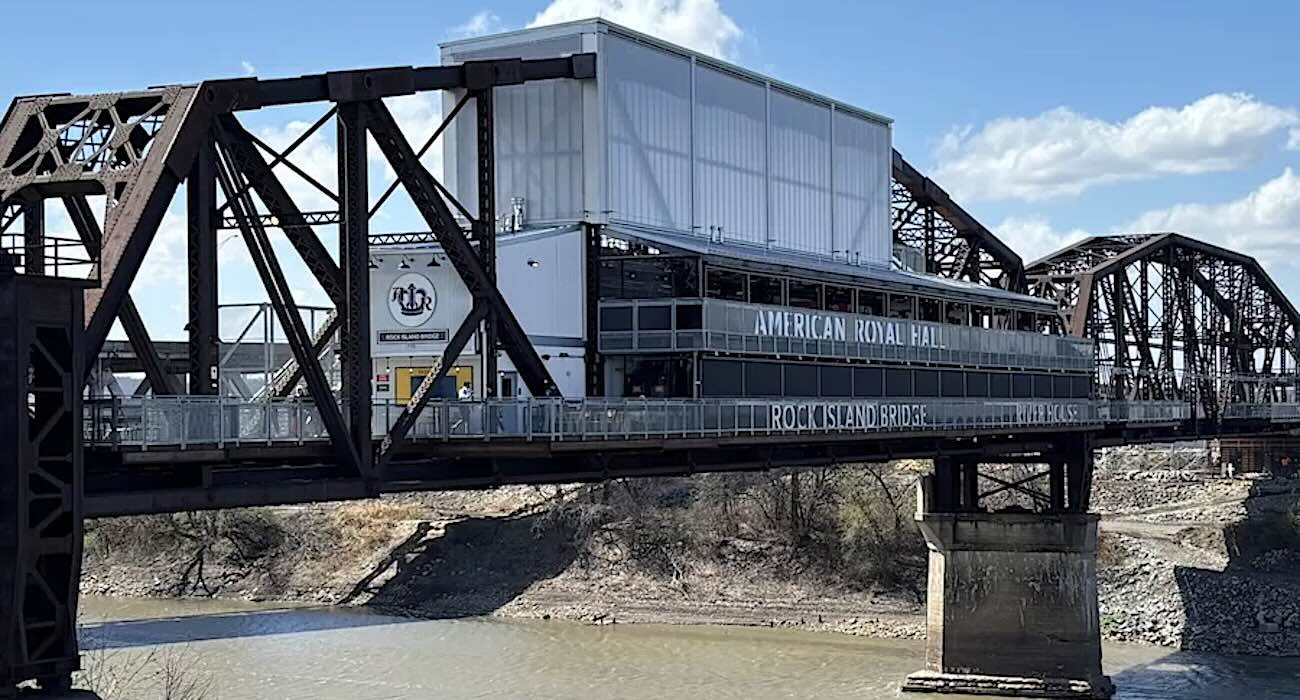
The Rock Island Bridge stretches 300 feet across the Kansas River, just as it has for 120 years—but these days, the steel trusses built by Andrew Carnegie's own steel firm don't carry freight trains. They carry diners, dancers, and pedestrians enjoying what Kansas City Magazine has already called one of the city's most distinctive venues.
The transformation began with a boat trip. Mike Zeller was cruising the Kansas River a decade ago when he spotted the old rail bridge and thought: something should be done with this. Ten years later, in 2017, he founded Flying Truss LLC to make that vision reality. The project required a 66-year lease from the united authority of Wyandotte County, Kansas and Kansas City, Missouri—and years of what Zeller called a "P6 approach": public-private-philanthropy-people-purpose-process.
Some 35 local businesses answered that call, donating materials and labor for everything from the neon entrance sign crafted by Hammer Out Design to seven years of pro bono legal work from a local firm. The result is a two-story restaurant, an event venue, and an open-air space connecting to levee-top trails being built by both Kansas and Missouri governments. The total cost came to $20 million, funded through private investment (60%), public funding and grants (30%), and philanthropic donations (10%).
The bones were good. Structural analysis confirmed the bridge could support 3.16 million pounds before any elements were removed. Primary contractor L.G. Barcus and Sons, Inc.—which had actually raised the trusses back in 1952 to meet new levee heights—found that the original components needed little more than replaced bolts and rust treatment. New support steel and 15-foot cantilevers added roughly 680,000 pounds. The second story of the restaurant now sits comfortably under the central truss, which still lifts as it did in the railroad days. The US Army Corps of Engineers even signed off: the bridge meets standards for a 750-year flood.
Opened in April with a full opening slated for mid-summer, the bridge draws visitors into its history rather than away from it. The old steel railroad track runs along the bar as a footrest. Truss beams plunge right through tables and walkways, turning industrial bones into ambient charm. Best of all? It's free to cross on foot.
"We've created something spectacular for Kansas City that our kids and our grandkids are going to enjoy," Zeller said. "A gift from about 200 Kansas Citians to our city."
That gift now hosts farmers markets, live musicians, and ticketed concerts—proving that sometimes the best new gathering place is one that's been standing there all along.