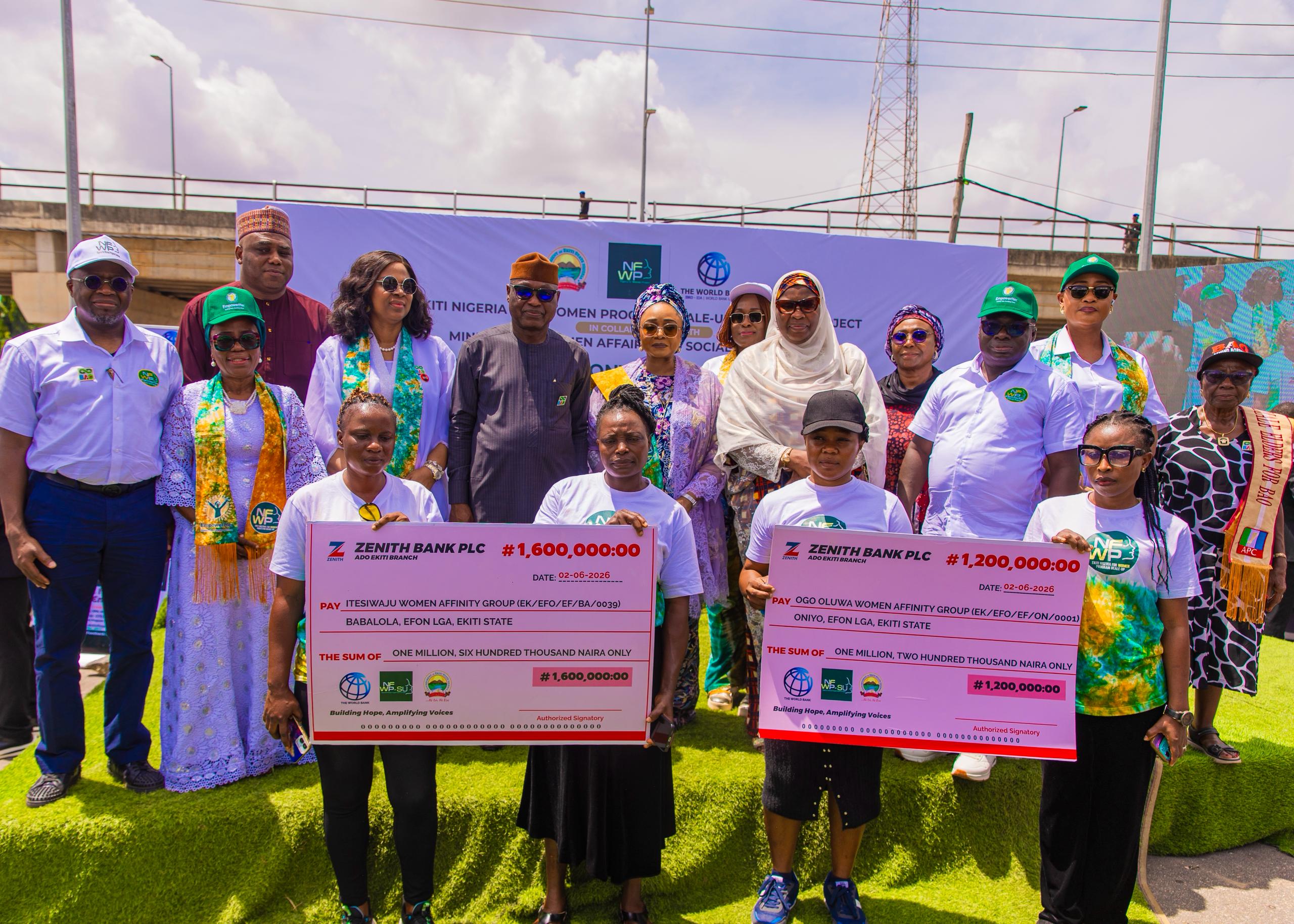
In Ekiti State's Efon Local Government Area, 142 women's groups gathered to receive something far more significant than a financial transfer: a structured pathway out of economic isolation. The moment marked the official launch of Nigeria's ambitious Women for Women Project Scale-Up, a nationwide initiative designed to reach five million women through a model that treats financial inclusion not as charity, but as community capital managed with transparency and shared responsibility.
The scale of ambition is striking. The first phase of the programme already reached 450,000 women across Nigeria. Now, with this scale-up, the target expands tenfold. In Ekiti State alone, since implementation began in June 2024, nearly 1,500 Women Affinity Groups have formed, engaging more than 25,000 women in productive economic activities—women who are now earning, saving, investing, and strengthening their households and local economies.
Minister Hajiya Imaan Sulaiman-Ibrahim, Nigeria's Minister of Women Affairs and Social Development, framed the launch as a turning point where government policy transforms into tangible impact. "When women rise, a family is strengthened. When families strengthen, our communities flourish. When our communities flourish, our nation will prosper," she said, positioning women's empowerment as central to national prosperity, particularly in light of President Bola Ahmed Tinubu's declaration of 2026 as the Year of Families and Social Development.
What distinguishes this approach is its recognition that money alone cannot dismantle the entrenched barriers women face. The World Bank's Senior Social Development Specialist Michael Ilesanmi emphasized this crucial insight: financial support, while necessary, is insufficient without addressing the structural obstacles—harmful social norms, gender-based violence risks, and limited access to markets and land—that constrain women's economic participation. The Women Affinity Group model weaves together savings mechanisms, credit systems, business development training, leadership development, and social support networks that directly confront these systemic barriers.
Community dialogues engaging religious and traditional leaders, alongside media campaigns and policy reforms, work to shift cultural attitudes and strengthen institutional backing for women's economic agency. The Community Investment Fund itself represents an innovation in how capital flows to grassroots entrepreneurs: it is neither a grant nor a conventional loan, but structured community capital managed by the groups themselves with accountability built into the system.
Ekiti State Governor Biodun Abayomi Oyebanji acknowledged both progress and frustration, noting that the state had contributed ₦450 million in 2024 to qualify for the programme, yet faced delays before this moment. His commitment to expansion signals momentum: the state stands ready to extend the initiative across all sixteen local government areas, whatever the investment required.
For the women now organizing collectively in Ekiti and across Nigeria, the programme represents more than financial access. It signals the emergence of an ecosystem where economic opportunity, social inclusion, enterprise growth, and family resilience reinforce one another. The 25,000 women already engaged in productive activities in Ekiti are not waiting for perfect conditions. They are building them—one affinity group, one saved naira, one household strengthened at a time.