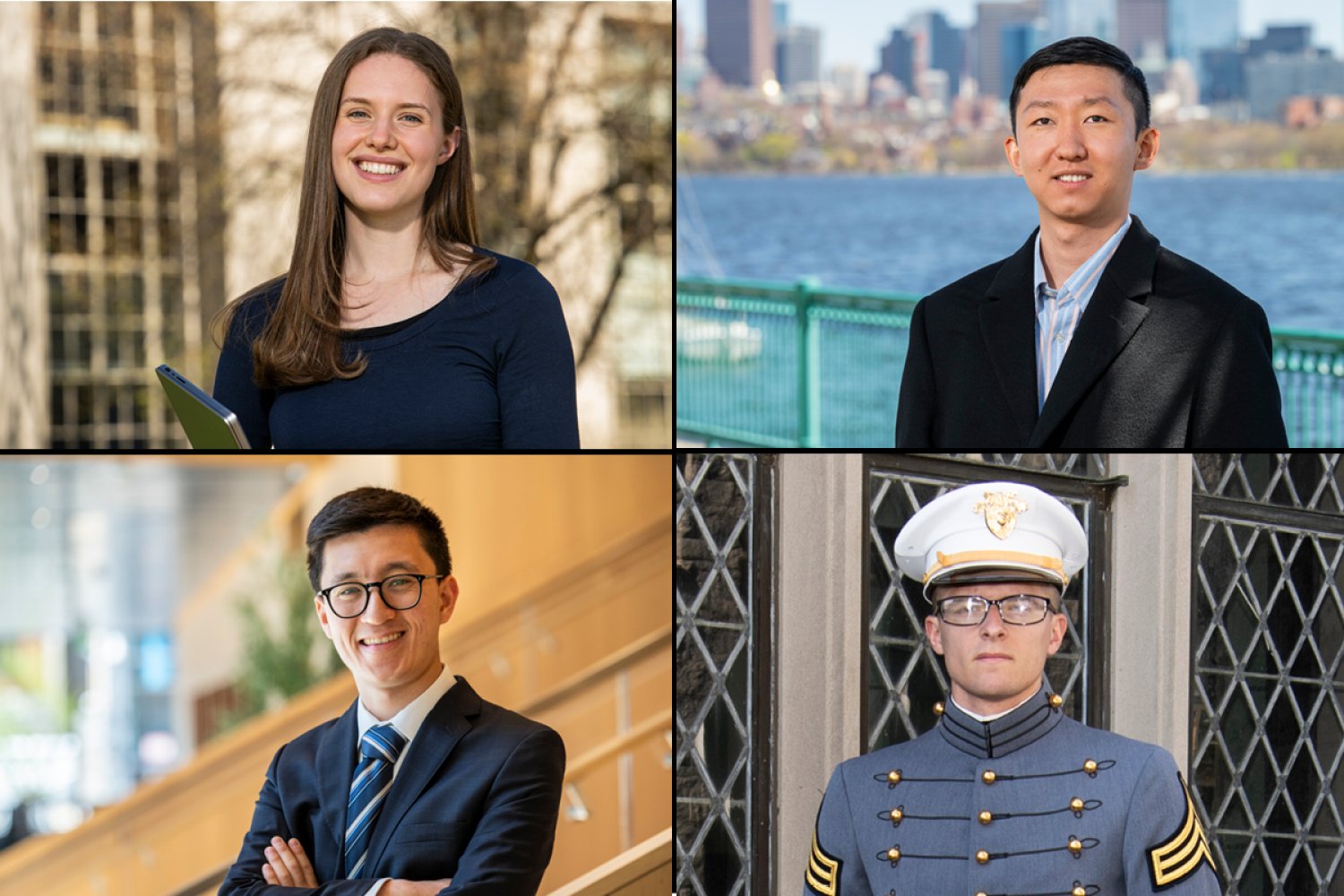
Four MIT-affiliated students have been awarded the prestigious Hertz Foundation Fellowships for 2026, each receiving five years of financial support that promises to reshape the trajectory of their research careers. Annika Marschner, Alvin Q. Meng, Zachary S. Siegel, and Matthew Wanta join a select cohort of nineteen fellows chosen from across the United States — a distinction that comes with far more than a stipend and tuition coverage.
The Hertz Foundation award, established in 1963, recognizes young scientists and engineers at a pivotal moment: when they're transitioning from undergraduate work into doctoral research. The five-year package provides a full stipend and tuition equivalent, which Philip Welkhoff, a Hertz Fellow himself and director of the malaria program at the Gates Foundation, describes as granting fellows "an unusual measure of autonomy to pursue ground-breaking research." What sets this recognition apart is not just the money, but the freedom it creates — the ability to pursue ambitious ideas without the pressure of additional funding cycles or teaching obligations.
Marschner, a mechanical engineering major completing her undergraduate degree at MIT, will begin her PhD this fall, continuing her work in biologically inspired robotics and assistive medical technology. Her undergraduate research spans custom bioprinters, light-based biofabrication systems developed with ETH Zürich, and robotic systems designed to improve the speed and dexterity of bio-inspired limbs. Meng, already a doctoral student in inorganic chemistry, studies iron-sulfur clusters under the guidance of Professor Daniel L.M. Suess — fundamental chemical interactions that unlock new possibilities in materials science. He immigrated to the United States from Tianjin, China, at age ten and brings dual expertise in chemistry and mathematics from the University of Virginia.
Siegel represents a growing intersection of artificial intelligence and cognitive science. The summa cum laude Princeton graduate, who minored in philosophy, works at MIT's Computer Science and Artificial Intelligence Laboratory on a question that fascinates cognitive scientists: how do humans infer the goals of others? His doctoral research aims to build machines that learn and reason like people — systems capable of combinatorial generalization, composing known skills in novel ways to solve previously unseen problems. His advisors include Leslie P. Kaelbling, Tomás Lozano-Pérez, and Joshua B. Tenenbaum, three of MIT's leading minds in robotics and artificial intelligence.
Wanta, who graduates this year from the United States Military Academy at West Point with degrees in computer science and mathematical sciences, brings expertise in machine learning for autonomous systems and will pursue operations research at MIT beginning this fall. His work integrating probabilistic modeling and computer vision into cooperative drone systems reflects the growing importance of AI in real-world applications.
What particularly captures attention is the fellowship's ripple effect. Since 1963, over 1,300 Hertz Fellows have been named, and their collective impact spans breakthroughs in advanced medical therapies, global defense networks, and contributions to the James Webb Space Telescope. The fellowship provides lifelong access to mentoring, networking, and collaborative opportunities — a network that has sparked startups, research partnerships, and commercialization across technology and engineering. "What particularly impresses me about this cohort is their fearlessness in taking on new challenges and advancing the frontiers of science," Welkhoff says. "Each has exhibited tremendous creativity, grit, and vision, and I cannot wait to see what each accomplishes with the freedom to innovate provided by the Hertz Fellowship." For these four fellows, that freedom begins now.