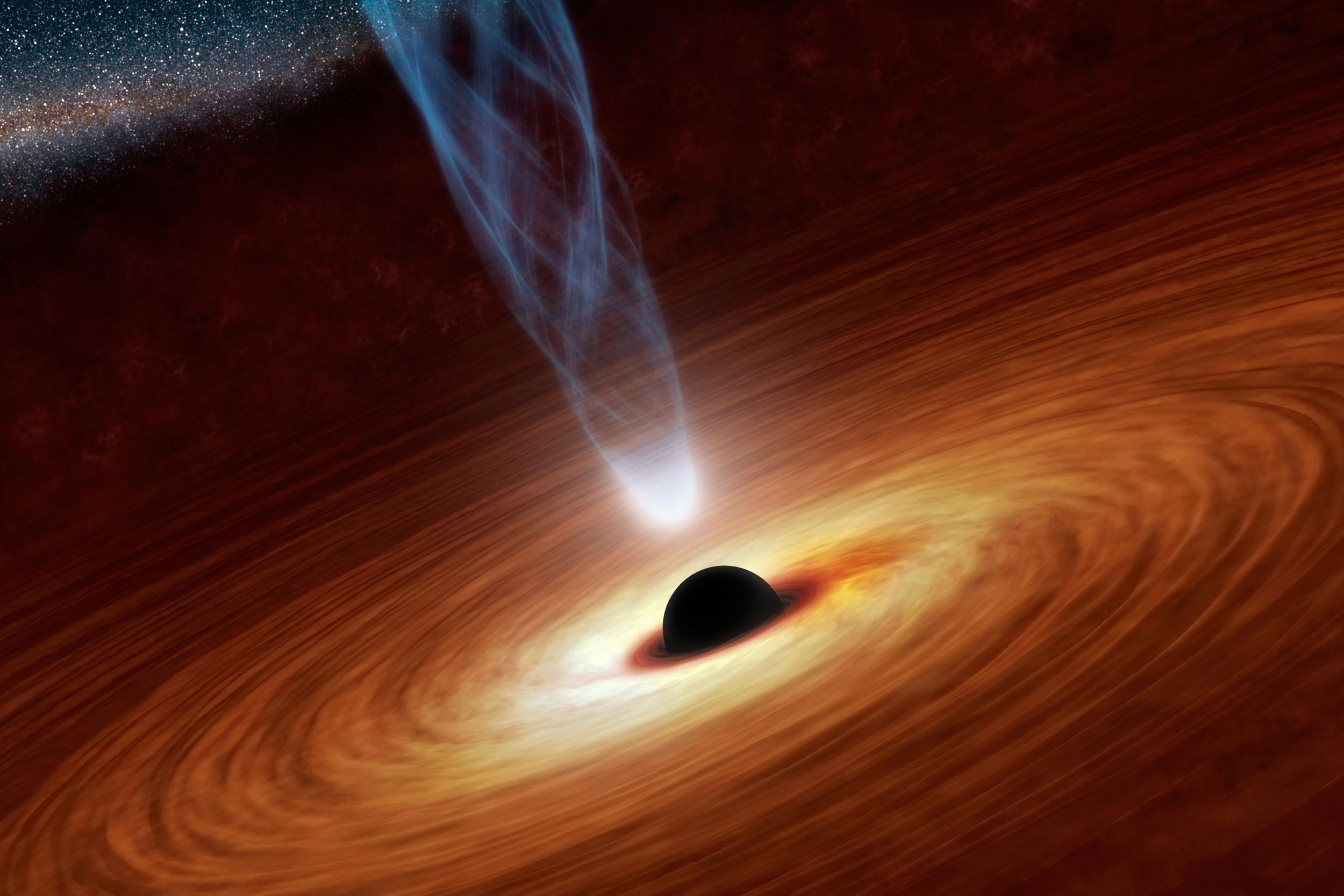
Gene Leung's team at MIT has just seen something astronomers thought they wouldn't spot for decades: a quasar flickering near the cosmic dawn, its light arriving from just 850 million years after the Big Bang. This isn't simply another distant object catalogued in the sky—it's the earliest flickering quasar ever detected, and it's forcing physicists to rethink how supermassive black holes grew so massive so quickly.
At the heart of nearly every galaxy lies a supermassive black hole, gravitational behemoths billions of times more massive than our sun. When these holes are active, they become quasars—the most luminous objects in the universe, blazing so brightly they can outshine all the stars in their host galaxy combined. For decades, scientists assumed these cosmic monsters needed over a billion years to form and mature. But observations since the early 2000s shattered that assumption: astronomers have identified more than 200 supermassive black holes in the universe's first billion years alone, detected as brilliant pinpricks of light across the ancient cosmos.
The problem is that distant pinpricks tell you almost nothing. "These earliest quasars were observed as pinpricks of light, which signal the existence of a supermassive black hole at early times," Leung explained. "But from these bright and distant dots, scientists aren't able to tell much more about the black holes and their cosmic dawn environments." To understand what's actually happening in these ancient systems, astronomers needed to catch something far more elusive: the flicker.
When a quasar flickers—something scientists have observed in nearby galaxies—the variations in brightness reveal the internal structure of the accretion disk, the swirling whirlpool of gas and dust being devoured by the black hole. A flat, pancake-like disk suggests a mature, stable black hole in a calm state. A puffy, chaotic one suggests a younger system still in violent growth. The prediction was clear: ancient quasars should look chaotic. This one doesn't.
The discovery stunned researchers. Using infrared observations to compensate for the stretching effect of the expanding universe—what physicists call redshift—Leung and his MIT colleague Anna-Christina Eilers detected the quasar's flicker pattern stretched across months of observation. And what they found contradicted textbook theory: the accretion disk was flat, pancake-shaped, and stable, exactly like those in much younger quasars closer to Earth. "Physicists have assumed that a flat accretion disk reflects a relatively mature black hole that is in a calm and stable state," Eilers noted. "Black holes that are just starting to form should be more unsettled systems."
This paradox points toward a remarkable possibility. Rather than growing slowly and steadily over a billion years, supermassive black holes may have undergone their violent, chaotic growth phases even earlier than we can currently observe. "What this suggests is that all the messy, very rapid growth phases that we expect all black holes to go through happen very, very early on, before we see them as these very bright luminous quasars," Eilers said. "That's the picture that's emerging." The findings, reported today in Nature Astronomy, suggest that the early universe was far messier and more dynamic than we imagined—and that supermassive black holes matured with stunning speed, reshaping the galaxies around them in the cosmic blink of an eye.