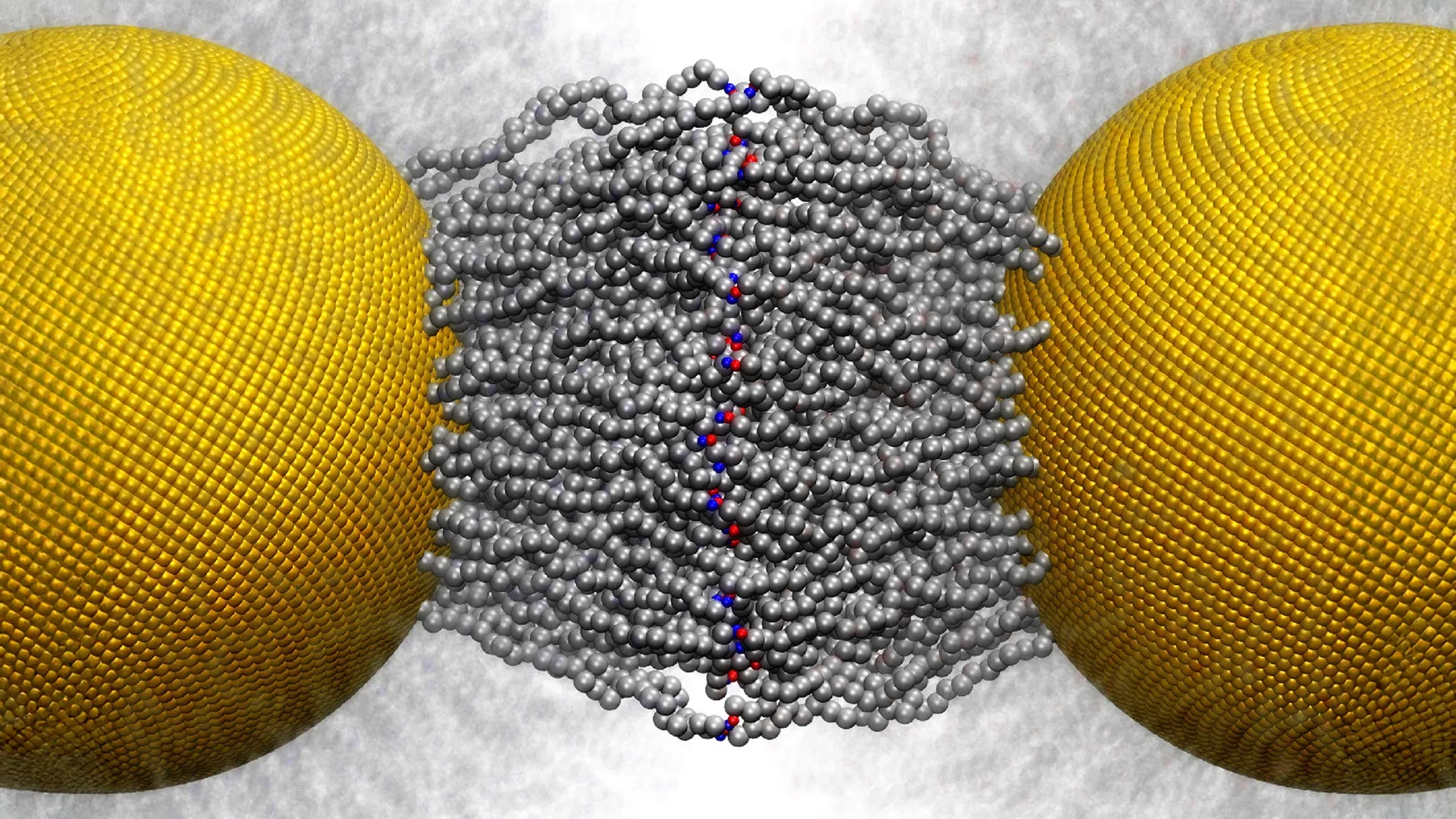
For 20 years, materials scientists have treated flexible molecular links as a problem: if the links between nanoparticles bend too much, the particles should fail to assemble as planned. Researchers at the Massachusetts Institute of Technology in Cambridge, Massachusetts, have now shown that turning that rule on its head can create crystal structures never seen before.
The finding matters because the way tiny building blocks are arranged helps determine how a material behaves. Nanoparticles—extremely small pieces of matter whose size, shape and properties can be adjusted—are already used in fields such as drug delivery, energy storage, computing and sensors. But combining them into larger, orderly materials is difficult. Scientists need to control both how many neighbors each particle connects to and the directions of those connections. Without that control, particles tend to settle into tightly packed patterns, limiting the range of materials they can make.
Researchers have tried to guide assembly by changing particle shapes or making only selected parts of their surfaces sticky. Those approaches can work, but they often require specialized methods tailored to one material, size or condition. Molecular connectors called ligands, which attach to nanoparticle surfaces and link particles together, are part of the challenge. The longstanding approach was to make these ligands rigid, holding connections at planned angles.
The MIT team instead developed extremely flexible connectors that can bend and adjust as particles come together. The researchers found that the flexibility and electrical charges of these molecular links can shape the crystal structures that form. In other words, a connector does not have to hold particles in a fixed pose to guide them into an organized pattern. Flexibility itself can become a tool for directing assembly.
“This is a new approach in nanoparticle assembly that hasn’t been investigated before,” said Rob Macfarlane, the Richard P. Simmons (1953) Professor in MIT’s Department of Materials Science and Engineering. He described the result as the opposite of two decades of accepted thinking: “We showed if you just crank it all the way to the opposite extreme, it works just as well.”
The research team included MIT PhD candidate Nicholas Sbalbi, University of Delaware doctoral student Stephen Kronenberger, MIT undergraduate Hana Shinzawa, Matthew Ye, and Arthi Jayaraman, a former University of Delaware professor. The findings are described in a paper set to appear in Nature Materials.
The new method could give scientists a broader way to build “designer materials,” where they have more control over the structures nanoparticles form. Those structures may bring useful properties for electronics, medicine, energy technologies, agriculture and chemical manufacturing. The work does not establish that any particular product is ready for use, but it offers a different route around a central materials-science obstacle: controlling how particles connect without having to shape each one or engineer its surface in a highly specialized way.
Next, researchers will be able to explore how flexible links and their electrical charges can be used to produce other arrangements and properties. The study’s central lesson is a striking one: sometimes loosening the connection between building blocks can give scientists more control over what they build.