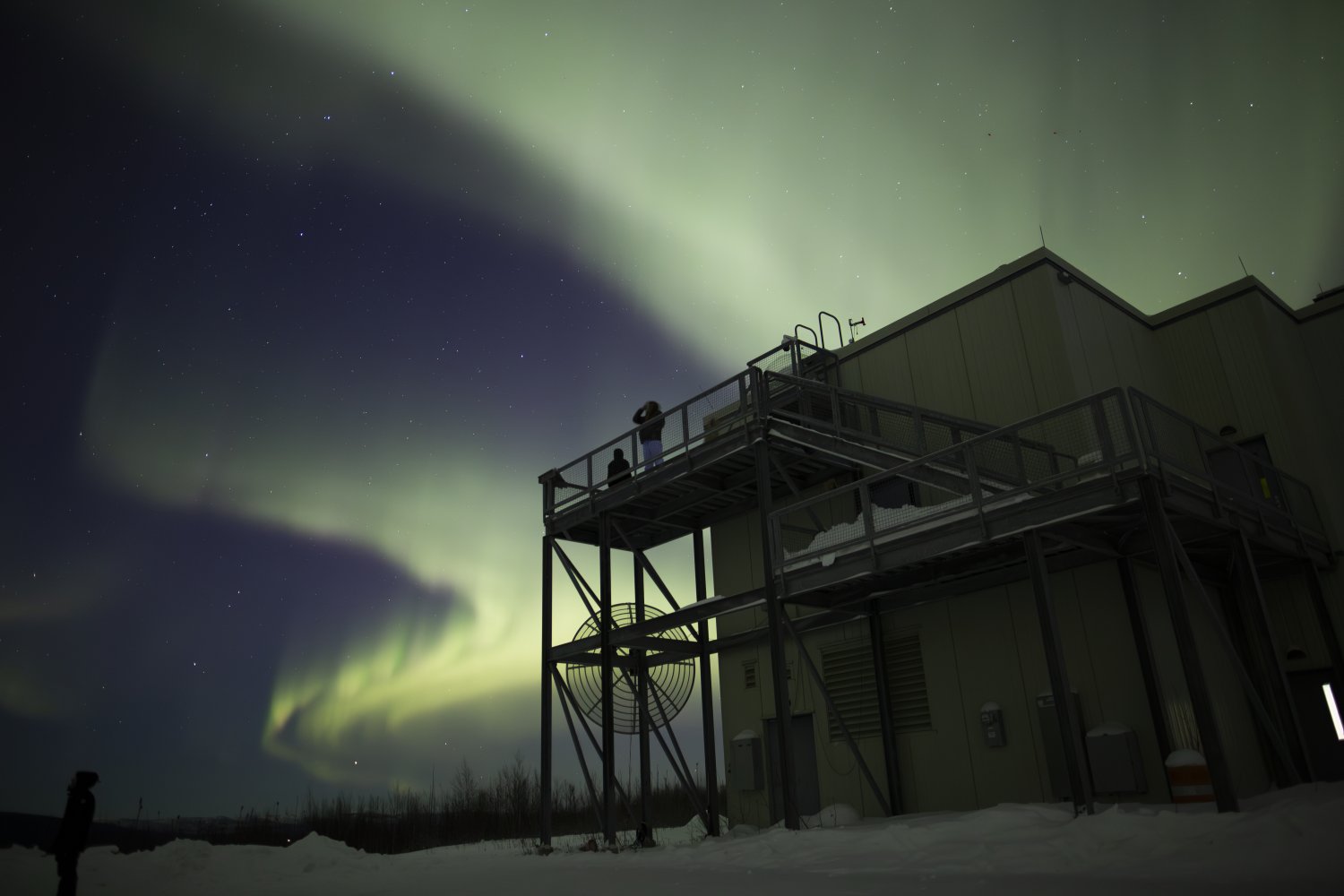
Leonardo Corsaro watched his laptop's battery drain from full to nearly empty in ten minutes, the cold stealing power as fast as the processor could burn it. He was sitting in Fairbanks, Alaska, at -25 degrees Fahrenheit, racing to transfer data from instruments monitoring the aurora borealis before everything shut down. For a plasma physicist, it was the price of admission to one of Earth's most spectacular natural laboratories.
A small group of MIT graduate students made their way to Alaska's interior not to escape the winter, but to study it — or rather, to study the charged particles dancing above it. The aurora borealis, those undulating curtains of green and violet light, represents visible proof of plasma in action: charged particles from the sun colliding with Earth's magnetic field and atmosphere in ways that create structures visible from the ground. Fairbanks sits directly beneath a region of especially intense auroral activity, making it one of the most reliable observation sites in the world. Understanding what happens there matters beyond mere curiosity; insights into plasma behavior in near-Earth space can help protect satellites, power grids, and communications systems from the effects of solar storms.
The work required more than cold tolerance. PhD student Leon Nichols explained that while the extreme temperatures could be managed with proper gear, the real challenge was movement. Deploying cameras across remote terrain meant walking through deep snow — burning 900 calories per hour — until the team switched to cross-country skis to reach sites up to 100 miles apart. They worked largely in darkness, their red headlamps the only human light for miles, since the sun set before 3 p.m. and barely climbed above 20 degrees Fahrenheit at its warmest.
The timing proved extraordinary. During their expedition, the strongest solar storm in two decades erupted, bringing the aurora alive with an intensity few researchers ever witness. Sydney Menne, a PhD student in nuclear science and engineering, described the moment with wonder: watching strips of light stretch across the sky in a pulsating aurora — a relatively rare phenomenon where the structures blink on and off several times per second — while surrounded entirely by the display, removed from Earth itself.
The team deployed multiple all-sky camera systems capable of capturing 360-degree images of the night sky, paired with magnetometers to correlate visual auroral features with magnetic field changes. This year, they added a new dimension: muon detectors to explore potential links between visible auroral activity, magnetic field shifts, and high-energy particle detections in the upper atmosphere. By combining instruments not traditionally used together and distributing them across vast distances, the MIT group is pioneering new approaches to understanding phenomena that have puzzled researchers for decades.
For Corsaro, the experience fundamentally changed how he saw his own research. "In my research, it is easy to associate these phenomena with colorful plots and simulations, losing touch with the physical process," he reflected. "Seeing structures in the aurora, electric currents and flows forming and shifting overhead, brought a sense of reality to those concepts, and served as a reminder that real plasmas are far less neat and intuitive than theory suggests." This marks the third year of the Geophysical Plasma Observation Expedition, a student-driven initiative that continues to send MIT plasma physicists to Fairbanks each winter, combining rigorous science with the humbling experience of witnessing nature at its most extreme.