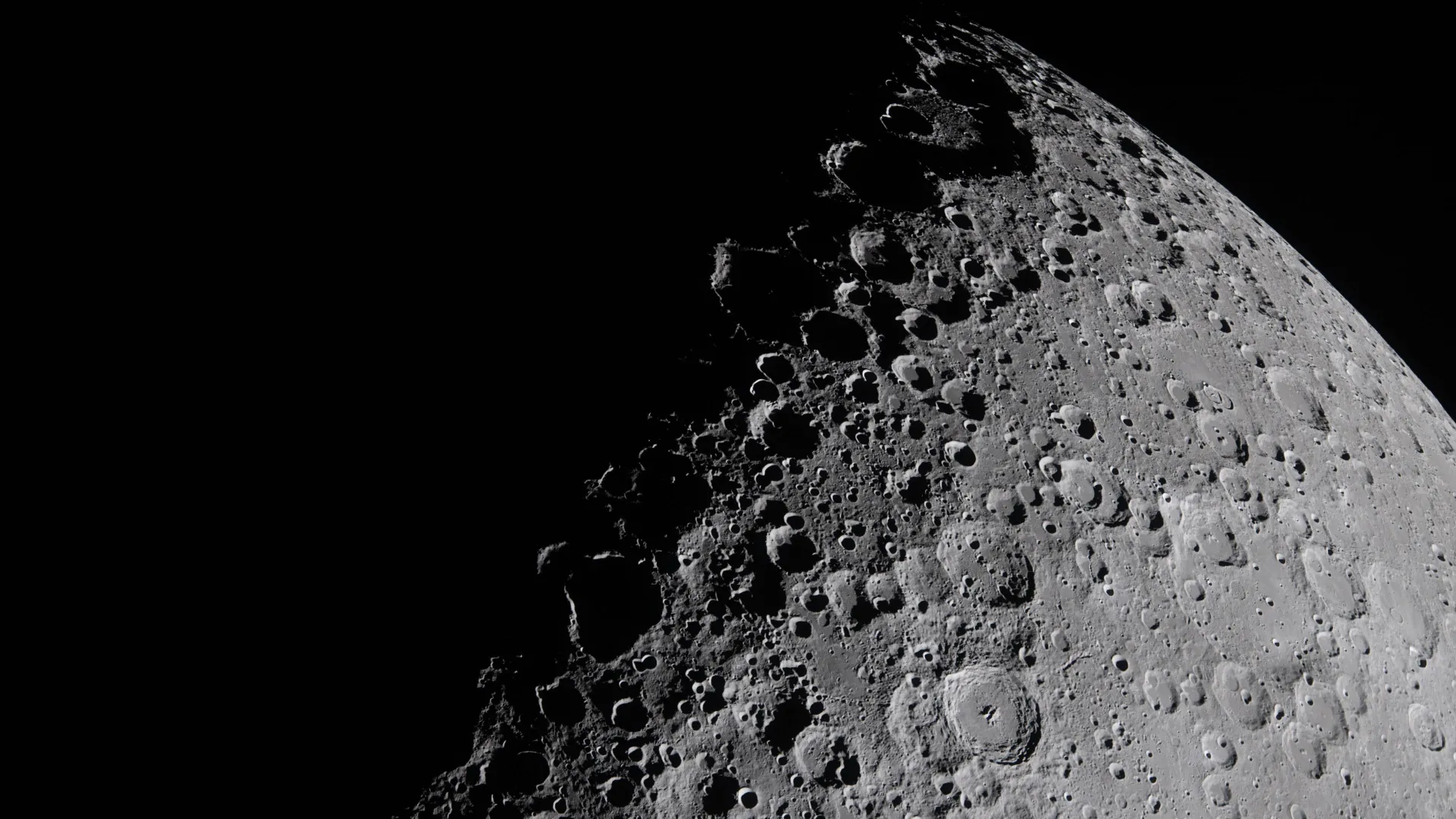
On the moon, water is buried treasure. Scientists have now figured out a way to find it — by listening to the moon shake.
Researchers from the University of Maryland, Lawrence Berkeley National Laboratory, and the University of Hawaii discovered that vibrations called seismic waves, the same kind scientists use to study earthquakes, can reveal hidden ice deposits beneath the lunar surface. Their findings were published in the journal Science Advances in July 2026.
The timing matters. NASA is planning to send astronauts back to the moon in 2028 through its Artemis program, targeting the south polar region where ice may be hiding in deep, dark craters that never see sunlight.
That ice could be incredibly valuable. Astronauts could melt it for drinking water. Machines could also split it apart: oxygen from the ice could help them breathe, while hydrogen could become rocket fuel. Having local water would mean astronauts wouldn't need to haul as much from Earth, making longer stays on the moon much more practical.
"It's crucial to identify any materials on the moon that an astronaut can make use of while they're up there," said Nicholas Schmerr, an associate professor at the University of Maryland and a co-author of the study. "Since they will be limited by the few resources they brought from Earth, anything they find on the moon will help them basically live off the land."
The problem is, no one has been able to see deep underground. Satellites orbiting the moon can only peer a few inches into the soil. But the new research shows that seismic waves behave differently when they pass through frozen ground. Ice makes the material stiffer, allowing vibrations to travel two to three times faster than through dry dirt. Scientists can detect these changes with a seismometer — a device that measures ground movement, similar to how doctors use sound waves to look inside the body.
The research team tested the idea in three ways. Lead author Harrison Lisabeth, a geologist at Lawrence Berkeley, froze crushed volcanic rock from Arizona that closely matches lunar dust, then used X-rays to watch how ice formed inside tiny gaps between particles. Matthew Siegler from the University of Hawaii built detailed temperature maps of the moon's south polar region to find craters cold enough to preserve ice for billions of years. Schmerr ran computer simulations modeling moonquakes passing through underground ice deposits. All three approaches showed the same thing: ice leaves a clear, measurable fingerprint.
But the discoveries don't end there. The ice trapped in those ancient craters is roughly four billion years old. Because it has been sealed away in permanent darkness all that time, it may carry clues about how water arrived in our solar system — including perhaps how Earth's oceans formed.
"The moon witnessed some of the most critical parts of the early solar system," Schmerr said. "Studying the ice deposited there could reveal how water spread and ultimately how Earth's oceans formed."
Scientists may not have to wait long to test their predictions. China's Chang'e-7 mission, planned for late 2026, will land a seismometer near Shackleton Crater, a location with suspected ice deposits nearby. NASA is also developing a seismic monitoring station that Artemis astronauts could deploy in 2028, with Schmerr helping design the instrument.
"No one has physically measured the ice on the moon yet, but we now have a prediction for what to look out for," Schmerr said. "That's an important first step."