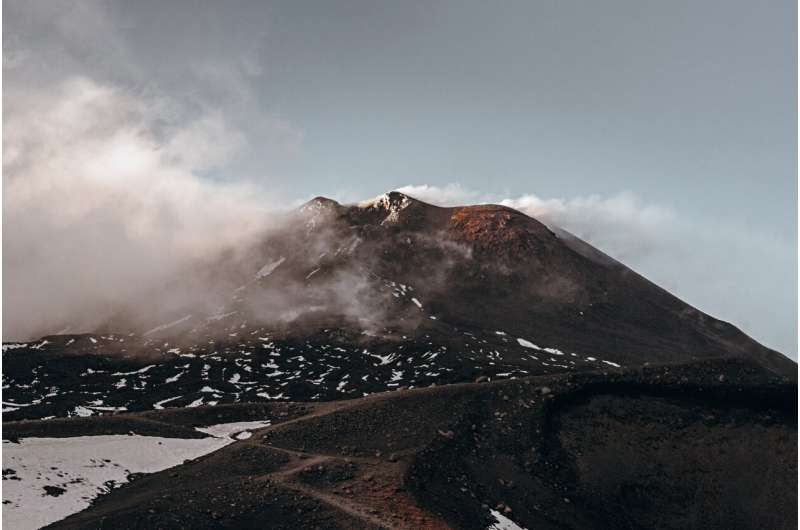
When magma sits beneath Mount Etna in Italy, it doesn't always follow the same path to the surface—and now, Cornell-led geologists have figured out why. Using a pioneering technique called Raman spectroscopy to peer into magma crystals no thicker than a human hair, researchers led by Esteban Gazel discovered that carbon dioxide and water trigger fundamentally different explosive pathways in the same volcano, a finding that could transform how geologists predict future eruptions.
For decades, the geological community assumed water was the primary volatile driving volcanic explosions. But Gazel's lab, working with collaborators from Columbia University and the University of Hawaii, Manoa, has upended that assumption. Their work, published in Geochemistry, Geophysics, Geosystems, shows that CO₂ can be equally—or even more—powerful in triggering eruptions. "Imagine a bottle of soda," Gazel explained. "If you open that bottle without agitating it, you can drink it, but if you shake it up, all the bubbles get separated really fast, and you have an explosion. Volcanoes work in a similar way."
The researchers studied two prehistoric eruptions of Mount Etna to test their theory. In 122 B.C., one of the largest explosions on record, magma rose slowly from about 22 kilometers depth and paused for several weeks at a shallow level between 2 and 5 kilometers, gradually releasing gas before erupting. This eruption was water-dominated. In stark contrast, the Fall Stratified event nearly 4,000 years ago unfolded in a matter of hours, propelled by magma that rocketed upward from 24 to 30 kilometers depth—driven by a much higher concentration of CO₂.
The discovery hinges on a remarkable technique: Raman spectroscopy allows geologists to measure the tiny micron-sized bubbles trapped in magma crystals, revealing their density and, by extension, the pressure and depth at which they formed. This precision imaging lets researchers reconstruct a volcano's "plumbing system" with unprecedented detail. As postdoctoral researcher Maxim Gavrilenko noted, "That technique gives us the density of CO₂, and, using a state equation, we can transform that density into pressure, and pressure can be transformed into depth."
What makes Mount Etna particularly revelatory is its unique position among the world's volcanoes. While some are dominated entirely by CO₂ (mostly on oceanic islands) and others by water (in subduction zones), Etna sits at an intersection where the two volatile species compete. "This shows that at a certain threshold of CO₂, the eruption will come from very deep and really fast, but when you have a higher threshold of water, then the process is controlled at shallow levels," Gazel said. Understanding this balance is crucial for predicting which eruptions will be slow-building and which will happen in hours.
The implications extend far beyond Sicily. Gazel's team is now applying its Raman spectroscopy method to volcanoes across Chile, Hawaii, and beyond. "Ideally, this should be done in every volcano on the planet," Gazel said. "This is the data we need for physical models of eruptions that are the base of risk assessment." As volcanic hazards threaten millions of people worldwide, this technique offers a powerful tool for geologists to assess danger with greater accuracy and speed.