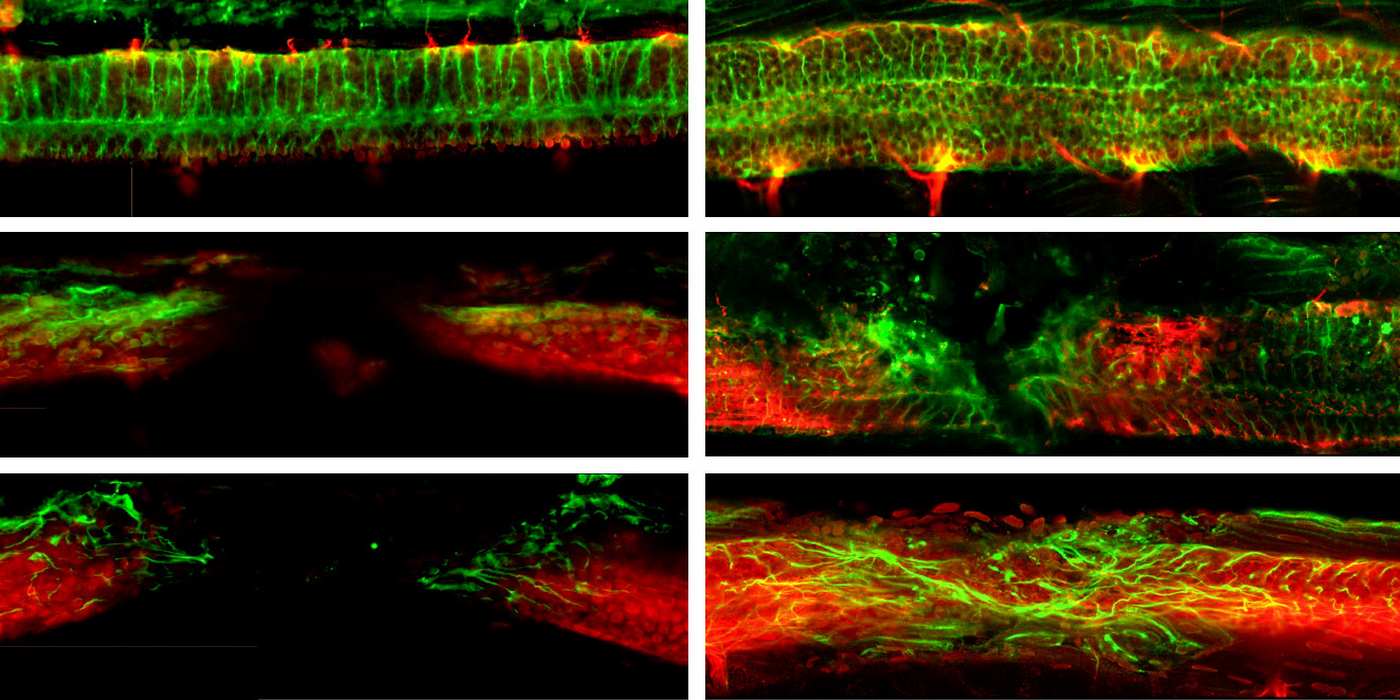
In a laboratory at ETH Zurich, researchers have coaxed millions of magnetically guided nanoparticles and stem cells into working together to achieve what was long thought impossible: restoring normal movement in a mouse whose spinal cord had been completely severed. The breakthrough, published in Nature Materials, marks a significant shift in how scientists approach one of medicine's most stubborn challenges—the fact that nerve cells in the spinal cord rarely regenerate naturally, and scarring typically prevents any meaningful regrowth.
What makes this moment worth attention is that spinal cord injuries have historically offered limited hope. Existing treatments like implantable electrode nerve stimulation can restore some movement, but they come with serious drawbacks: they require electrodes to be surgically implanted into an extremely sensitive area, and transplanted cells often fail to survive or integrate properly into existing tissue. The researchers at ETH Zurich's Multi-Scale Robotics Lab, led by Professor Salvador Pané i Vidal, developed a radically different approach that sidesteps these problems entirely.
The method begins with a patient's own skin cells, which are converted into induced pluripotent stem cells and then transformed into neuro progenitor cells—cells capable of becoming nerve tissue. Alongside these, researchers create nanoparticles with a magnetic-responsive inner layer and an outer layer that converts magnetic stimulation into electrical signals. When combined in a one-square-centimeter culture medium, these components self-assemble into what the team calls "NPCbots." The process takes about thirty minutes, after which several million of these hybrid entities are ready for treatment.
The testing phase revealed remarkable results. In zebrafish, which naturally repair their own spinal cords, the NPCbots produced quick, substantial, and lasting improvements in movement. But the mouse studies—more directly relevant to potential human application—proved even more compelling. Within 28 days of treatment, the severed nerve fibers at both ends of the spinal cord reconnected. Over that same period, the treated mice showed increasingly normal movement patterns: their gait improved, stride length normalized, coordination strengthened, and exploratory behavior returned. Critically, the animals tolerated the treatment well with no evidence of adverse effects or immune reactions.
Senior scientist Hao Ye, the study's first author, acknowledged that significant work remains before this could reach human patients. Researchers first need to determine which magnetic fields work best in the human body and establish the optimal duration of stimulation. They also want to verify that the nanoparticles—coated with barium-titanate to ensure stability and minimal reactivity—either dissolve safely in muscle tissue or are excreted without complications. Multiple animal studies must continue to confirm safety across different species before any human trials could even be considered.
Yet the potential is staggering. Currently, there is no reliable way to repair nerve damage in the human spinal cord. If this method successfully translates to people, it would fundamentally transform how spinal cord injuries are treated, offering restoration of function where patients have historically faced permanent disability. For now, ETH Zurich's mice are walking proof that regeneration—once deemed impossible—may finally be within reach.