Deep inside our galaxy, something is hurling tiny particles called protons to almost unthinkable speeds — and scientists just figured out what it is.
An international team led by Hiroshima University in Japan has confirmed the first clear example of what researchers call a "proton PeVatron" in the Milky Way. That's a natural particle accelerator powerful enough to fling protons beyond one quadrillion electron volts. That number — one quadrillion — looks like a 1 followed by 15 zeros. It's an energy level far beyond anything human-built machines can reach.
The discovery, published in The Astrophysical Journal on July 16, 2026, could finally help explain where our galaxy's highest-energy cosmic rays come from. Cosmic rays are invisible particles, mostly protons, that zip through space at nearly the speed of light. They constantly rain down on Earth, yet scientists have long struggled to pinpoint exactly how they reach such extreme speeds.
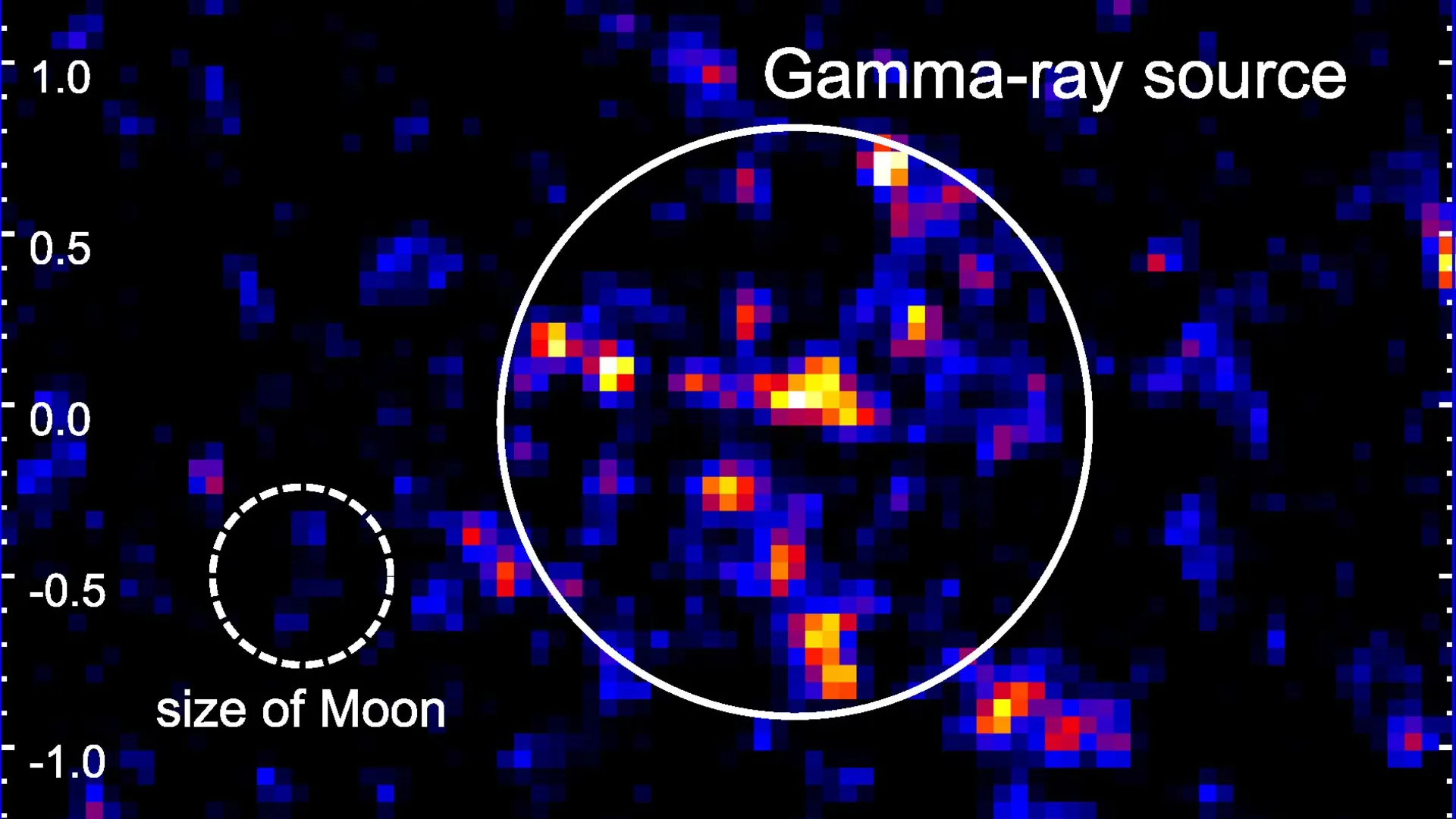
"Finding a cosmic-ray proton accelerator above that PeV level is one of the most exciting topics in modern astrophysics," said Tsunefumi Mizuno, associate professor at Hiroshima University's Hiroshima Astrophysical Science Center and lead author of the study. "We identified one such object previously known as LHAASO J19J12+1014u."
The object sits in the constellation Aquila, near Altair — one of the bright stars that form the Summer Triangle, a pattern easily spotted in the night sky during warmer months. Scientists first spotted it in 2024 and initially thought it might be debris from an exploded star. But new evidence now points to something even more unusual.
To confirm what they were seeing, researchers combined data from three major observatories: the Tibet AS gamma experiment (a joint project by Japan and China running since 1990), China's Large High Altitude Air Shower Observatory (LHAASO), and NASA's Fermi Large Area Telescope. Each instrument measured different types of radiation coming from the object, ranging from low-energy radio waves all the way up to ultra-high-energy gamma rays. By putting all these measurements together, scientists built a detailed picture that ruled out other explanations and strongly supported the proton PeVatron conclusion.
The Large Hadron Collider — the world's most powerful particle accelerator, located beneath the border of Switzerland and France — can push protons to remarkable speeds. But even it falls short of the energy levels this natural accelerator produces. Nature, it turns out, still has tricks humanity hasn't learned to replicate.
Understanding where cosmic rays come from matters more than it might seem. These high-speed particles influence events throughout the galaxy, affecting everything from the formation of new stars to the behavior of black holes. Solving this decades-old mystery brings scientists one step closer to understanding the violent, energetic engine that powers our Milky Way.