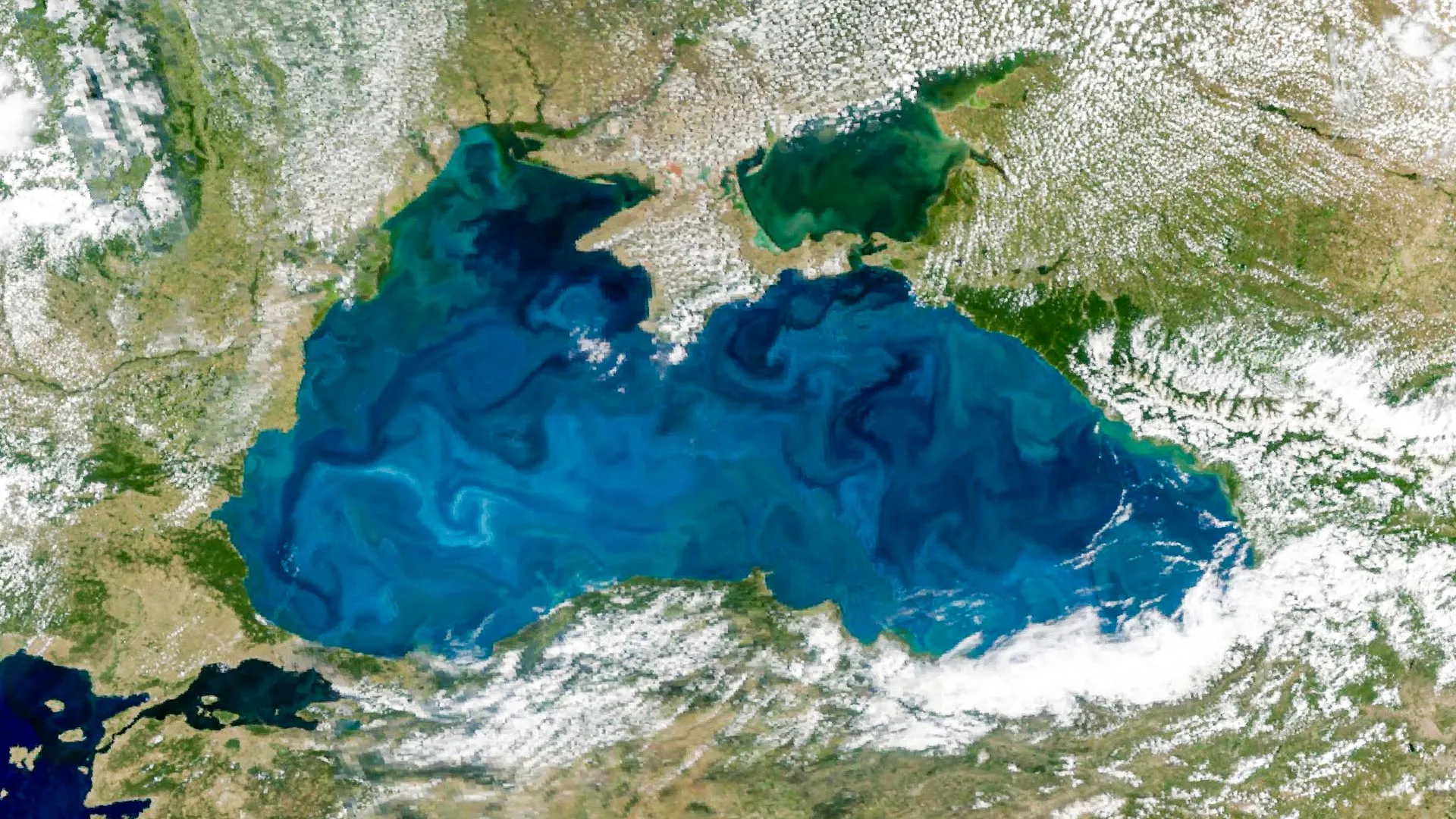
Every spring and summer, something unexpected happens to the Black Sea: its usually dark waters turn a brilliant turquoise, bright enough to see from space. On June 22, 2026, NASA's PACE satellite captured this phenomenon in stunning detail, revealing swirls of pale blue stretching across the sea that lies between Europe and Asia. Scientists say the color comes from tiny living things — so small that millions could fit in a single drop of water.
The brilliant color is caused by billions of microscopic organisms called coccolithophores (koh-koh-LITH-oh-forz). Each one is a single-celled phytoplankton coated in tiny plates made of calcium carbonate — the same material found in chalk and seashells. When these organisms multiply in enormous numbers during late spring and early summer, their reflective shells scatter sunlight and give the ocean a milky blue glow.
This isn't just a pretty picture. The color change tells scientists something important: the ocean is alive and busy. "These blooms are easily detected from orbit, giving researchers a window into marine ecosystems in areas where collecting water samples is difficult," the NASA Earth Observatory noted.
The turquoise transformation extends even into the Bosphorus, the narrow waterway that runs through Istanbul and connects the Black Sea to other seas. On May 27, 2026, about a month before the satellite spotted the wider scene, an astronaut aboard the International Space Station photographed swirling phytoplankton tracing bright currents on both sides of that famous channel.
But there's more to this story than color. Coccolithophores and other phytoplankton play a crucial role in supporting life on Earth. As they grow, they absorb carbon dioxide — the gas that traps heat in our atmosphere. When they die, some of that carbon sinks to the seafloor, where it can stay stored for a very long time. Scientists call this process the biological carbon pump, and it helps regulate Earth's climate by moving carbon from the sky and surface waters down into the deep ocean.
For the Black Sea, this seasonal bloom is a reminder that even the most familiar places can hide surprises — and that looking at Earth from 250 miles above, as the space station orbits our planet, can reveal beauty most of us never get to see from the ground.