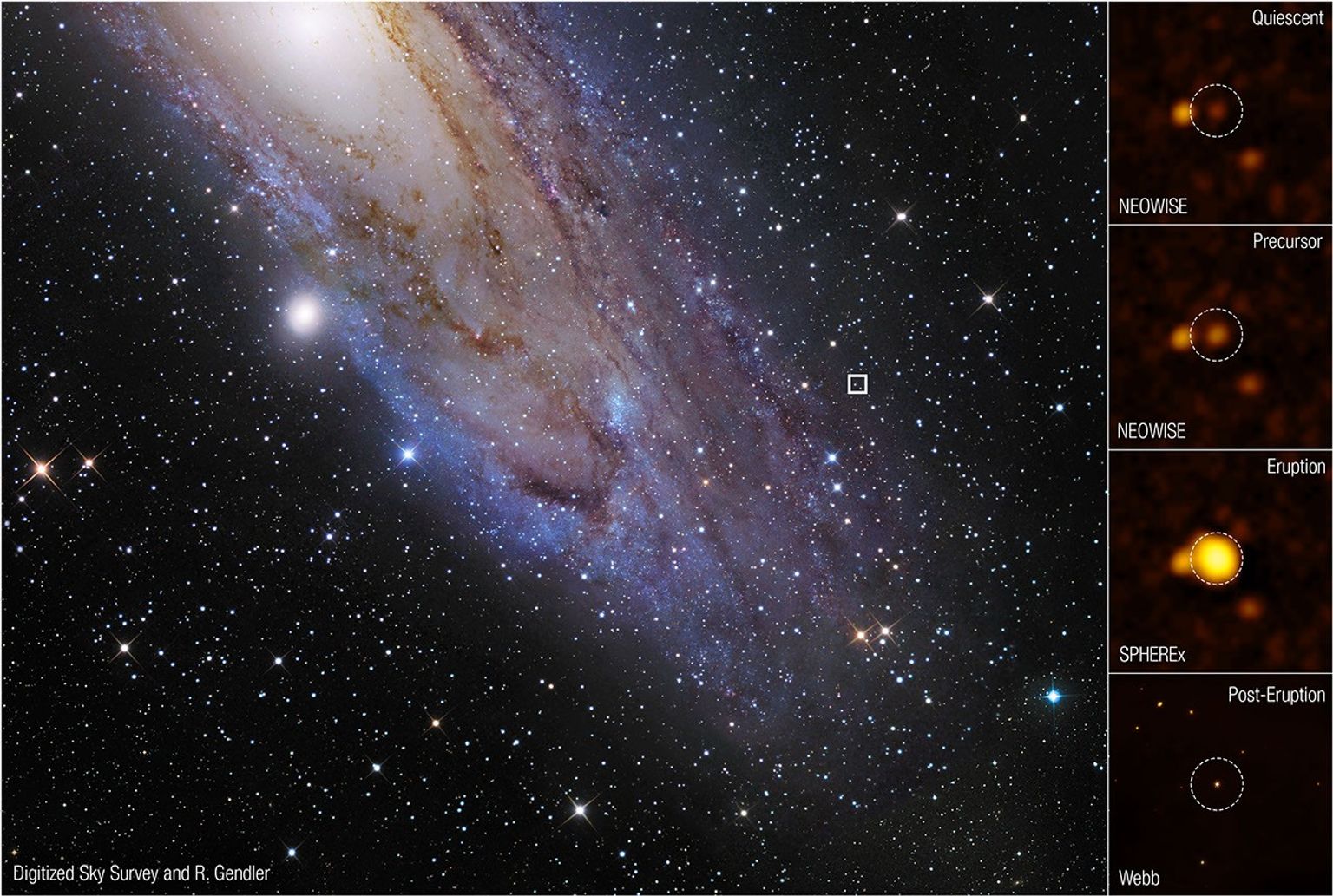
Seven years and just seven orbits were enough for a small star to disappear into a giant one near the edge of the Andromeda galaxy. Astronomers call the newly merged star Bao, and observations from NASA’s James Webb Space Telescope helped them piece together the event unusually soon after it happened.
Star mergers are hard to catch as they unfold because they are difficult to predict. Many are identified only after the fact, leaving scientists with little chance to study what the stars were doing before and during their collision. Bao offered a rare opportunity: Researchers noticed unusual changes in 2023, kept watching, and saw the system erupt in 2025. Webb observed it 47 days after the eruption reached its peak, the earliest follow-up of an event like this, according to the research team.
Before the merger, Bao was a pair of stars orbiting one another. The larger star, nicknamed Big Bao, was about seven times as massive as the Sun, 350 times its radius and 18,000 times as bright. Its smaller companion, Little Bao, had about 0.7 times the Sun’s mass. After the smaller star began touching the giant’s outer layers, it took only seven orbits — about seven years — for the pair to unite. In other known mergers of two smaller stars, the process followed thousands of orbits.
The first sign was a gentle rise in brightness. As Little Bao continued around its companion, it pulled gas from Big Bao’s outer layers. The smaller star then spiraled into the giant’s shared outer gas, losing energy as it moved. The team’s analysis found that it was dragged into Big Bao’s core, rather than escaping.
The merger’s sudden flare surprised researchers. Nadia Blagorodnova, an associate professor at the University of Barcelona and a co-author of the study, said the team expected an outburst from such a large, spread-out star to take years. Instead, its brightness rose and peaked within a week. Co-author Kishalay De of Columbia University described the encounter as “almost like a bomb exploding inside a living star.”
Webb’s mid-infrared observations showed dust shed by the giant over centuries. Researchers compared those observations with simulations and drew on data from telescopes both in space and on the ground. Together, the evidence helped them reconstruct what happened before, during and after the eruption, and confirmed that the stars merged.
That matters beyond Bao. In some binary systems, both stars survive a shared-envelope phase, shedding much of their mass but remaining in close orbits. Such pairs can eventually become neutron stars or black holes, and may produce supernovae or gravitational waves — ripples in space-time. Bao shows one possible ending for a pair, while offering scientists an unusually close look at how a merger unfolds.
The star now called Bao is still changing, and its final size and heft are not yet known. Future observations will show how it settles after swallowing its companion. For astronomers, the record-early Webb view is already a rare chance to follow a stellar transformation in near real time.