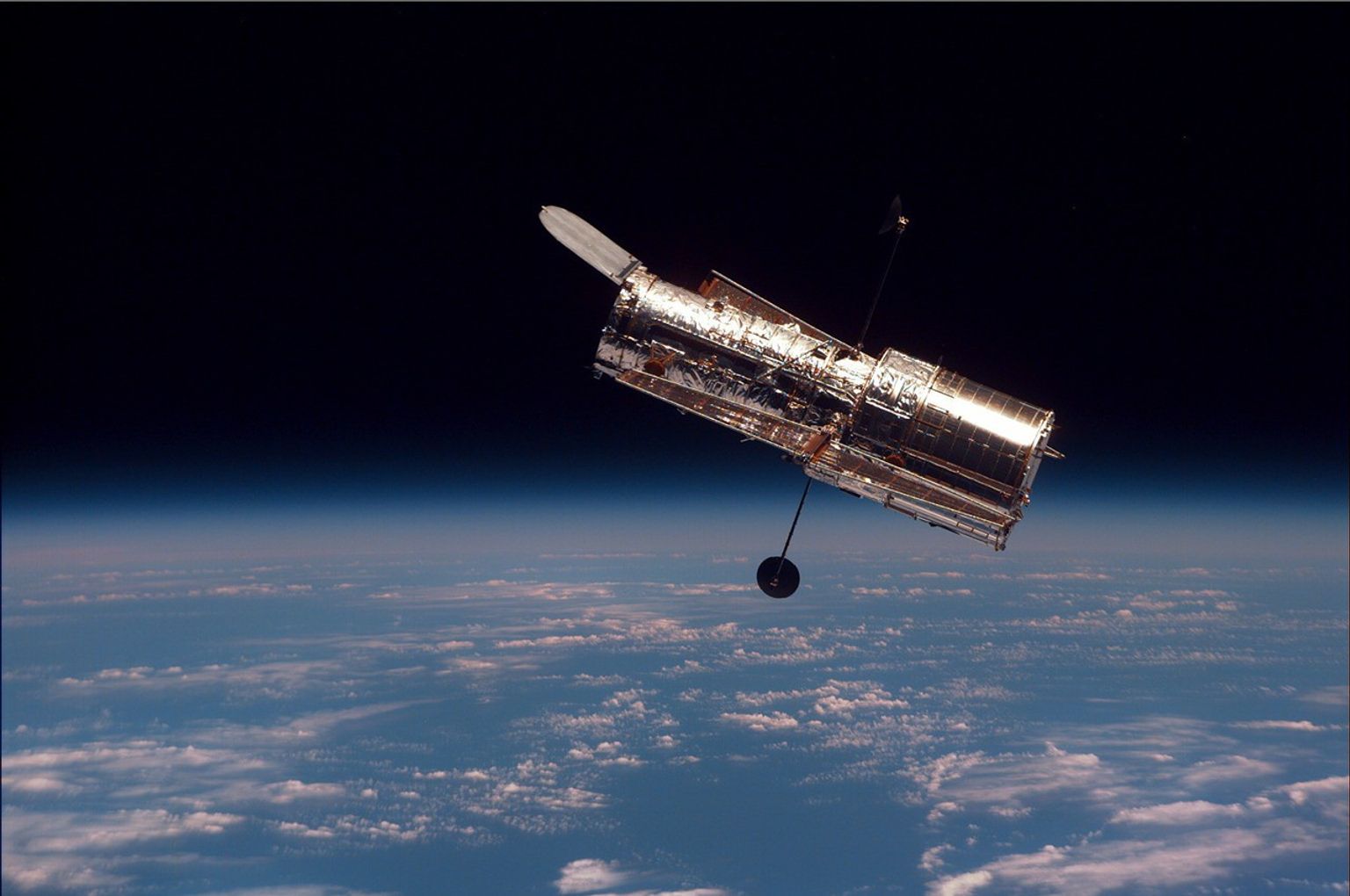
For more than 35 years, the Hubble Space Telescope has been sending images and measurements from orbit, but Earth’s thin atmosphere is slowly pulling it lower. NASA is now asking companies whether they can help keep the observatory working longer—or guide it safely at the end of its mission.
On Oct. 29, NASA issued a Request for Information, a formal call for companies to describe what they could do. The agency is looking at ways to boost Hubble into a higher orbit, service it to improve its capabilities, or arrange a safe, controlled return through Earth’s atmosphere or disposal in orbit. The request is not a decision to carry out a mission. It is a way for NASA to learn what commercial companies can offer.
Hubble has no propulsion system to raise or maintain its orbit. Atmospheric drag gradually slows spacecraft in low Earth orbit, causing them to lose altitude. NASA’s analysis says Hubble is likely to re-enter Earth’s atmosphere in 2033 or 2034. Because of that timeline, the agency says a mission to intervene would need to happen by 2032.
NASA Administrator Jared Isaacman said the telescope still has important science ahead. He called for the agency to examine reasonable ways to keep it delivering discoveries, provided they are innovative and cost-effective. More time in orbit could give researchers further chances to study the universe with a telescope that has already shaped how people understand it.
The idea also reflects changes in the space industry. Nicky Fox, NASA’s associate administrator for its Science Mission Directorate, said commercial companies have developed new abilities in recent years to capture and service satellites in space. NASA wants to explore those options while it develops the flagship mission that will follow Hubble.
Companies can respond to the request until 3 p.m. Eastern time on Monday, Nov. 30. Their answers may help NASA judge whether a higher orbit or servicing mission is practical, and what safe end-of-mission plans might be available. The agency has not announced a selected company, a design, or a cost for any mission.
Hubble is a joint project of NASA and the European Space Agency. NASA’s Goddard Space Flight Center in Greenbelt, Maryland, manages the telescope and its mission operations, with support from Lockheed Martin Space in Denver. The Space Telescope Science Institute in Baltimore conducts Hubble’s science operations for NASA.
For now, Hubble continues its work while NASA gathers information about what may come next. The responses will help the agency weigh a possible extension against the telescope’s expected return, with the goal of making the most of its remaining years in orbit and planning a safe path beyond them.