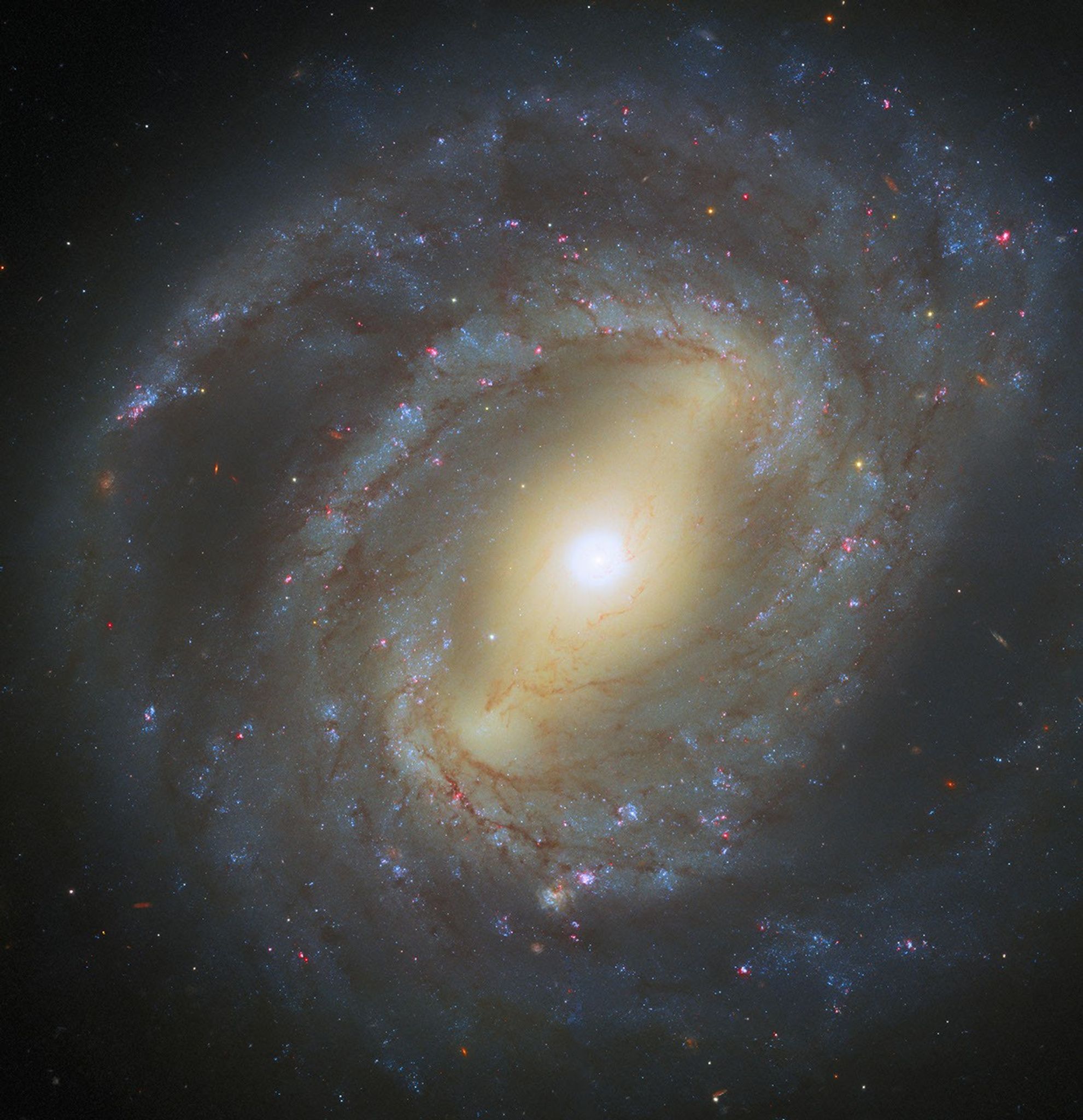
A straight band of stars cuts through the center of NGC 4394, where it meets the galaxy’s sweeping spiral arms. The NASA and European Space Agency Hubble Space Telescope has captured a new view of this galaxy, which lies about 55 million light-years away in the constellation Coma Berenices, also known as Berenice’s Hair.
NGC 4394 is relatively close by galactic standards. It is one of more than 1,000 galaxies in the Virgo Cluster, the nearest galaxy cluster to Earth. Its face-on shape also offers a useful comparison with our own Milky Way: astronomers think the Milky Way would look much like NGC 4394 if viewed from a similar angle. Both galaxies may also have a feature called a LINER, a region near a galaxy’s center where light reveals certain ionized or neutral elements. Scientists are still working out how these regions form; a feeding supermassive black hole or intense star formation may be involved.
The bar across NGC 4394 is made of stars, and it is not an unusual feature. Astronomers estimate that about 65 percent of nearby spiral galaxies have such bars. Hubble has also photographed barred spirals including NGC 5728, NGC 685 and NGC 613. Their straight central bands stand apart from the curved arms and clouds of gas and dust often seen in galaxies.
Researchers think a bar can emerge when a galaxy’s star-filled disk becomes unstable. A passing galaxy might give it a gravitational nudge, or interactions among stars and other forces could help disrupt the disk. Stars that once followed more circular paths can then move in elongated orbits, forming a bar. Observations suggest bars are more common among galaxies today than they were several billion years ago. But the structures may not last forever: as a bar grows more massive, it can become unstable itself.
This is not Hubble’s first look at NGC 4394. An image released about a decade ago came from an observing program focused on the galaxy’s neighbor, Messier 85. While one Hubble instrument studied Messier 85 and its unusual collection of star clusters, the Advanced Camera for Surveys captured a nearby patch of sky that included NGC 4394.
The new image also draws on observations from a more recent program, designed to investigate how star formation ends in galaxies inside dense clusters and how that process compares with galaxies in less crowded regions. Using Hubble’s Wide Field Camera 3, researchers can measure a broad range of light and estimate the ages of individual star clusters. NGC 4394 is one of 40 galaxies studied for the project.
The image is more than a portrait of a striking spiral. By comparing galaxies in different surroundings and measuring their star clusters, astronomers can learn how a galaxy’s environment shapes its life. NGC 4394’s familiar-looking bar and arms make it a particularly clear place to explore those questions, while leaving the origins and future of its bar open for further study.