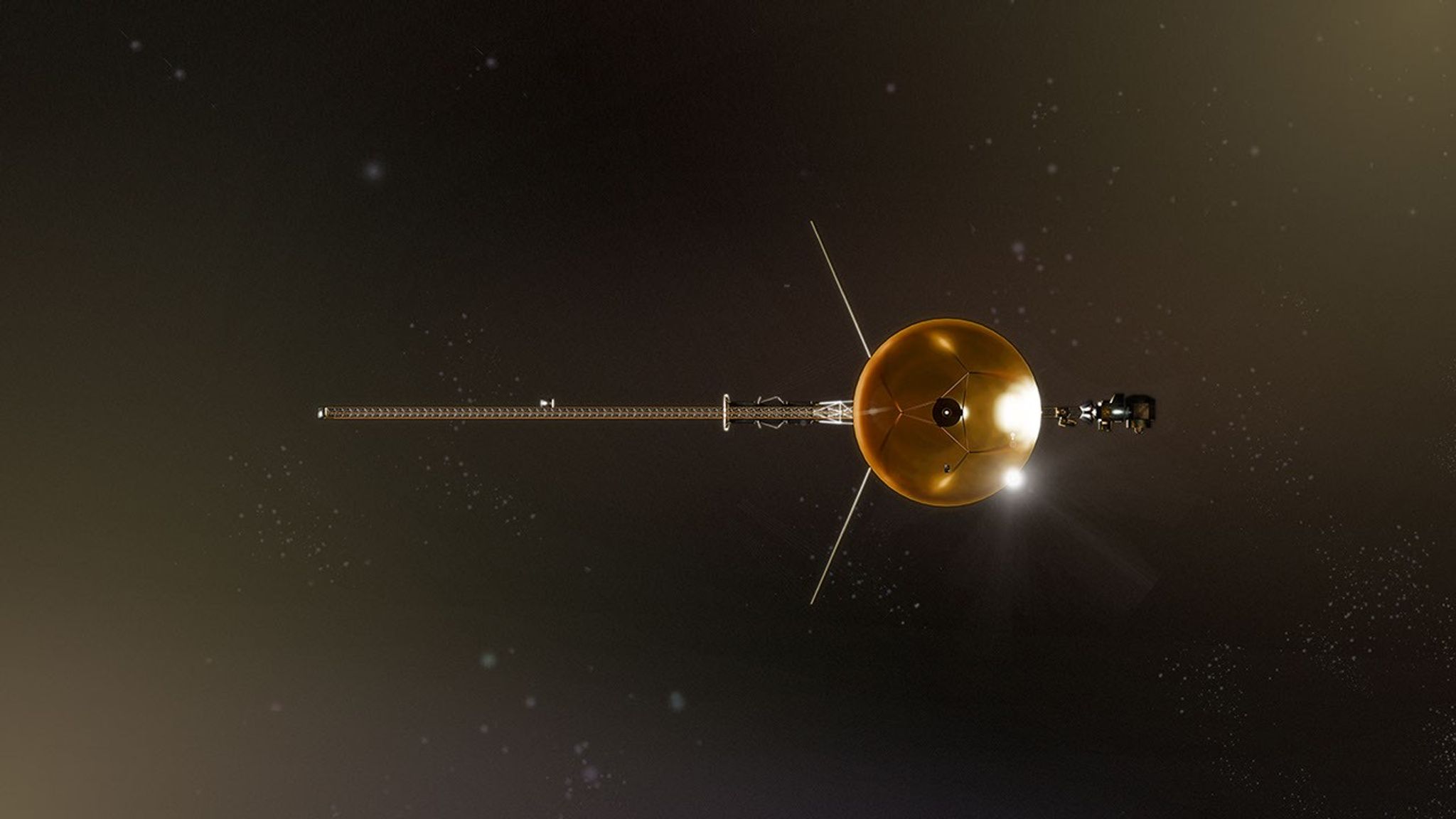
On Nov. 18, NASA’s Voyager 1 will reach a distance so vast that a beam of light sent from Earth would need a full day to catch up: more than 16 billion miles away. Launched in 1977, the spacecraft is the most distant human-made object, still sending observations from beyond the Sun’s protective bubble.
NASA is marking the one-light-day milestone with two events that invite people to take part and learn more about the mission. The scale is hard to picture: even a message traveling at light speed takes 24 hours to reach Voyager 1. The spacecraft’s long journey also shows what careful engineering can make possible over decades, as its twin, Voyager 2, continues to work in the same far-off region of space.
On Tuesday, Nov. 17, people around the world can join “Shine Bright for Voyager’s Light-Day.” After sunset, participants are invited to use a phone or tablet to make a symbolic wave of golden light around the planet. NASA’s website will make devices flash “VGR,” Voyager’s call sign, in Morse code. People can photograph or film their signal and share it on social media, tagging @NASA. Instructions are at go.nasa.gov/shinebright.
A NASA discussion follows on Thursday, Nov. 19, at noon Eastern time (9 a.m. Pacific). Hosted at the Jet Propulsion Laboratory in Southern California, it will bring together mission staff and NASA leaders to talk about the status of Voyager 1 and Voyager 2, the science they still collect in interstellar space, and the challenges of operating spacecraft across such enormous distances. A question-and-answer session is planned, along with a preview of a NASA+ documentary about Voyager, scheduled for 2027, the mission’s 50th anniversary.
The discussion will take place in JPL’s von Kármán Auditorium, which hosted Voyager briefings during the probes’ tour of the outer planets. Participants include Nicky Fox, associate administrator of NASA’s Science Mission Directorate; Jonathan Lunine, JPL chief scientist and a Caltech planetary science professor; Voyager project manager Suzanne Dodd; mission manager Kareem Badaruddin; and deputy project scientist Jamie Rankin of Princeton University. The event will be available online at nasa.gov/live.
Voyager 1 and Voyager 2 were built to explore the outer planets, making use of a rare alignment of planets that occurs once every 176 years. Voyager 1 entered interstellar space in 2012, and Voyager 2 followed a different route into it in 2018. Both continue to study the space beyond the heliosphere, the broad protective bubble shaped by the Sun.
NASA’s Jet Propulsion Laboratory, managed by Caltech in Pasadena, built and operates the spacecraft. NASA’s Deep Space Network carries communications to and from the probes. As Voyager 1 reaches a distance measured in light-days, the public events offer a way to mark not just a record, but a mission still returning science from a place no other human-made object has reached.