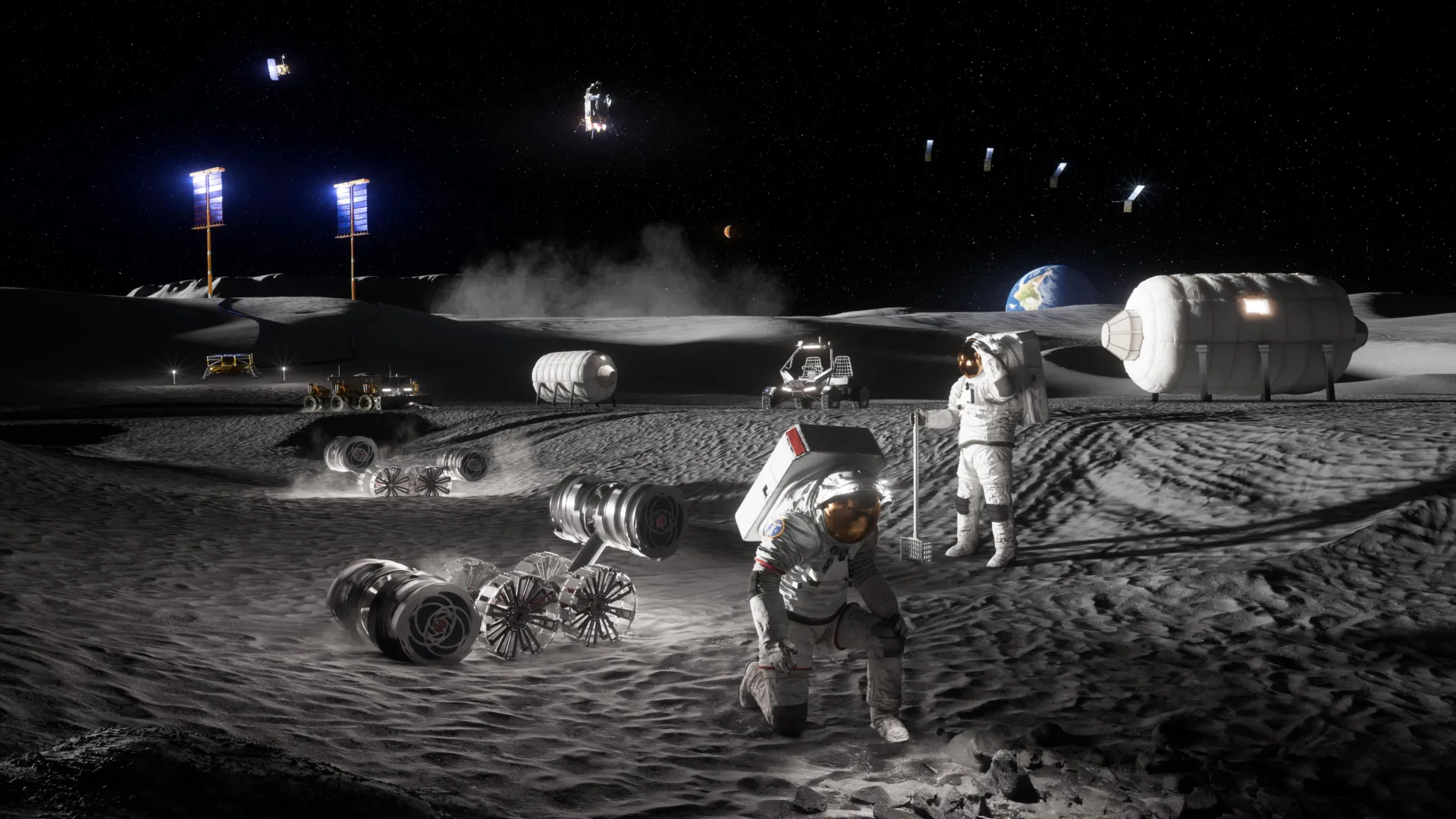
At Kennedy Space Center Visitor Complex in Florida, NASA put a million-dollar question to students: What will it take for people to live and work on the Moon? The agency has opened its $1 million Moon Base Challenge to high school and college teams across the United States, inviting them to design ideas for a future lunar home.
NASA is working toward a permanent base near the Moon’s South Pole. Astronauts could use it to live, conduct research and explore the surrounding region. Building a lasting human presence there would also help prepare for future missions carrying astronauts to Mars. The challenge gives students a chance to work on problems tied to those plans—not just imagine what a Moon base might look like.
Announced during a MAX POWER event at the visitor complex, the competition will unfold in multiple phases. Teams will develop possible solutions in six areas: generating and storing power, constructing facilities, keeping life-support systems running, moving across the lunar surface, setting up communications networks and protecting astronauts.
Those tasks reflect practical needs of daily life away from Earth. NASA says participants will work with real environmental conditions and mission requirements, and produce work similar to projects in the space industry. That can include comparing technical options, proposing designs and presenting ideas to project stakeholders. Students do not need prior engineering or technical training: NASA encourages people from technical, vocational and other academic backgrounds to take part.
NASA Administrator Jared Isaacman said students need not wait until graduation to contribute. He pointed to curiosity, teamwork and a willingness to tackle hard problems as qualities the agency wants in people helping shape its future on the Moon. Carlos García-Galán, manager of NASA’s Moon Base Program, said students could bring fresh perspectives to the design, adding that the base is ultimately for people who may experience a world where humans stay on the Moon.
The competition is meant to do more than gather ideas. By working through a complex design challenge, students can build skills in collaboration and creative problem-solving, while getting a view of careers in aerospace and related fields. Elaine Ho, associate administrator for NASA’s Office of STEM Engagement, said young people’s perspectives can help the agency imagine a future away from Earth.
Teams must register through NASA STEM Gateway by January 25, 2027. NASA’s Office of STEM Engagement developed the challenge with the Moon Base Program. The Institute of Competition Sciences will administer it under a contract with NASA’s Center of Excellence for Collaborative Innovation, part of the Research and Technology Mission Directorate.
The Moon Base Challenge turns a distant goal into a set of problems students can begin tackling now. Whether their ideas ultimately shape the base or help launch careers, the invitation is clear: a future in space will depend on people willing to ask practical questions—and work together to answer them.