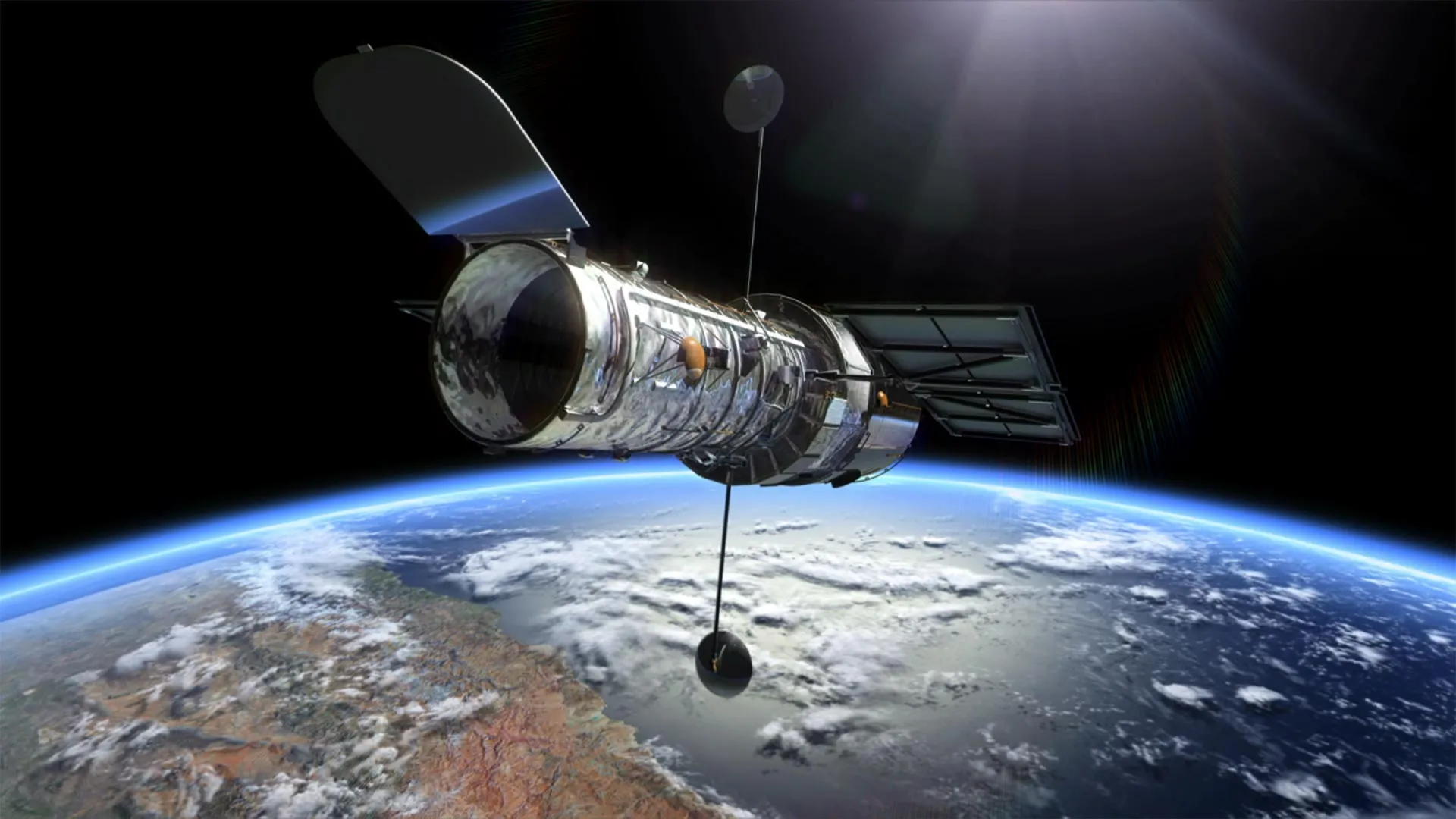
Hubble has spent more than 35 years turning its eye toward the universe, but the telescope is slowly losing altitude—and NASA is asking private space companies whether they can help keep it working.
On October 29, NASA issued a Request for Information, inviting companies to describe spacecraft and other technologies that might service Hubble in orbit. The agency is exploring whether commercial capabilities could extend the telescope’s life, improve its performance, or help end its mission safely. The request is an inquiry, not an approved rescue plan: NASA wants to learn what is possible and whether any option could be practical and affordable.
One idea is to send a spacecraft to lift Hubble into a higher orbit. The telescope moves through low Earth orbit, where thin traces of atmosphere create drag. That resistance slowly lowers its orbit. Hubble has no propulsion system that can raise it again, so it cannot stop the gradual descent on its own.
NASA’s analysis suggests Hubble could reenter Earth’s atmosphere sometime in 2033 or 2034. To give the telescope more time through an orbit boost, a mission would need to happen by 2032. That leaves a limited period to assess proposals, build a mission and carry it out.
NASA is also seeking ideas for servicing Hubble and improving its capabilities. If the telescope’s scientific work comes to an end, another mission might guide it through a controlled descent into the atmosphere or arrange for disposal in orbit. Each option would depend on what companies can offer and what NASA finds workable.
“Hubble still has important science ahead of it, and we should be looking at every reasonable opportunity to keep it delivering for as long as possible,” NASA Administrator Jared Isaacman said. He added that extending the telescope’s life could mean more discoveries and more chances to expand our understanding of the universe. Nicky Fox, who leads NASA’s Science Mission Directorate, said commercial companies have developed new ways to capture and service satellites in space. NASA is exploring those possibilities while developing the flagship mission that will follow Hubble.
The stakes reach beyond one spacecraft. Hubble’s observations have reshaped astronomers’ understanding of the cosmos, and it continues to contribute to research. The observatory is part of a long-running partnership between NASA and the European Space Agency, or ESA. NASA’s Goddard Space Flight Center in Maryland oversees the telescope and its mission operations, with support from Lockheed Martin Space in Denver. The Space Telescope Science Institute in Baltimore handles scientific operations.
Companies can respond to NASA’s request until 3 p.m. Eastern Standard Time on Monday, November 30. Their answers will help the agency judge whether newer commercial space technology can give Hubble more time—or guide it safely when that time is up. For now, NASA is still weighing possibilities, but the telescope’s remaining years may offer one more chance to protect a working observatory and the science it can still deliver.