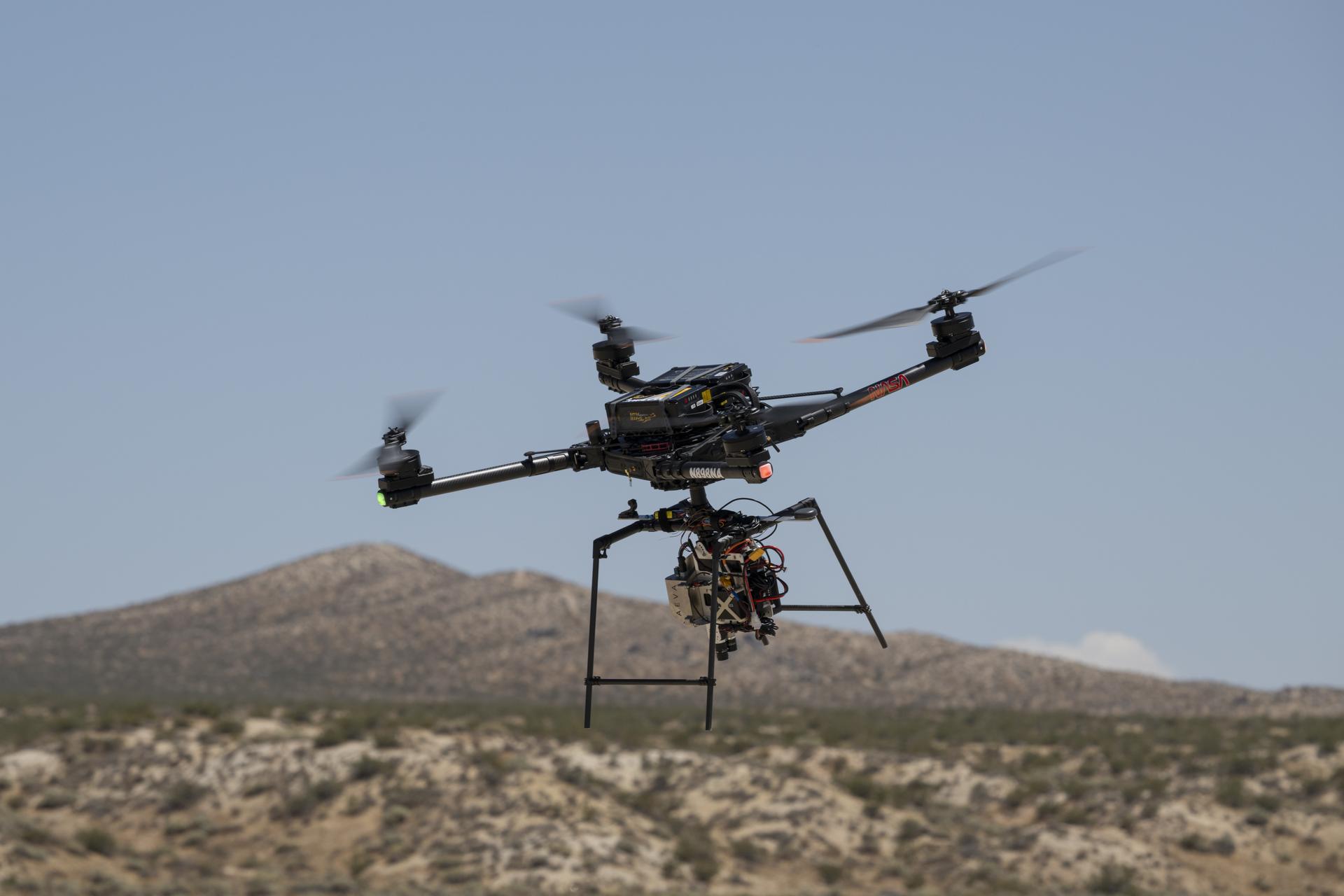
At Rogers Dry Lake in California, an Alta-X drone steered through a simulated lunar landing, using NASA technology to spot hazards and seek safer ground. The Aug. 27 flight showed how a spacecraft might one day choose where to touch down on the Moon or another world without waiting for directions from Earth.
Landing safely is a major challenge for missions to the Moon and Mars. A spacecraft must read unfamiliar terrain while moving toward the surface, then avoid rocks or other dangers in time to reach a safer place. NASA’s Safe and Precise Landing – Integrated Capabilities Evolution, or SPLICE, is designed to help with that task. Its guidance and navigation equipment can map the ground and assess possible landing areas during descent.
On the test flight, SPLICE flew aboard an Alta-X drone near NASA’s Armstrong Flight Research Center in Edwards, California. The system used light-detection and sensor data to build high-resolution digital elevation maps. If it judged the planned landing area unsafe, it could redirect the drone toward a safer location. The drone carried out simulated lunar descent and landing maneuvers, giving researchers a way to test the technology on Earth before using it in space.
Researchers at NASA’s Johnson Space Center in Houston developed the SPLICE payload. They worked with specialists at NASA Armstrong to fit it to the drone and prepare it for flight. Tests in June and July checked the links between the payload and aircraft, including communications, data handling, telemetry—the sending of flight information—and command and control. Those checks prepared the system for a larger test at Voyager Technologies in Mojave, California, planned for later in November 2026.
“This flight test is the culmination of almost a decade of work, for the SPLICE project,” said Davis Adams, NASA’s project manager. He said the flight raised the technology’s readiness for possible use on future robotic and crewed lunar missions. He also noted that the same guidance and navigation methods could apply to landings on Earth, the Moon, and Mars.
The test builds on years of flight work. NASA’s Flight Opportunities project, based at Armstrong, supported early testing. In 2019, researchers flew a descent from altitude and a landing path modeled on a lunar mission. In 2020, they demonstrated two NASA-developed precision-landing sensor systems. Each step helped move SPLICE toward more demanding trials.
NASA has also worked with commercial lunar lander companies to bring versions of SPLICE into their designs. Some landers planned for future Moon Base missions are drawing on data gathered during NASA’s development of the system to support soft landings. NASA and industry are discussing use of the guidance system through NASA’s software catalog, with availability planned for fall 2026. Companies are also considering its use for precision landings and, potentially, helping vehicles move autonomously across a planet’s surface.
The Alta-X flight did not land a spacecraft on the Moon, but it tested a key part of the decision-making such a landing requires: reading the ground and changing course when needed. Further trials will show how well the system performs at larger scale and how it can be adapted for future missions.