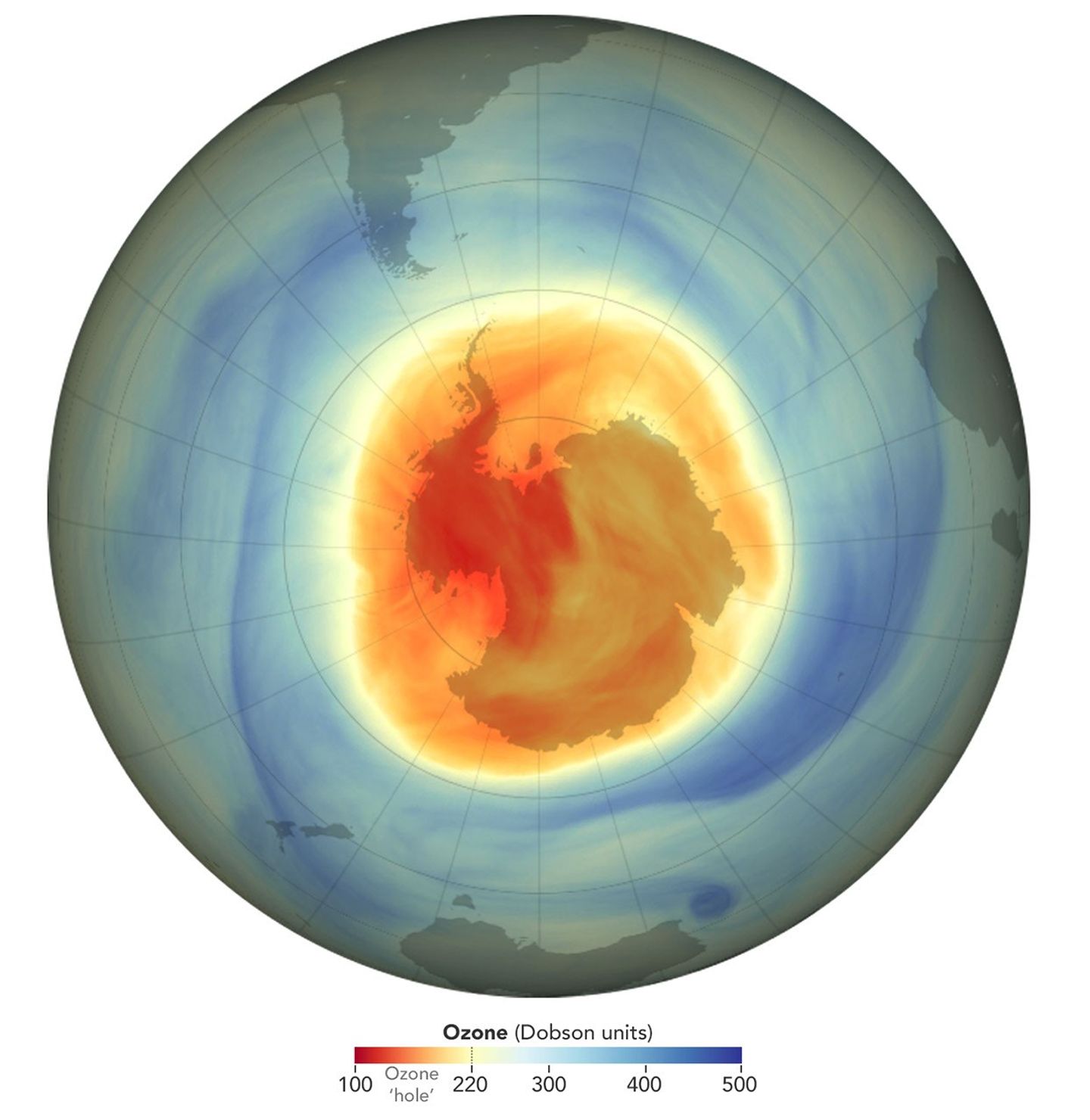
On Sept. 18, 2026, the Antarctic ozone hole spread across 10.5 million square miles—an area larger than the United States. That was its biggest one-day reach of the year, and it put the hole among the seven largest recorded in 48 years of monitoring by NASA and the National Oceanic and Atmospheric Administration (NOAA).
The ozone layer is a natural shield high above Earth. It absorbs much of the Sun’s harmful ultraviolet radiation, helping protect people, animals and plants. It is different from ozone near the ground, which is a pollutant. Scientists watch the Antarctic each year because cold conditions there allow chlorine and bromine from human-made chemicals to break down ozone.
During the main depletion season, from Sept. 7 to Oct. 13, the hole covered an average of about 9.6 million square miles, or 25 million square kilometers. Its average size made it the seventh largest since records began, but its depth was less severe than in some earlier years. NOAA balloon instruments at the South Pole measured a low of 105 Dobson units on Oct. 17. Dobson units are the standard way to measure ozone concentration. The lowest South Pole reading on record was 92 units, in October 2006.
An unusually strong polar vortex helped the hole grow. This ring of powerful winds holds very cold air over Antarctica, creating conditions in which ozone-depleting chemicals can do more damage. Amy Butler, a research scientist at NOAA’s Chemical Sciences Laboratory, said weather patterns that often rise from lower in the atmosphere and weaken the vortex were especially weak in August and September. As a result, the strongest winds stayed farther from the pole, leaving a wider area cold enough for ozone loss.
Even so, the 2026 hole would likely have been larger without decades of global action. The Montreal Protocol, signed in 1987, set limits on chemicals that damage ozone and pushed countries to replace them with less harmful options. Paul Newman, a senior scientist at the University of Maryland, Baltimore County, said the hole could have been 1 million to 2 million square miles larger if those substances were still as common in the atmosphere as they were at their peak in 2000. NOAA scientist Stephen Montzka said Antarctic stratospheric chlorine from these chemicals has fallen by about one-third from 1980s levels.
Satellites have helped track ozone since 1979. NASA’s Aura satellite, NOAA-20 and NOAA-21, and the Suomi National Polar-orbiting Partnership all contributed to the latest report, alongside ground and balloon observations. The measurements show both the value of continued monitoring and the limits of quick fixes: old chemicals can remain in the air or leak from discarded products and landfills for many decades. Scientists estimate that the Antarctic ozone hole will recover by the 2070s. The unusually large area this year is a reminder that weather can still shape each season, while the long-term direction remains tied to the phaseout of ozone-harming chemicals.