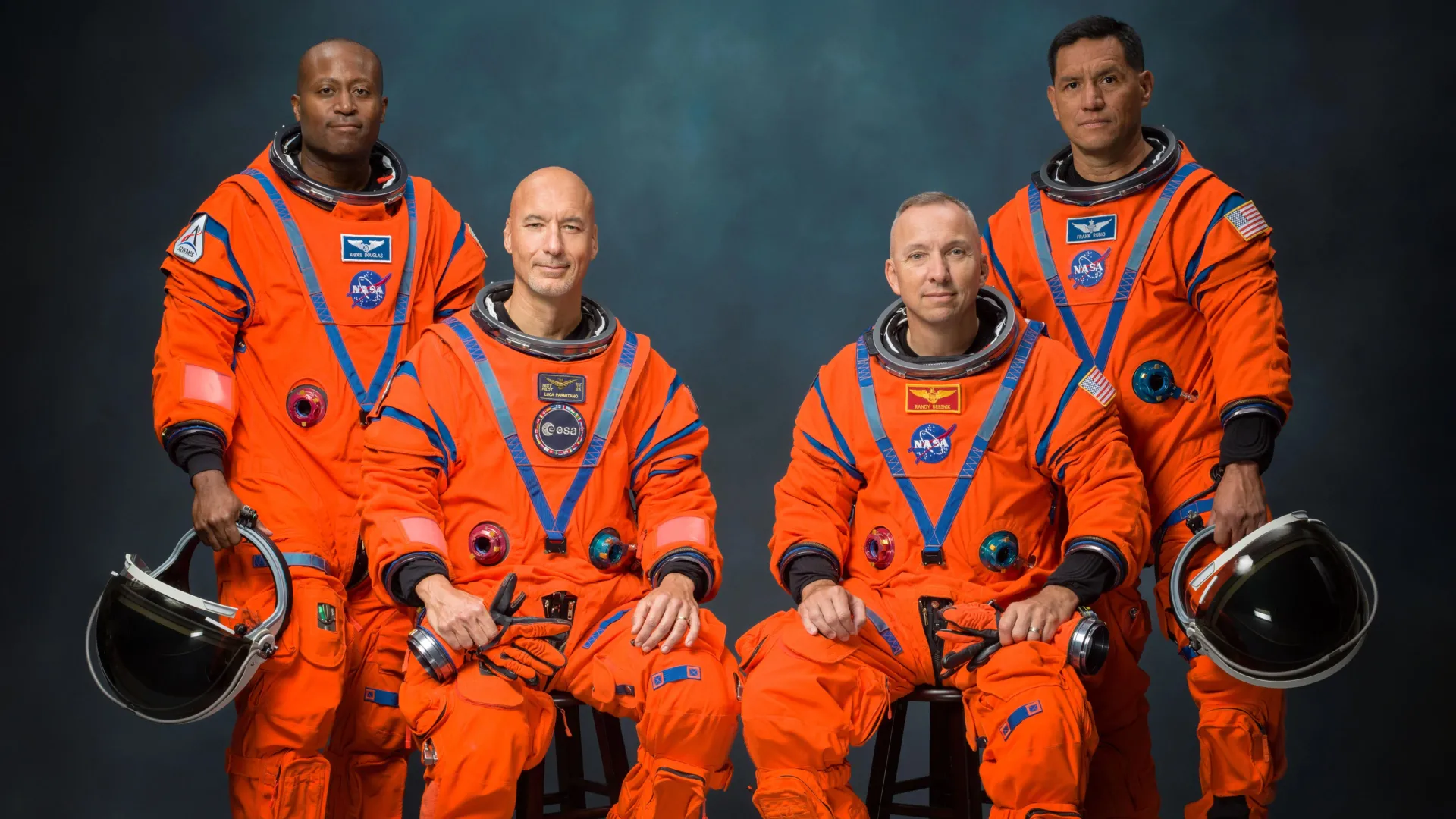
On a launch pad in Florida this summer, teams will begin stacking NASA's most powerful rocket to carry four astronauts on one of the most complex orbital tests humanity has ever attempted. Artemis III, scheduled for 2027, will not land on the Moon — instead, it will push the boundaries of spacecraft coordination in Earth orbit by attempting rendezvous and docking operations with prototype lunar landers from Blue Origin and SpaceX. This mission is the crucial bridge between today's ambitions and the first crewed journey to the Moon's South Pole, planned for 2028.
NASA has named the crew who will undertake this intricate dance of spacecraft: Randy Bresnik as commander, Luca Parmitano of the European Space Agency as pilot, Andre Douglas as mission specialist, and Frank Rubio as mission specialist. Bob Hines has been selected as backup. The announcement carries particular significance for international cooperation — Parmitano's assignment marks the first time an ESA astronaut has been selected for an Artemis mission, a recognition of Europe's deepening role in humanity's return to the Moon.
The Artemis III mission will launch aboard NASA's Space Launch System rocket from Kennedy Space Center, carrying the Orion spacecraft and crew into low Earth orbit. Once Orion completes initial system checks, it will attempt something that has never been done before in this context: rendezvous and docking with test versions of two entirely different lunar lander designs. The mission will evaluate how Orion and the landers work together across their software, communications, propulsion systems, and other critical technologies. This is not a demonstration of capability for its own sake — it is essential preparation for Artemis IV, when astronauts will actually descend to the lunar surface.
Hardware preparations are advancing in parallel across multiple sites. This summer, engineers plan to join Orion's crew module and service module and install the spacecraft's docking system, which will fly for the first time during Artemis III. Testing of Orion's heat shield continues, with individual heat shield blocks undergoing ultrasonic inspections before installation. Meanwhile, teams are integrating the Space Launch System's engine section with the rest of the core stage, preparing to install four RS-25 engines later this summer. All solid rocket booster segments have already arrived at Kennedy Space Center, and rocket stacking is expected to begin this summer.
Blue Origin and SpaceX are simultaneously developing crewed versions of their lunar landers — Blue Origin's Blue Moon and SpaceX's Starship — with test vehicles being built specifically for the Artemis III mission. NASA is working closely with each company throughout design, development, testing, and evaluation, drawing on expertise gained from decades of human spaceflight experience.
The four astronauts will begin training immediately on Orion systems while supporting the development and testing of both lander prototypes. They are stepping into roles that will require extraordinary coordination with international partners and teams across government and industry. Artemis III represents more than a single mission — it is the culmination of extraordinary technical achievement and the foundation upon which humanity will stand as it takes its next steps into the solar system.