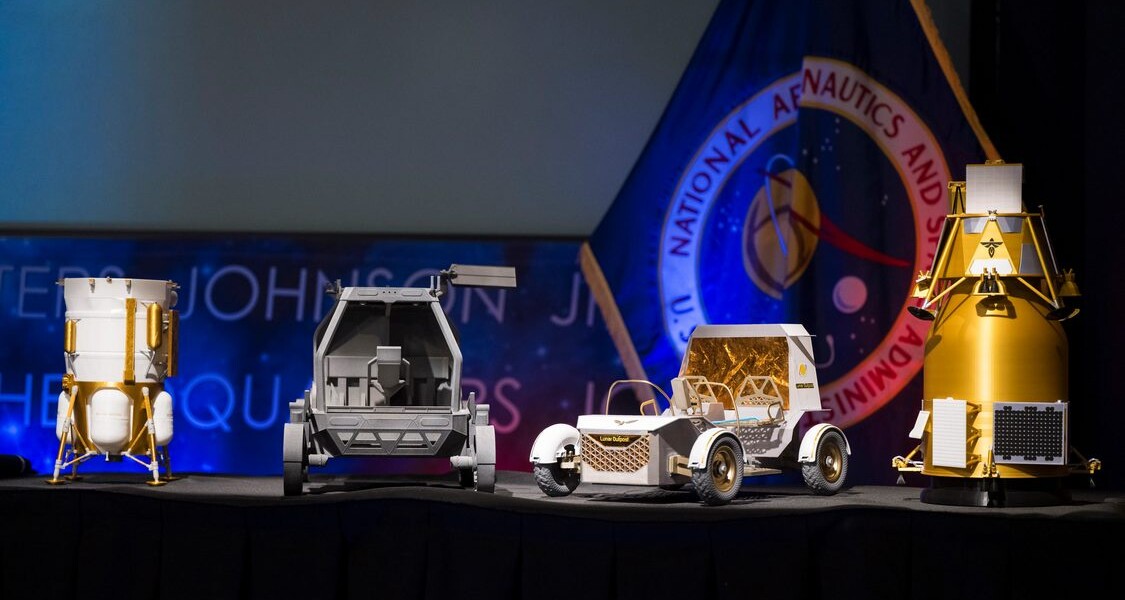
Blue Origin's Mark 1 Endurance lander will touch down on the Moon's south pole in 2026, carrying instruments that will measure how thrusters kick up lunar dust and test laser reflectors to guide future spacecraft—and with it, humanity inches closer to staying on another world.
NASA has just unveiled the Moon Base program: three back-to-back missions beginning next year that will transform the lunar south pole from a distant destination into humanity's first outpost beyond Earth. Each mission is designed as a stepping stone, gathering operational data and reducing risk before astronauts return to the lunar surface for the first time since Apollo 11 in 1969.
Moon Base I will deploy the thrust-impact science instruments and Laser Retroreflective Array from Blue Origin's lander, answering basic but crucial questions about how equipment behaves in the Moon's unforgiving environment. Just months later, Moon Base II sends Astrobotic's Griffin lander with a more ambitious payload: 1,100 pounds of equipment, including Astrolab's FLIP rover—a "Lunar terrain vehicle" designed to collect data on how wheels, treads, and tires perform when navigating in reduced gravity. The third mission, Moon Base III, will carry instruments from the European Space Agency and the Korea Astronomy and Space Science Institute, signaling a collaborative approach to this new frontier.
NASA Administrator Jared Isaacman framed the significance clearly at Tuesday's announcement: "The Moon Base will be America's and humanity's first outpost on another celestial world. Every mission, crewed and uncrewed, will be a learning opportunity as we return to the lunar surface, build the infrastructure to stay, and master the skills required to live and operate in one of the most demanding and dangerous environments imaginable." The agency plans to announce more than a dozen additional missions this year, each one deliberately designed to prepare for crewed Artemis surface activities later in the decade.
Beyond Moon Base, NASA is simultaneously advancing MoonFall, a companion program that will deploy four drones to the lunar surface by 2028. These aircraft will hop across potential landing sites, scouting safe zones for future astronauts. The Jet Propulsion Laboratory has partnered with Firefly Aerospace to build the spacecraft that will ferry the drones from Earth orbit to the Moon.
What makes these missions urgent isn't just exploration for its own sake. The Moon holds trillions of dollars worth of resources—materials that exist in an environment unburdened by forests to fell, rivers to pollute, or ecosystems to damage. Helium-3, a rare isotope used in medical diagnostics and potentially revolutionary for nuclear fusion reactors, costs $2,000 per liter on Earth, yet may be more accessible on the lunar surface. The Moon also harbors billions of tons of common metals and rare earth elements critical to modern technology. Some estimates place the Moon's total material wealth in the quadrillions of dollars—a figure that underscores why establishing a sustained human presence there matters not just scientifically, but economically.
These three Moon Base missions represent more than technological achievement. They are the foundation of a new chapter for our species: learning to live beyond our home world, one careful, data-driven step at a time.