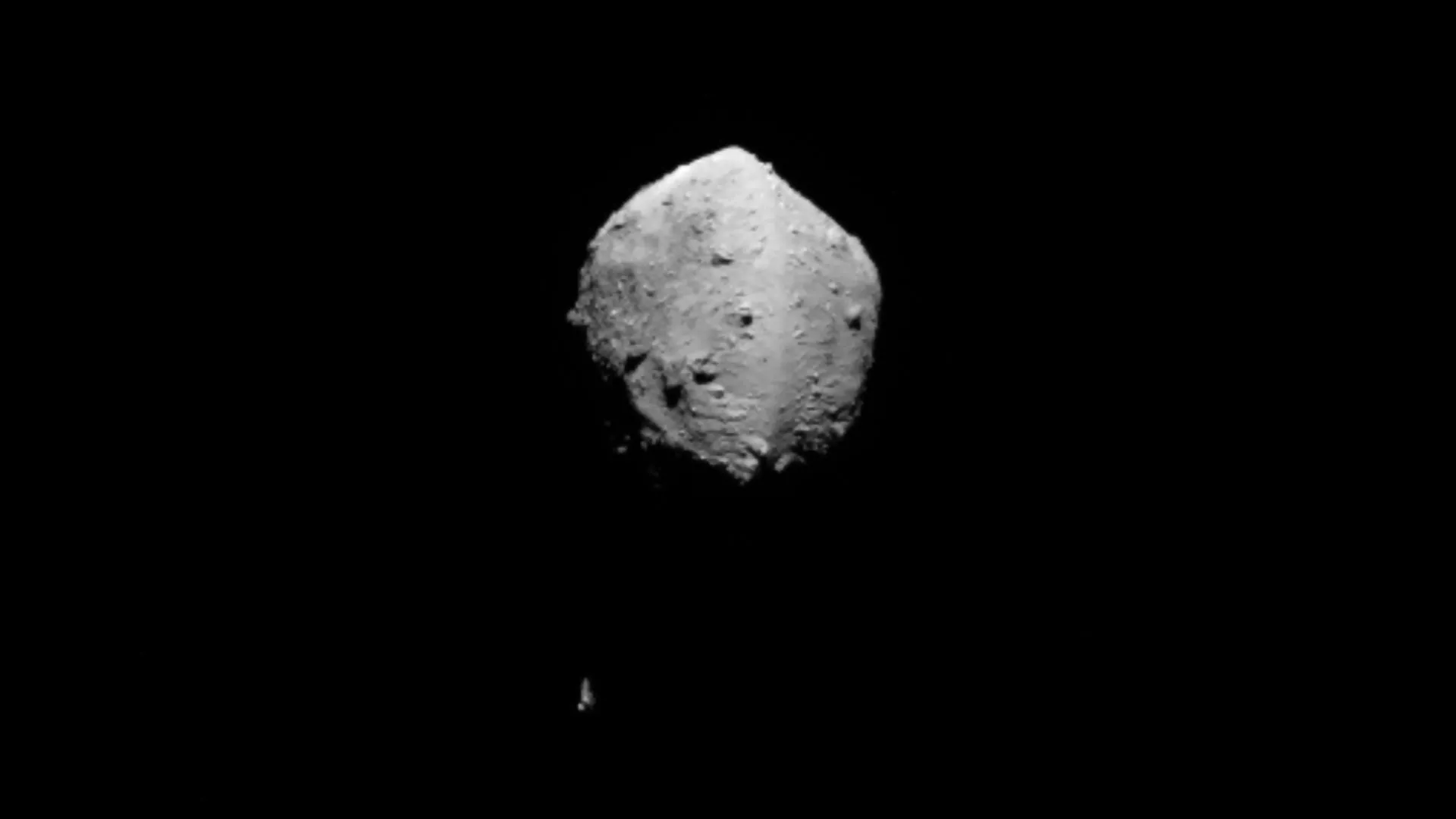
At 60 kilometers away, Hera’s black-and-white camera caught a side of Didymos that scientists had never seen in such detail: a rugged landscape of boulders, craters and possible grooves.
The European Space Agency spacecraft has arrived at the double-asteroid system to study the aftermath of NASA’s 2022 experiment, when the DART spacecraft deliberately slammed into Dimorphos, the smaller of the pair. That crash changed Dimorphos’s orbit around its larger companion, Didymos. Hera’s new view begins to show the setting in which that test took place—and may help researchers learn what an asteroid impact does to nearby worlds.
Didymos is about 780 meters wide, while Dimorphos measures 151 meters across. In Hera’s image, Didymos is clear, but much of Dimorphos is hidden in shadow. The newly visible face of Didymos still has the central ridge around its equator seen in earlier images, but the rest looks different. “The first thing we said was wow!” said Hera principal investigator Patrick Michel, a research director at France’s CNRS and the Observatoire de la Côte d’Azur. “This is the other side of Didymos from the one that DART’s camera showed us shortly before impact, so this feels like looking at a whole new world.”
The unfamiliar terrain could hold clues to what happened during the collision. DART hit Dimorphos on September 26, 2022, at about 6.1 kilometers per second. The impact blasted material into space. Because the two asteroids are separated by roughly one kilometer, some debris may have crossed over and landed on Didymos. Scientists now want to find out whether that material helped create any of the features Hera has photographed.
The first close-up is only an early look. Hera reached the system, 196.8 million kilometers from Earth, after a two-year journey and is preparing to examine both asteroids in detail. It will map their surfaces and the impact’s effects, helping scientists understand why DART changed Dimorphos’s motion and how similar attempts might work elsewhere.
The result of DART’s crash was striking: Dimorphos takes about 33 minutes less to orbit Didymos than it did before, give or take a minute. That was a bigger change than researchers expected. The mission showed that a spacecraft can alter an asteroid’s motion by hitting it—a method called kinetic impact deflection. Hera’s investigation is meant to turn that single demonstration into knowledge that could make future asteroid protection efforts more predictable.
More detailed images of both asteroids were scheduled to be unveiled on November 25. Hera mission manager Ian Carnelli called the new image an exciting moment for the team, adding that “the adventure is only beginning.” As Hera maps the pair, the strange new face of Didymos may help explain not just what the crash changed, but how to prepare if an asteroid ever threatens Earth.