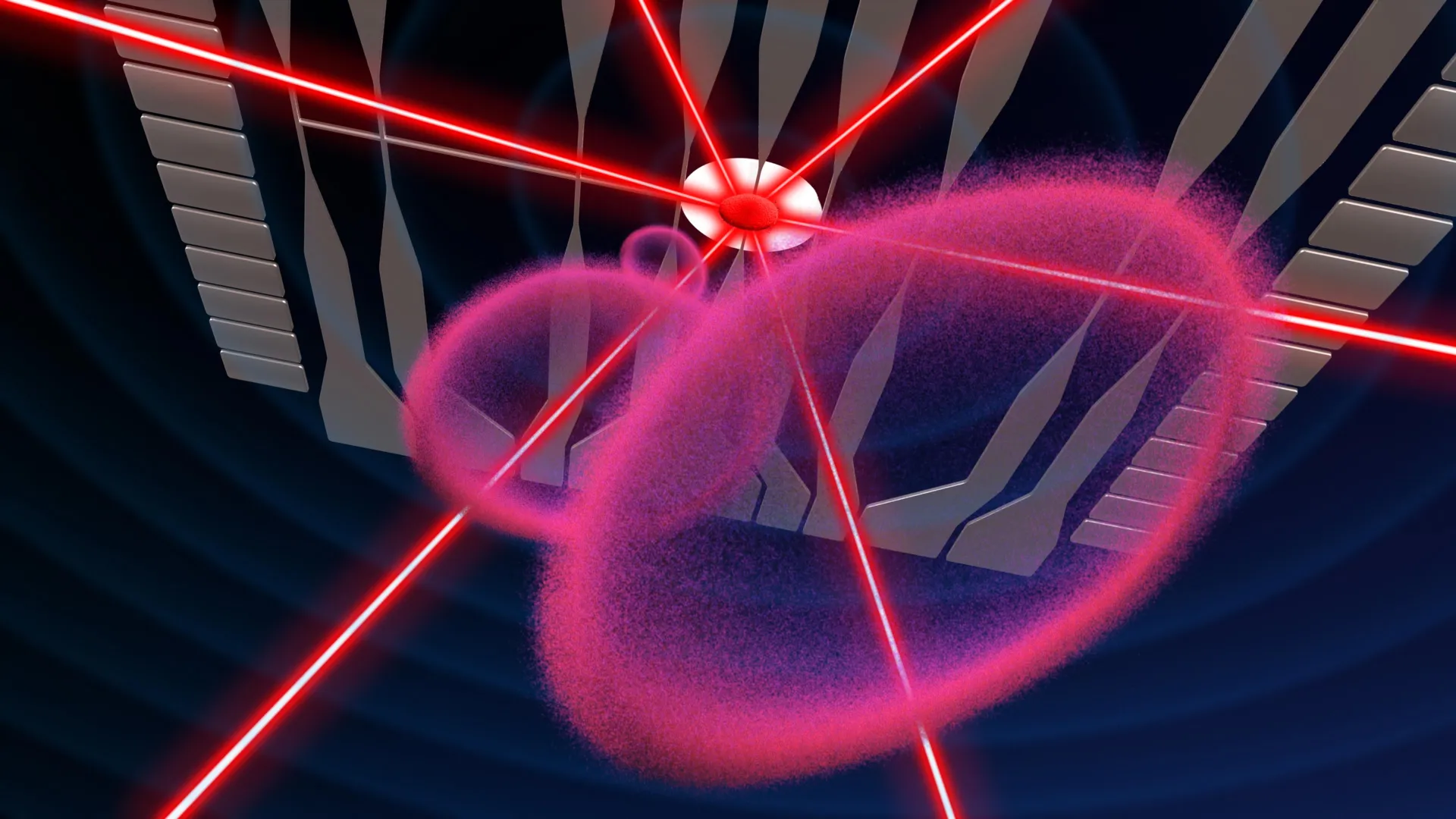
On a rack aboard the International Space Station, a mini-refrigerator-sized box hums quietly, cooling atoms to within a whisper of absolute zero—colder than the void of deep space. This is NASA’s Cold Atom Lab, the first facility to produce Bose-Einstein condensates in orbit, where quantum physics sheds its earthly limits. Here, in the silence of microgravity, atoms stop behaving like particles and begin acting like waves—stretching, overlapping, and existing in multiple places at once. These strange states of matter, known as Bose-Einstein condensates (BECs), form when clouds of rubidium or potassium are cooled below minus 459 degrees Fahrenheit, just above absolute zero. In this realm, the quantum world isn’t just visible—it’s manipulable.
The Cold Atom Lab, built by NASA’s Jet Propulsion Laboratory in Southern California, was upgraded in April 2024 with a new science module delivered by a Commercial Resupply Services mission. This fourth major enhancement since its 2018 installation includes a redesigned magnetic trap that can shape quantum gas clouds in new ways, and improved metal atom sources that generate more stable atomic gases. These upgrades allow scientists to probe deeper into quantum phenomena than ever before. On Earth, gravity pulls these fragile quantum states apart within fractions of a second, but in the microgravity of low Earth orbit, BECs can be observed for up to 10 seconds—more than ten times longer than possible in ground labs. That extra time is transformative, enabling precision measurements of time, gravity, and motion that could one day power ultra-sensitive space-based sensors.
Five international research teams are now using the lab to explore fundamental physics, from quantum wave behavior to the subtle effects of gravity on matter waves. The facility also serves as a proving ground for next-generation quantum instruments that may one day support Earth observation missions or deep space navigation. “At the coldest temperatures, matter behaves drastically different from anything we have experienced,” said Jason Williams, project scientist for Cold Atom Lab at JPL. “The wavelike nature of matter dominates, and ultracold matter can behave in ways that are not only unexpected, but that also enable extremely precise measurements.”
By miniaturizing what would normally be a room-sized quantum laboratory into a compact, remotely operated system, engineers have proven that complex quantum technology can operate reliably in space. “We’re performing quantum 2.0—direct manipulation of large quantum states,” said Ethan Elliott, deputy project scientist at JPL. As the quantum revolution of the 20th century gave us lasers and MRIs, this orbital leap could unlock a new era of quantum sensing and communication. In the quiet chill of the Cold Atom Lab, the universe is revealing its deepest rules—one wave-like atom at a time.