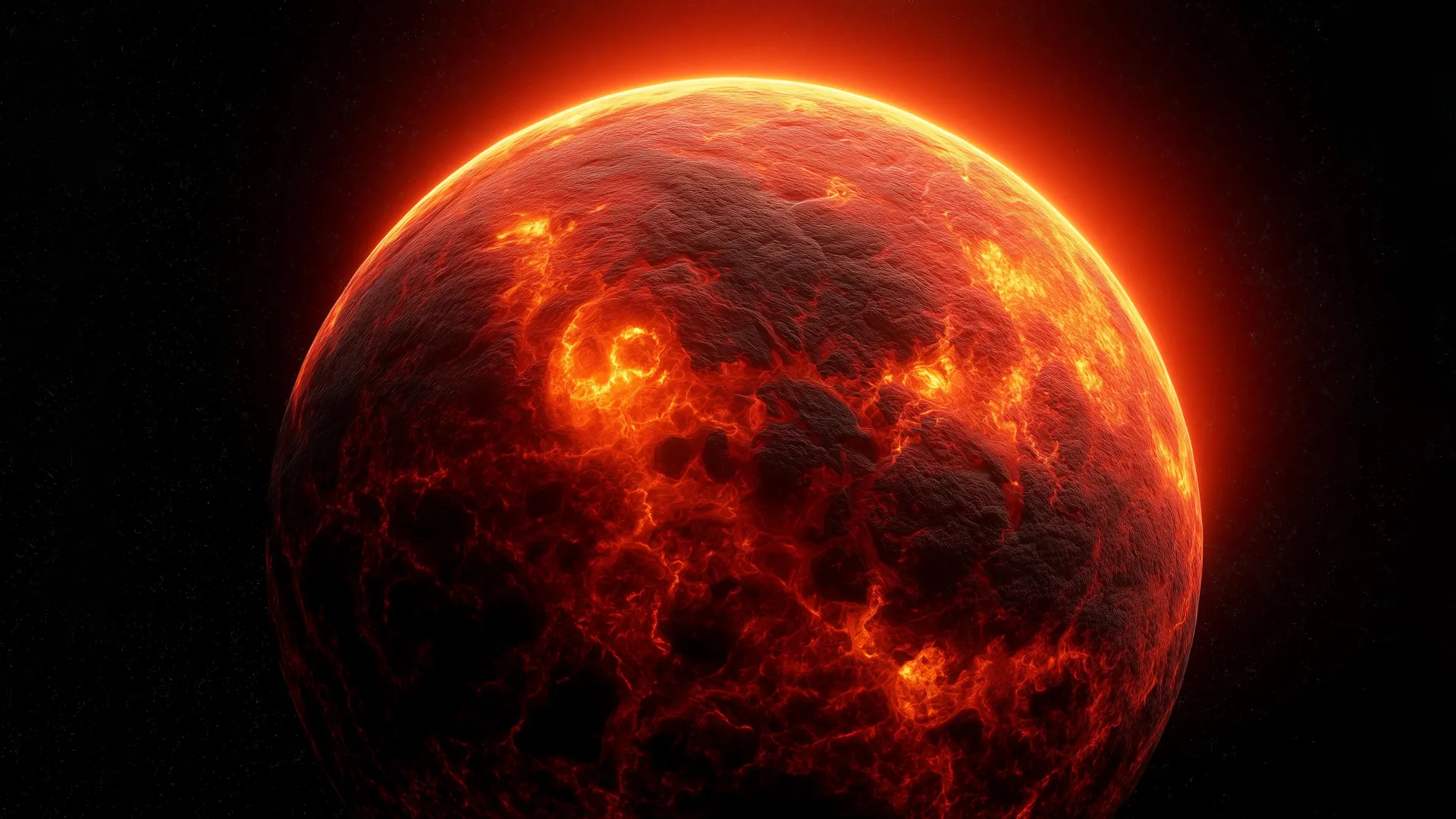
Forty-one light years from Earth, there's a world where rock flows like water and volcanoes never sleep. Scientists using NASA's powerful James Webb Space Telescope just took their closest look yet at this strange place — and what they found surprised everyone.
The planet is called 55 Cancri e, and it's roughly twice the size of Earth with about eight times our planet's mass. But the real jaw-dropper is how close it orbits its star: once every 0.7 days. Our planet Mercury, by contrast, takes 88 days to circle the Sun. That means 55 Cancri e is scorched by relentless stellar heat, keeping its surface in a permanent molten state — a world literally made of lava.
Researchers watched the planet pass in front of its star five separate times using the James Webb Space Telescope, Earth's most powerful eye in the sky. They expected the atmosphere to contain lots of carbon dioxide or carbon monoxide — those are the gases most computer models predicted for rocky planets like this one.
Instead, the telescope detected something unexpected: a hydrogen-rich atmosphere. Hydrogen is the simplest and lightest element, and it shouldn't stick around easily on such a hot world. Yet there it was, in surprisingly large amounts.
"The preference for hydrogen-rich models, together with the steep inversions they produce, therefore suggests an interior with relatively low oxygen fugacity," the researchers noted in their study, which has been submitted for publication in the journal Nature Astronomy.
In plain terms, the atmosphere is acting like a window into the planet's hidden interior. By studying the gases swirling above the lava, scientists can learn about the chemistry deep below the surface — something that's normally impossible to probe from millions of miles away.
The team also noticed something curious: the five observations didn't match perfectly. They think this could mean volcanic eruptions are constantly releasing new gases, or that clouds of material from the planet's interior briefly cool the surface before drifting away.
Interest in lava worlds like 55 Cancri e has exploded in recent years. While 55 Cancri e was first spotted in 2004, scientists have since discovered several others nearby, including worlds named K2-141 b, L 98-59 d, and TOI-561 b. These planets share a dramatic feature: tidally locked to their host stars, they keep the same face turned toward the sun at all times. One side bakes in eternal day while the other lingers in darkness.
Unlike Jupiter's volcanic moon Io, which is heated by the pull of giant neighboring worlds, these lava exoplanets are melted by starlight alone. It's a reminder of how wildly different planetary conditions can get across our galaxy.
The findings suggest scientists still have much to learn about how rocky planets form, evolve, and build their atmospheres. And as telescopes like JWST peer deeper into space, they might just reveal that Earth isn't the only world with secrets hiding beneath its surface.