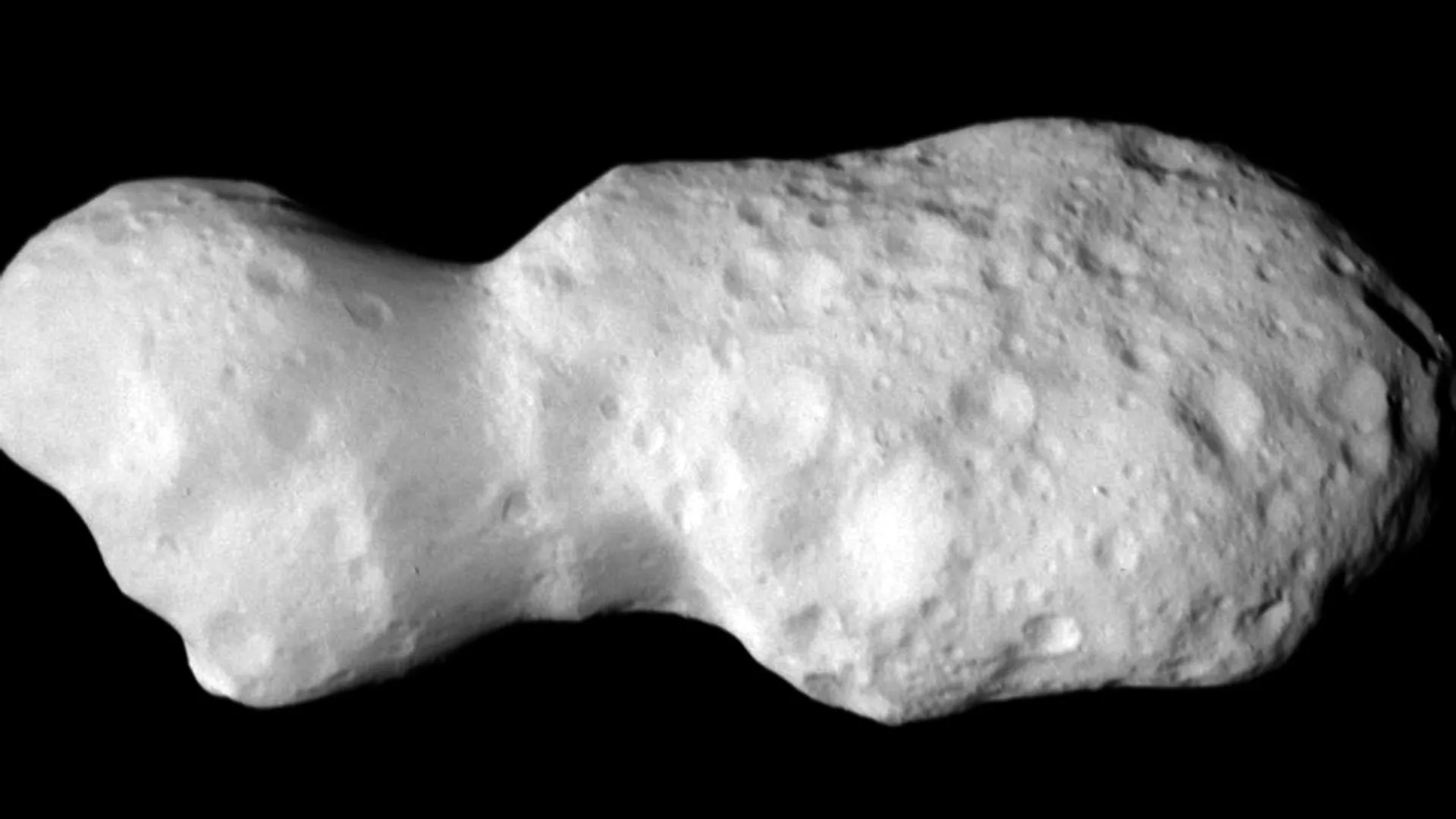
Donaldjohanson tumbles through the darkness of space like a spinning peanut, wobbling end-over-end as it traces its path around the Sun. When NASA’s Lucy spacecraft zoomed within 650 miles of this 4-mile-long asteroid on April 20, 2025, it revealed a world shaped not just by ancient collisions but by sunlight itself — and one that once briefly hosted liquid water. This unassuming relic, named after the famous fossil of early human ancestor Lucy, carries secrets from the early solar system, now uncovered in stunning detail.
The flyby was a rehearsal for Lucy’s primary mission: visiting the Jupiter Trojan asteroids, starting with Eurybates in 2027. But Donaldjohanson, nestled in the main asteroid belt, turned out to be far more than a dress rehearsal. Before Lucy’s arrival, astronomers thought the asteroid simply rotated every 10.5 days. The reality, revealed in data published June 18 in Science, is far stranger. Donaldjohanson doesn’t spin smoothly — it wobbles like a top losing its balance, completing a full end-over-end tumble every 10.5 days while also rocking side-to-side every 26.5 days. This complex motion hints at a dynamic past shaped by subtle forces acting over eons.
The spacecraft’s images showed a bilobate structure — two rocky lobes connected by a narrow neck, resembling a peanut. Scientists believe this form emerged 155 million years ago when fragments from a shattered parent asteroid gently reassembled under their own gravity. Initially spinning at least ten times faster, Donaldjohanson has slowed dramatically over the past 20 to 60 million years. The culprit? The YORP effect — a phenomenon where sunlight, absorbed and re-emitted as heat, exerts a tiny but persistent torque on irregularly shaped bodies. Over time, this force reshaped not just the asteroid’s spin, but its surface: loose debris slid downslope, softening crater edges and smoothing terrain.
Perhaps most intriguing is the evidence of ancient water. Lucy’s instruments detected iron-rich clay minerals — a chemical signature that can only form in the presence of liquid water. But unlike Bennu and Ryugu, where magnesium-rich clays point to prolonged aqueous activity, Donaldjohanson’s iron-rich clays suggest water was present only briefly. That fleeting exposure could mean its parent body was smaller, heated quickly by radioactive decay, and lost its water before deep alteration occurred.
By comparing Donaldjohanson with Bennu and Ryugu, scientists are piecing together a mosaic of early solar system diversity. Each asteroid tells a different story of formation, collision, and evolution — and together, they deepen our understanding of how rocky bodies transform over time. As Lucy continues its journey, it carries with it the lessons learned from this wobbling, watery relic — a humble asteroid with an extraordinary past.