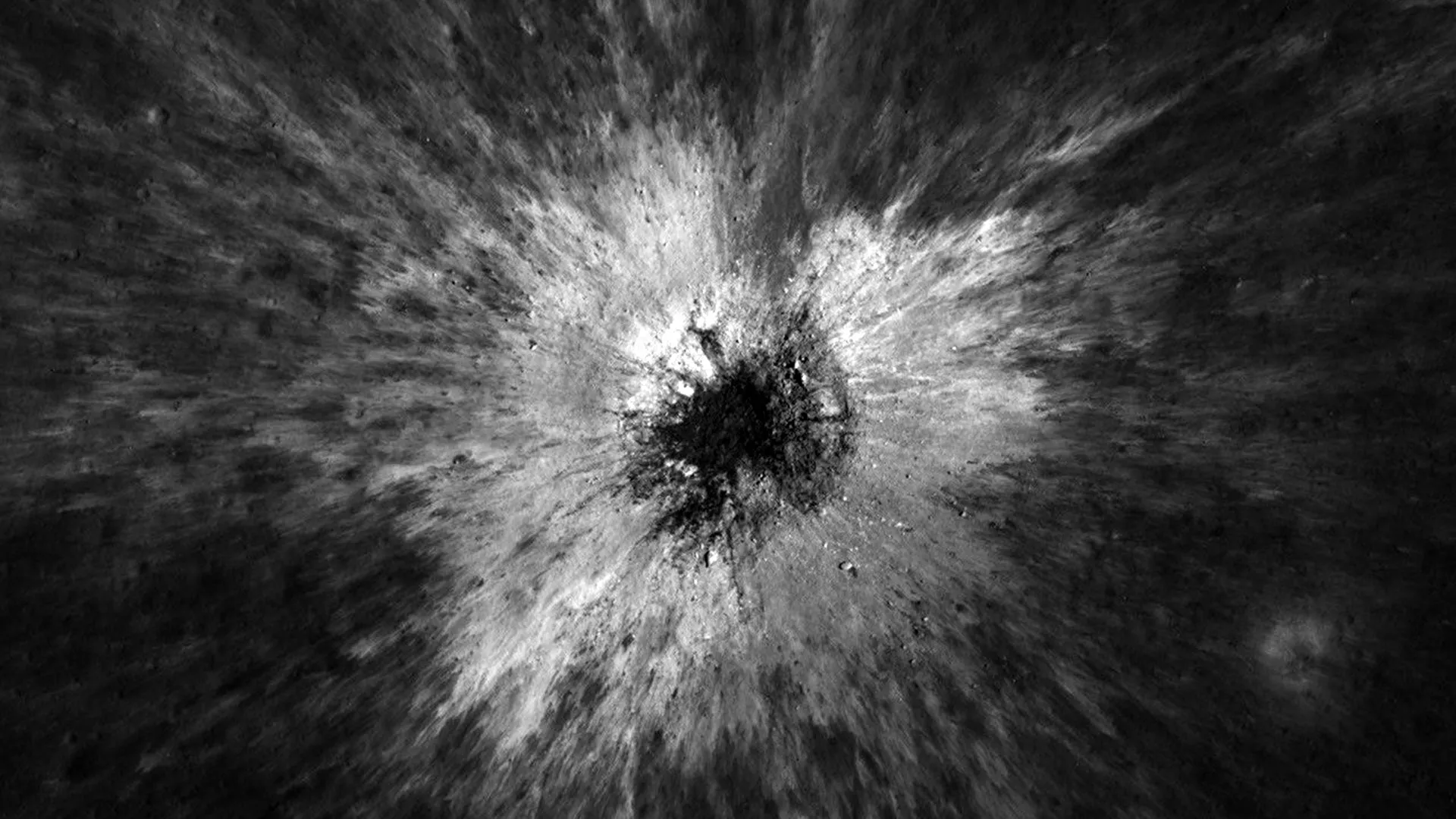
Robert Wagner was scanning a giant map of the Moon on his computer screen when something made him stop cold. An unusually bright patch sat surrounded by a dark halo, a telltale sign that fresh lunar soil had been kicked up. "I just stopped, dropped everything, and started looking into what that spot was," said Wagner, an image specialist from Intuitive Machines who works with NASA's Lunar Reconnaissance Orbiter (LRO).
His curiosity led to a record-setting discovery. Between April 11 and May 22, 2024, an asteroid or comet roughly the size of a three- to six-story building slammed into the Moon and carved out a crater 728 feet wide — about the length of two football fields — and 141 feet deep, deep enough to stack three yellow school buses vertically. Scientists reported in Science Advances that it is the largest newly formed crater ever identified in the solar system. They named it McGetchin, in honor of pioneering lunar scientist Tom McGetchin.
Impacts this large are vanishingly rare. Researchers estimate one may strike the Moon only about once a century, or even less often. That is partly because the Moon has no atmosphere to slow incoming space rocks or burn them up, so asteroids and meteoroids hit the ground directly in a way they rarely can on Earth.
But the Moon is constantly getting pelted. In more than 17 years of circling our nearest neighbor, LRO has helped scientists spot at least 1,000 new impact craters and about 100,000 other changes to the surface. Most of those are tiny. The smallest craters researchers can reliably detect are around 30 feet across, made by rocks roughly 43 inches wide — about the size of a monster-truck tire. Those small impacts create about 140 new craters across the Moon every year.
The surprises did not end with the crater itself. Using a thermal instrument called Diviner, scientists found that an area about 4 miles wide around McGetchin is roughly 16 degrees Fahrenheit colder at night than the surrounding terrain. The impact churned up and loosened the lunar regolith — the loose rock and dust covering the surface — leaving it less dense and less able to hold onto heat after sunset)Skip. This "cold spot" shows that a big impact can change the Moon well beyond the crater's rim, which scientists did not expect.
That matters for more than curiosity. NASA is working toward a sustained human presence on the Moon, and differences in how loose or dense the regolith is could influence how rover wheels move across it or how equipment performs.
Wagner made his discovery while comparing global maps taken years apart, searching for changes wider than 150 feet. It is a routine survey, yet it produced an extraordinary find — a reminder that careful watching of the Moon keeps revealing things we never saw coming.