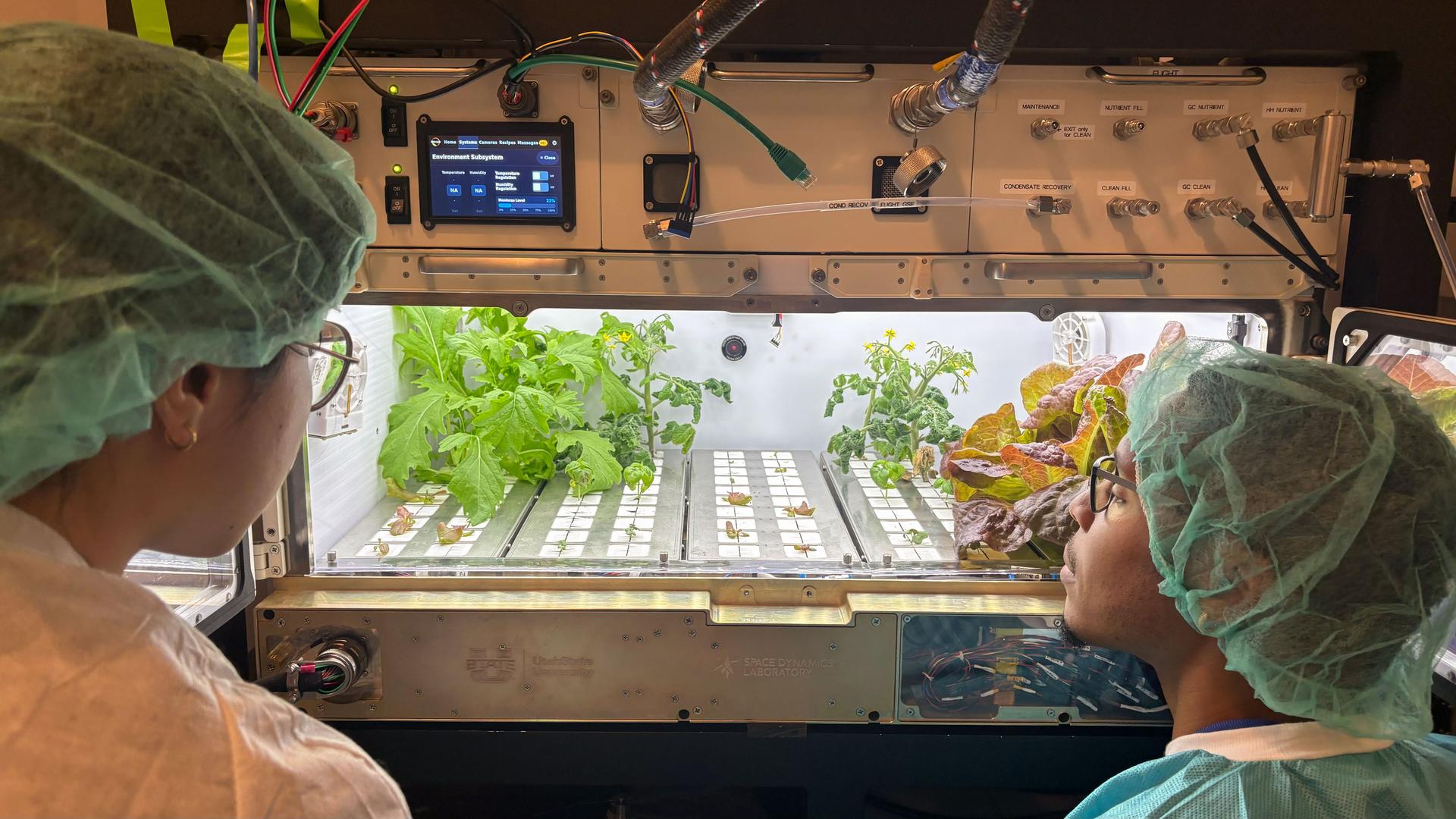
A prototype growing chamber and lab-grown brain tissue models are headed to the International Space Station aboard Northrop Grumman’s 25th Commercial Resupply Services mission for NASA, known as NG-25. The two experiments will test tools that could help astronauts stay healthier and grow some of their own food as missions travel farther from Earth.
For crews on future trips to the Moon or Mars, resupply from Earth will be difficult or impossible. Growing food in space could help make longer missions more sustainable, but plants must be raised in the unusual conditions of microgravity, where water and other resources behave differently. NASA’s Biological and Physical Sciences Division is sending a first-of-its-kind space crop production system to begin testing those challenges aboard the station.
The new prototype growth chamber will let researchers check how well its water delivery system works and how it can use space efficiently. The investigation will also test volume optimization technology, which is intended to make the setup work within limited room. The results could guide the design of systems that provide safe, nutritious, and reliable crops for future Moon Base habitats and Mars missions.
The research may have uses closer to home, too. NASA says knowledge from the space crop system could help inform vertical farming and other indoor growing methods. Those systems aim to produce crops in controlled spaces, and lessons about delivering water efficiently may be useful beyond spaceflight. The mission is a research test, not a ready-made farm: its purpose is to gather evidence that could shape future growing systems.
A second investigation focuses on human health. It builds on earlier work that sent miBrains—small, lab-grown models of human brain tissue—to the space station. This time, researchers will validate a miniature fluid-handling system. It is designed to mix, deliver, and maintain the nutrient-rich liquid that keeps the tissues alive.
Studying brain tissue in space could help scientists look for neurological risks linked to spaceflight and, in time, develop ways to protect astronauts. The findings may also support research on human tissues and models of neurological disease on Earth. The experiment is an early step toward longer studies of how brain tissue responds to the space environment; it does not yet provide answers about those risks.
Together, the experiments show how space research can tackle practical questions for exploration while also offering possible benefits on Earth. NASA’s Biological and Physical Sciences Division studies living systems and physical processes under conditions that cannot be recreated easily on the ground. As the NG-25 experiments test crop-water systems and miniature tissue care, their results could help researchers plan what people will need to live and work beyond Earth for longer periods.