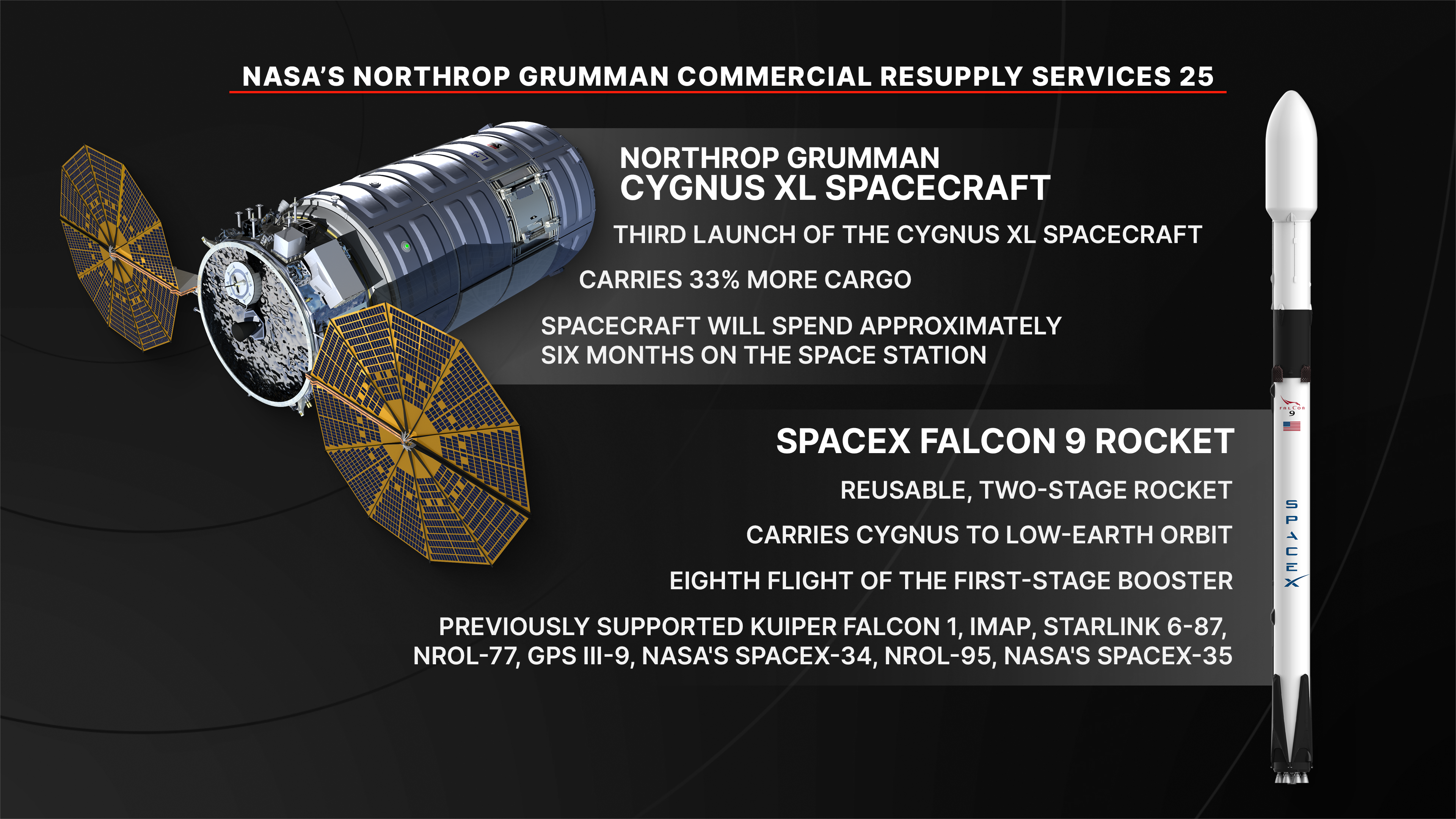
A Cygnus XL cargo ship will carry about 11,000 pounds of research and supplies to the International Space Station, including experiments on muscle loss, cancer, radiation and growing food beyond Earth. The mission, known as Northrop Grumman Commercial Resupply Services 25, is also the third flight of the company’s larger, more cargo-capable Cygnus spacecraft.
Regular cargo flights keep the station supplied and give researchers a place to test ideas in microgravity, where objects and living systems behave differently than they do on Earth. The findings can support health care and help prepare crews for longer journeys, including future missions to the Moon and Mars.
A SpaceX Falcon 9 rocket is set to launch the solar-powered Cygnus XL from Cape Canaveral Space Force Station in Florida. After it reaches the station, astronauts will use the Canadarm2 robotic arm to capture the spacecraft. Ground controllers will then guide it to the Earth-facing port of the station’s Unity module, where crews can unload its cargo.
Among the research is Cardinal Muscle 2.0, which will use a model of muscle tissue to test whether drugs already approved by the U.S. Food and Drug Administration for other conditions might help prevent or reduce muscle loss. Astronauts can lose muscle and strength during spaceflight, and the changes share features with age-related muscle decline on Earth. In microgravity, these effects can happen faster without exercise.
Another project, DNA Nano B, will make tiny particles inspired by DNA. They are designed to carry medicine into dense tissues, including cartilage and solid tumors. Researchers hope microgravity will help the particles form more evenly, improving the way they are made for possible cancer and osteoarthritis treatments.
Encapsulate-1 will study miniature copies of patients’ tumors to see how cancer cells move into nearby tissue and may spread. The researchers aim to develop a space-based tool that could help predict cancer progression months or even years ahead. A separate device, the Active Radiation Environment Sensor, will test real-time radiation monitoring inside crew living areas, with future Artemis and lunar missions in mind.
The shipment also includes Ohalo III, a mostly automated plant-growth facility that uses water recovery and air exchange technologies. It will help researchers study ways to grow crops on long missions. JOINS, short for JOining demonstrations IN-Space, will test ways for robots to join materials in orbit. Such methods could let crews build or repair large structures in space instead of fitting every part inside a rocket.
Practical station supplies are part of the delivery, too: replacement crew-quarter blankets and covers, hatch seal covers, a modified toilet hose, tools for the Alpha Magnetic Spectrometer and batteries for the Anomaly Gas Analyzer. Together, the cargo links daily station upkeep with research that may shape future exploration. Testing equipment and experiments in space also helps teams learn how they perform in unusual conditions before relying on them farther from Earth.