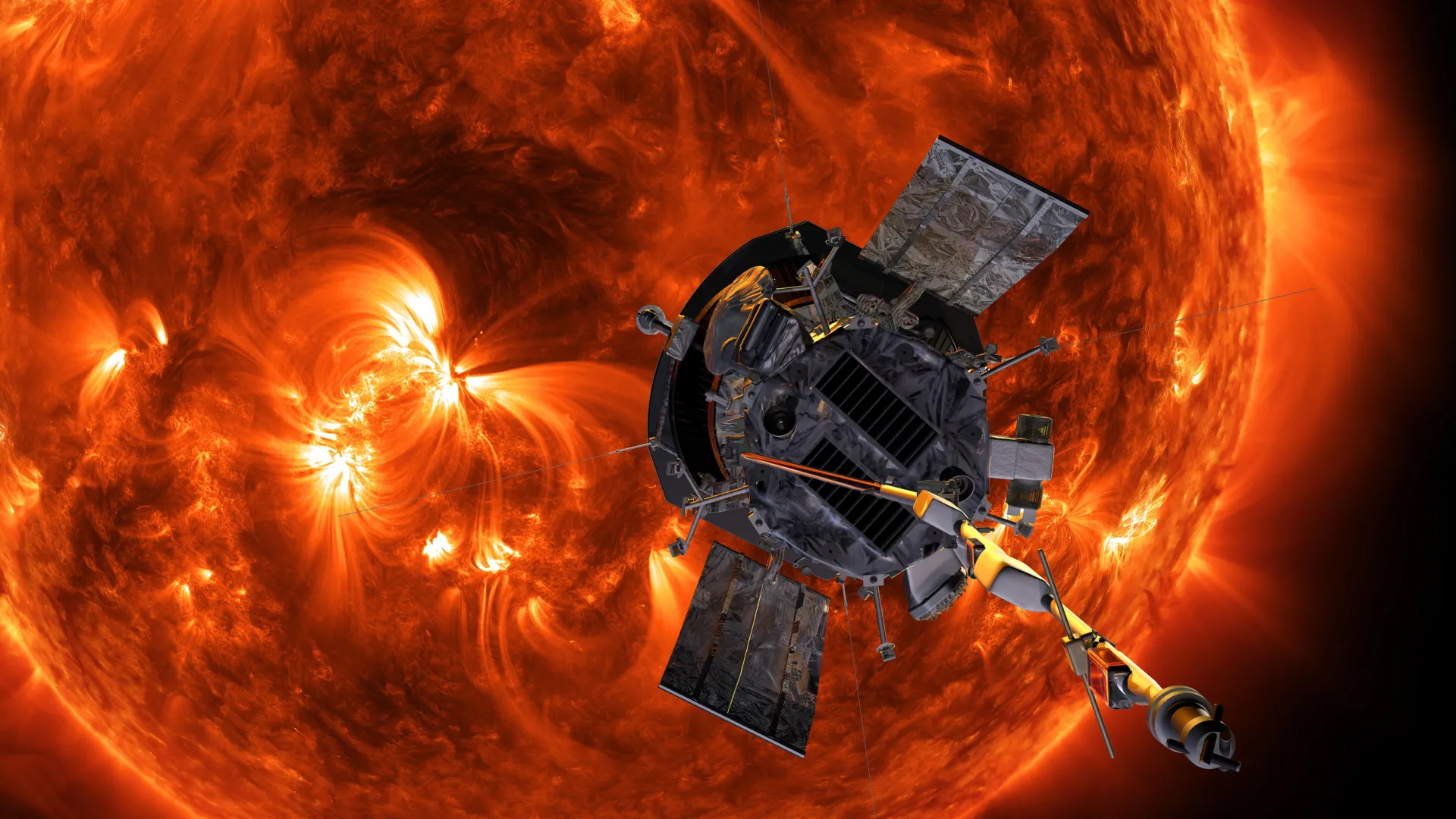
At the edge of the Sun’s turbulent wind, NASA’s Parker Solar Probe has found a pattern hiding in the magnetic fields: their preferred direction of rotation flips as the scale gets smaller.
The discovery offers a new clue to a problem scientists have wrestled with for years. Turbulence is familiar in swirling coffee and stormy seas, but it also fills space. There, much of the matter is plasma: electrically charged particles that interact with magnetic and electric fields. Unlike air or water, space plasma is so thin that its particles rarely collide. That makes its turbulent motion difficult to explain and model.
An international research team spotted the reversal in precise measurements of magnetic fields and particles collected by the Parker Solar Probe. Researchers from Technische Universität Braunschweig and the University of Tokyo worked with colleagues at Tohoku University, Kyushu University, Osaka University and other institutions. The collaboration included scientists from ten countries. Their findings were published in The Astrophysical Journal Letters.
The team found that magnetic fields rotate one way at larger scales and the opposite way at smaller ones. Looking outward from the Sun, the larger-scale fields tend to turn counterclockwise; at much smaller scales, clockwise rotation becomes more common. The change appears at a boundary where plasma shifts from moving collectively, much like a fluid, to behavior shaped more by individual particles. The researchers say this is the first direct observation of this kind of reversal in space turbulence.
The pattern also changes as the solar wind moves farther from the Sun: the reversal grows more pronounced and shifts toward longer wavelengths. Wavelength describes the distance over which a wave’s pattern repeats. The result links a clear magnetic pattern to the transition between two ways plasma behaves, giving researchers a new way to study how turbulence moves energy across different scales.
That matters well beyond the region measured by the probe. Plasma turbulence occurs in the solar wind, near Earth’s magnetic environment, in areas affected by solar eruptions, and around other astronomical objects. It also affects shock waves and clouds of magnetic material launched into space after eruptions on the Sun. Such disturbances can contribute to geomagnetic storms, which can disrupt conditions around Earth.
The finding does not by itself make space-weather forecasts more accurate. But it gives scientists a newly observed feature to test in the physical models used to explain the solar wind and predict geomagnetic storms. Dr. Masatomi Iizawa of Technische Universität Braunschweig, the study’s first author, said, “We see a clear structure in the spectrum, even though the turbulence represents unstructured motions.” By tracing how that structure changes, researchers can work toward a fuller picture of how the Sun’s restless plasma behaves—and how its disturbances travel through space.