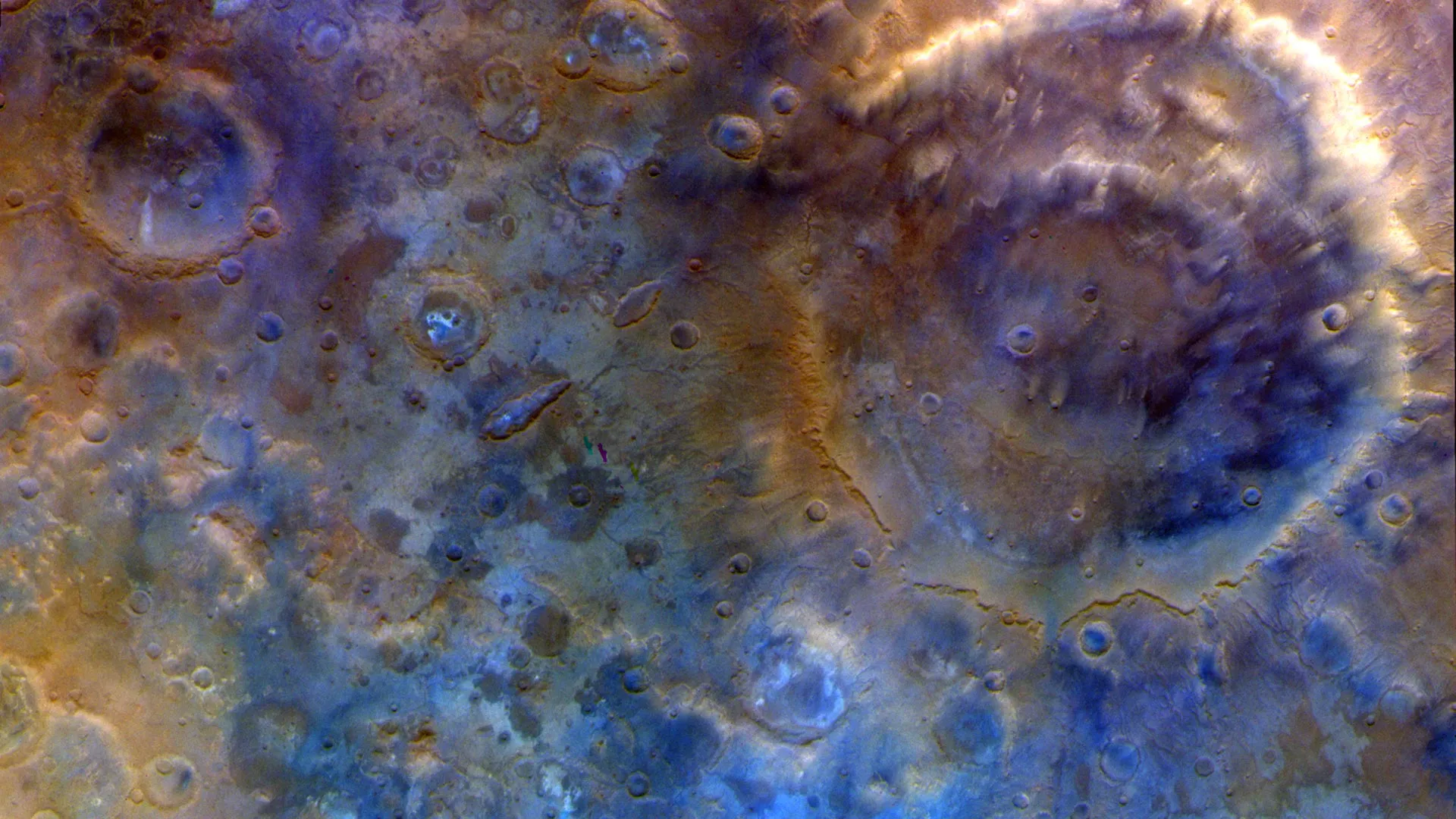
When the Psyche spacecraft zipped within 2,864 miles of Mars on May 15, it didn’t just snap a breathtaking image of the Huygens crater — it stole a piece of the planet’s gravity to fuel its journey deeper into space. As the spacecraft raced past the Red Planet, its multispectral imager locked onto the ancient, double-ringed Huygens crater, nestled in Mars’ heavily scarred southern highlands. The image, sharp and rich with geological detail, captures a world shaped by eons of impacts — but for the Psyche mission, this fleeting encounter was never about Mars. It was about momentum.
The flyby was a precisely choreographed gravity assist, a spaceflight technique that harnesses a planet’s natural pull to slingshot a spacecraft forward without burning precious fuel. By diving close to Mars, Psyche gained a critical velocity boost, altering its trajectory and setting it firmly on course for its true target: a distant, metal-rich asteroid also named Psyche, orbiting the Sun between Mars and Jupiter. Such maneuvers are essential for deep space missions, allowing spacecraft to travel farther and faster while conserving propellant for critical operations later in the journey.
Launched in October 2023, the Psyche spacecraft is now on track to reach its destination in August 2029. Once there, it will enter orbit and begin a detailed scientific survey of the 173-mile-wide asteroid. Scientists believe this metallic world may be the exposed core of a protoplanet — a remnant from the violent early days of the solar system, when planetesimals collided and shattered, leaving behind their dense, molten hearts. If confirmed, studying Psyche would offer an unprecedented glimpse into the hidden interiors of rocky planets, including our own Earth, which has a core too deep to ever drill into.
The data collected could reshape our understanding of planetary formation, revealing how worlds like ours came to have layered interiors of metal, rock, and magma. The mission, led by NASA’s Jet Propulsion Laboratory in Southern California, represents not just a journey across space, but a voyage back in time — to an era when the solar system was still under construction.
As Psyche sails toward its namesake asteroid, it carries with it the silent momentum of Mars, a gravitational gift from a neighboring world. What lies ahead isn’t just a rock in space, but a possible window into the very heart of planets.