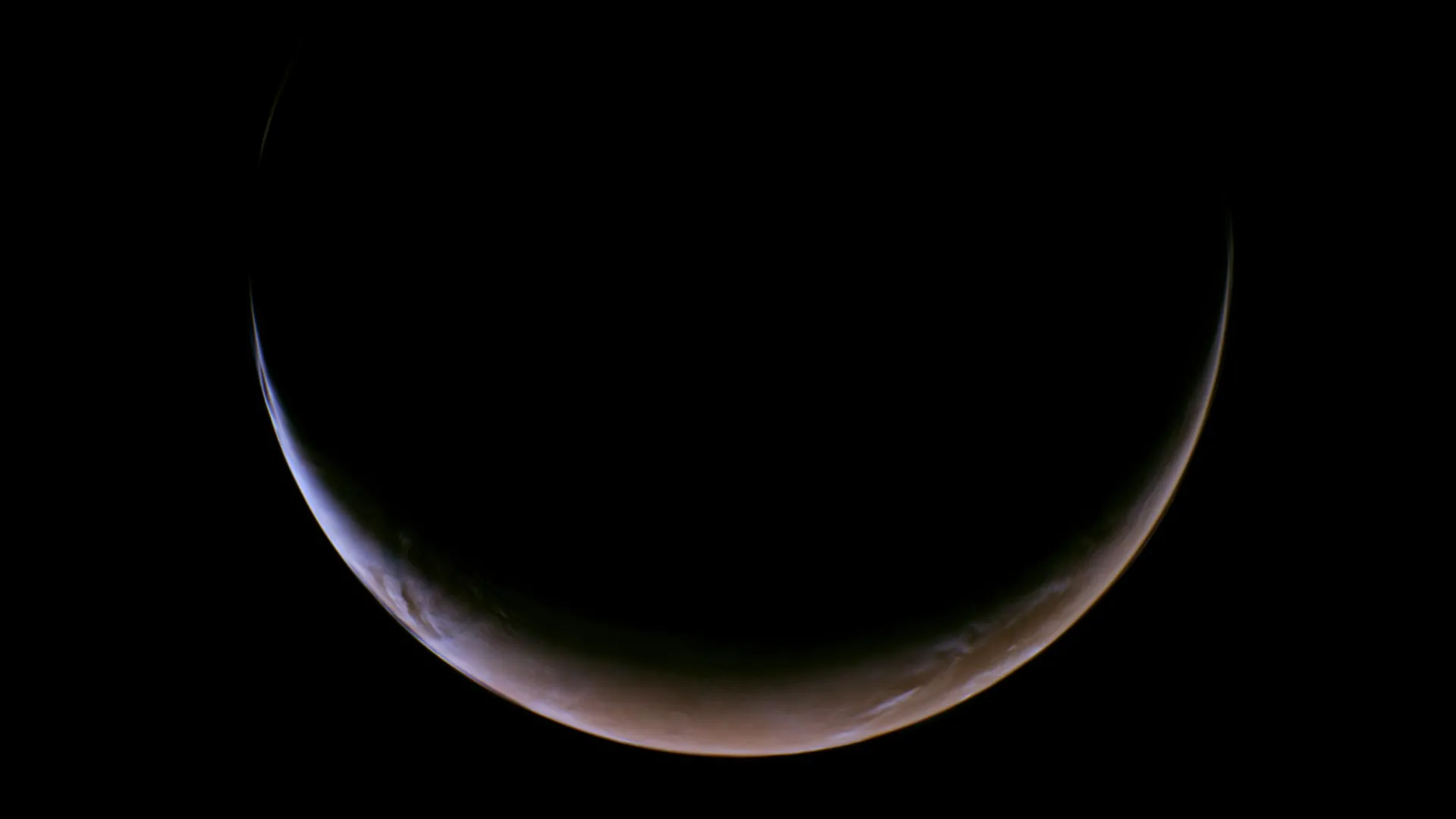
On May 15, NASA's Psyche spacecraft swooped within 2,864 miles of Mars, using the Red Planet as a cosmic springboard to slingshot deeper into the solar system without burning a drop of onboard fuel. The maneuver was textbook physics and pure magic: a gravitational assist that accelerated the spacecraft by 1,000 miles per hour and shifted its orbital plane by about 1 degree relative to the Sun, bending its trajectory toward an extraordinary destination—a metal-rich asteroid that may be the exposed core of an ancient world.
The Mars flyby represents a critical waypoint in humanity's quest to understand planetary formation itself. Scientists believe asteroid Psyche, measuring roughly 173 miles across at its widest point, could be the metallic heart of an early planetesimal—a building block that never finished becoming a planet. If they're right, Psyche offers something rare and invaluable: a window into the deep interiors of rocky planets like Earth, a glimpse at material we can never directly reach.
The confirmation was electric. Don Han, Psyche's navigation lead at NASA's Jet Propulsion Laboratory, watched in real time as the Deep Space Network monitored the Doppler signal during closest approach. "Although we were confident in our calculations and flight plan, monitoring the DSN's Doppler signal in real time during the flyby was still exciting," Han said. The precision was absolute: Psyche arrived exactly where it needed to be, now firmly on course for arrival at asteroid Psyche in August 2029.
But the Mars encounter offered far more than a navigational achievement. It was a full dress rehearsal. As the spacecraft approached, its multispectral cameras, magnetometers, and gamma-ray and neutron spectrometer powered up for the first time in operation. The imaging results were stunning: thousands of photographs capturing Mars as a narrow crescent from Psyche's vantage point, its edges appearing unexpectedly bright where sunlight scattered through the Martian dust. Near closest approach, the spacecraft rapidly photographed the surface as it crossed from the night side into daylight—raw calibration data that Jim Bell, the Psyche imager instrument lead at Arizona State University, will use to perfect the mission's image processing tools before they reach the asteroid.
The magnetometer team may have even detected Mars' bow shock, the turbulent boundary where the solar wind crashes against the planet's magnetic environment. The gamma-ray and neutron spectrometer gathered measurements that scientists can now compare against decades of existing Mars data, a crucial step in validating instruments that have never operated in the deep solar system before.
With Mars now receding behind it, Psyche will coast onward using its solar-electric propulsion system, crossing the asteroid belt toward its target. The asteroid awaits—a scientific prize that could rewrite understanding of how worlds form. Once Psyche arrives, the spacecraft will orbit at multiple altitudes, mapping the surface and gathering data that may reveal whether this strange metal world truly is a planetary remnant, a messenger from the solar system's violent youth.
"We've been anticipating the Mars flyby for years, but now it's complete," said Lindy Elkins-Tanton, principal investigator for Psyche at UC Berkeley. "We can thank the Red Planet for giving our spacecraft a critical gravitational slingshot farther into the solar system."