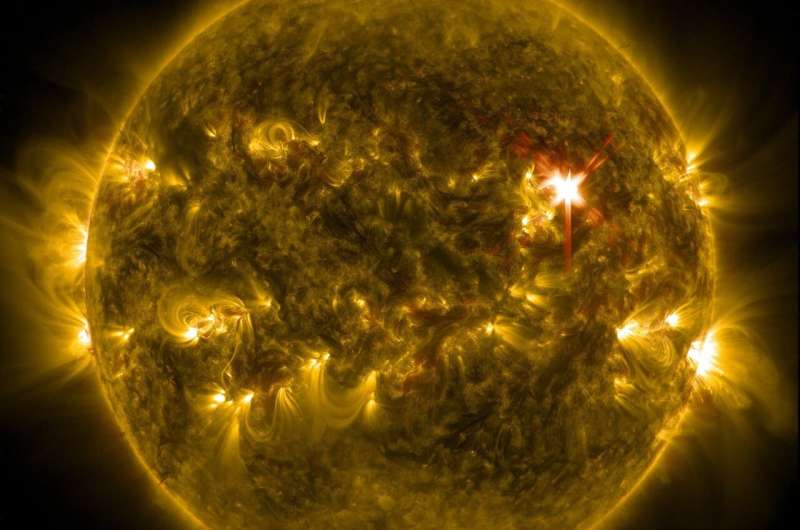
When a massive cloud of solar material erupted from the sun on May 31, 2025, scientists watched it travel across 93 million miles of space — and correctly predicted when it would strike Earth down to the half-hour. That prediction, just 30 minutes off the mark, represents a tenfold leap in how well we can forecast dangerous space weather before it arrives.
The breakthrough came from NASA's PUNCH mission, a set of four satellites that orbit Earth while photographing the inner solar system every four minutes. Before PUNCH, scientists could only catch glimpses of these eruptions, called coronal mass ejections, as they crossed the first chunk of their journey. The rest of the trip was essentially a blind spot. With PUNCH's wider view, researchers can now track solar storms nearly all the way to Earth in continuous 3D detail.
"We thought PUNCH would be good at this, but it's a stunning result," said Craig DeForest, the project's lead scientist at Southwest Research Institute in Boulder, Colorado. He compared the leap to swapping a steam engine for a modern car. The team fed real PUNCH images of the May 2025 eruption into a computer model, which tracked the storm's speed and shape as it hurtled toward our planet. Twelve hours after the eruption left the sun, the model predicted arrival eight hours later — a guess that landed just 30 minutes off the actual time. Standard forecasting methods today typically miss by five hours or more.
The practical stakes are real. Coronal mass ejections carry charged particles that can disrupt power grids, threaten satellites, and endanger astronauts. Better predictions mean utility companies, satellite operators, and space agencies can prepare instead of scramble.
But the images are revealing surprises beyond just forecasting. The high-resolution pictures showed that these clouds of solar material are clumpier than scientists expected, with structures that keep shifting as they cross the solar system. The data is also helping researchers understand how plasma — the hot, charged gas ejected by these eruptions — behaves throughout the galaxy, even in distant star-forming regions impossible to study up close.
DeForest said the team achieved its accuracy with a relatively simple process, made powerful only by the ability to track storms continuously. With sharper images and smarter models, the team hopes to forecast arrivals even earlier and with greater confidence.