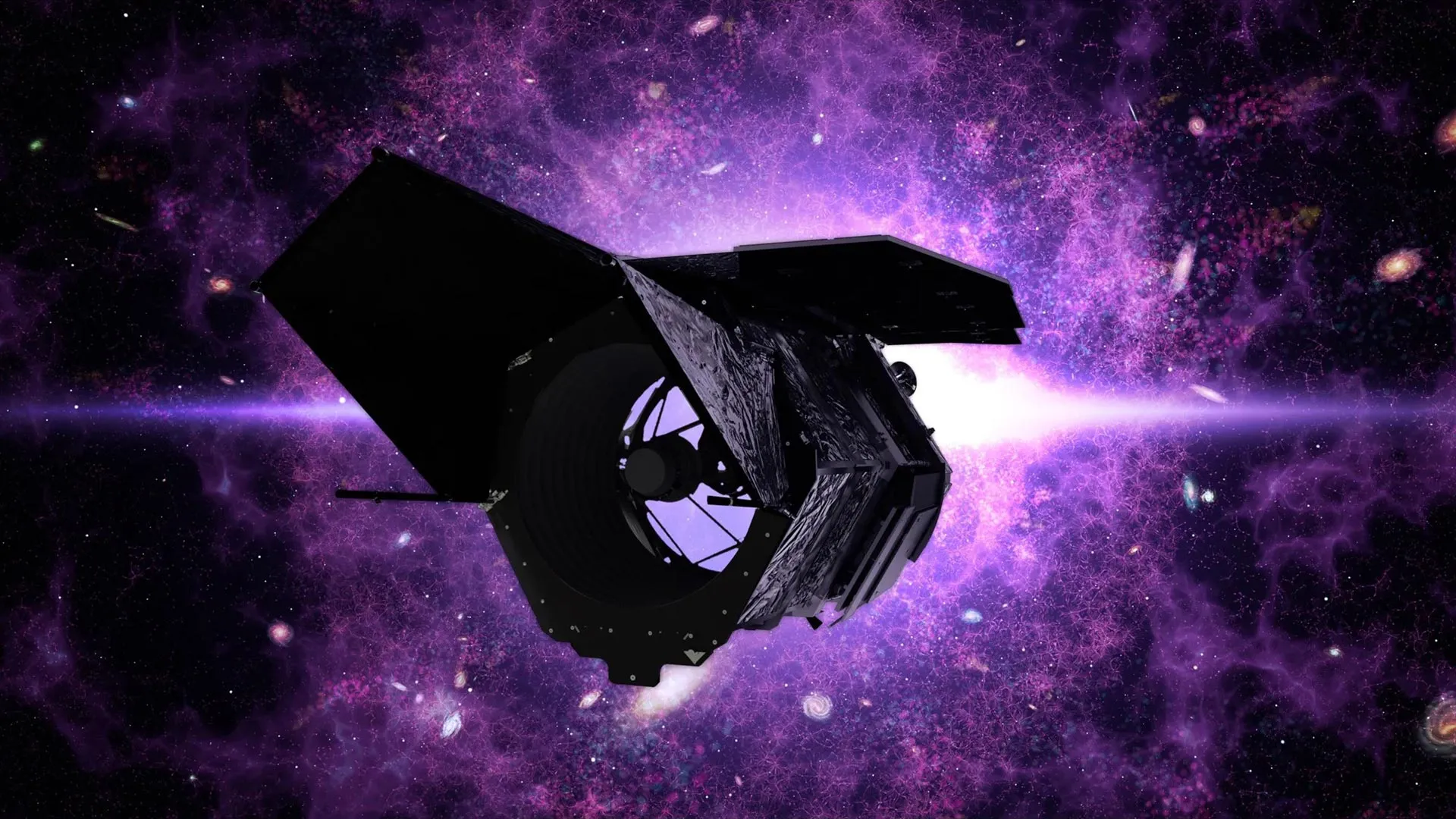
When NASA's Nancy Grace Roman Space Telescope begins its Galactic Bulge Time Domain Survey, it will peer into a cosmic fog so thick that millions of objects remain completely invisible to every telescope we have today. Neutron stars—the ultra-dense remnants left behind when massive stars explode—are believed to fill the Milky Way by the millions, yet most of them hide in plain sight, too dim and isolated to catch our eye. A new study published in Astronomy and Astrophysics reveals that Roman may finally unlock their secrets.
The problem astronomers face is fundamental: neutron stars are nearly invisible. They contain more mass than the Sun packed into an object roughly the size of a city, yet most produce little or no detectable light. We can see pulsars that emit radio waves, or neutron stars that shine brightly in X-rays, but the isolated ones remain dark and elusive. Scientists have identified only a few thousand neutron stars so far, yet estimates suggest the Milky Way could contain anywhere from tens of millions to hundreds of millions of them. We are seeing, as researcher Zofia Kaczmarek of Heidelberg University puts it, "a small sample that's not representative of the big picture."
Roman will find these hidden objects through a phenomenon called gravitational microlensing. When a massive object such as a neutron star passes in front of a more distant star, its gravity bends and magnifies the background star's light, temporarily making it appear brighter and slightly shifted in the sky. Other telescopes can detect this brightening, but Roman does something different. It will precisely measure both the increase in brightness and the tiny positional movement of the background star. Because neutron stars are relatively heavy, they create a stronger astrometric signal than smaller objects—meaning Roman can not only detect them, but directly measure their masses, something extraordinarily difficult to achieve using brightness measurements alone.
"What's really cool about using microlensing is that you can get direct mass measurements," explained Peter McGill of Lawrence Livermore National Laboratory, a co-author of the study. "It's the amount the star's position shifts that tells us how massive that object is. By measuring that tiny deflection on the sky, we can directly weigh something that is otherwise unseen."
The implications are profound. Researchers have only been able to measure neutron star masses in binary systems where two objects orbit each other. Roman's observations could help answer fundamental questions about whether there is a true gap between neutron star and black hole masses—a mystery that has vexed astronomers for decades. The mission may also reveal how quickly neutron stars travel through the galaxy, shedding light on the powerful "kicks" they receive during supernova explosions, which can launch them through space at hundreds of miles per second.
What makes this discovery particularly exciting is that it wasn't part of Roman's original plan. The telescope was designed primarily to find exoplanets through microlensing, yet its advanced astrometric precision has opened a door to entirely new kinds of discoveries. McGill notes that "even in the first months after commissioning, we expect to start identifying promising events." As the team prepares for the survey, their ambitions are both humble and bold: even a single confirmed detection of an isolated neutron star would be, as Kaczmarek says, "incredibly stimulating to our research," while a modest number of discoveries could significantly reshape our understanding of stellar explosions and matter under the most extreme conditions imaginable.