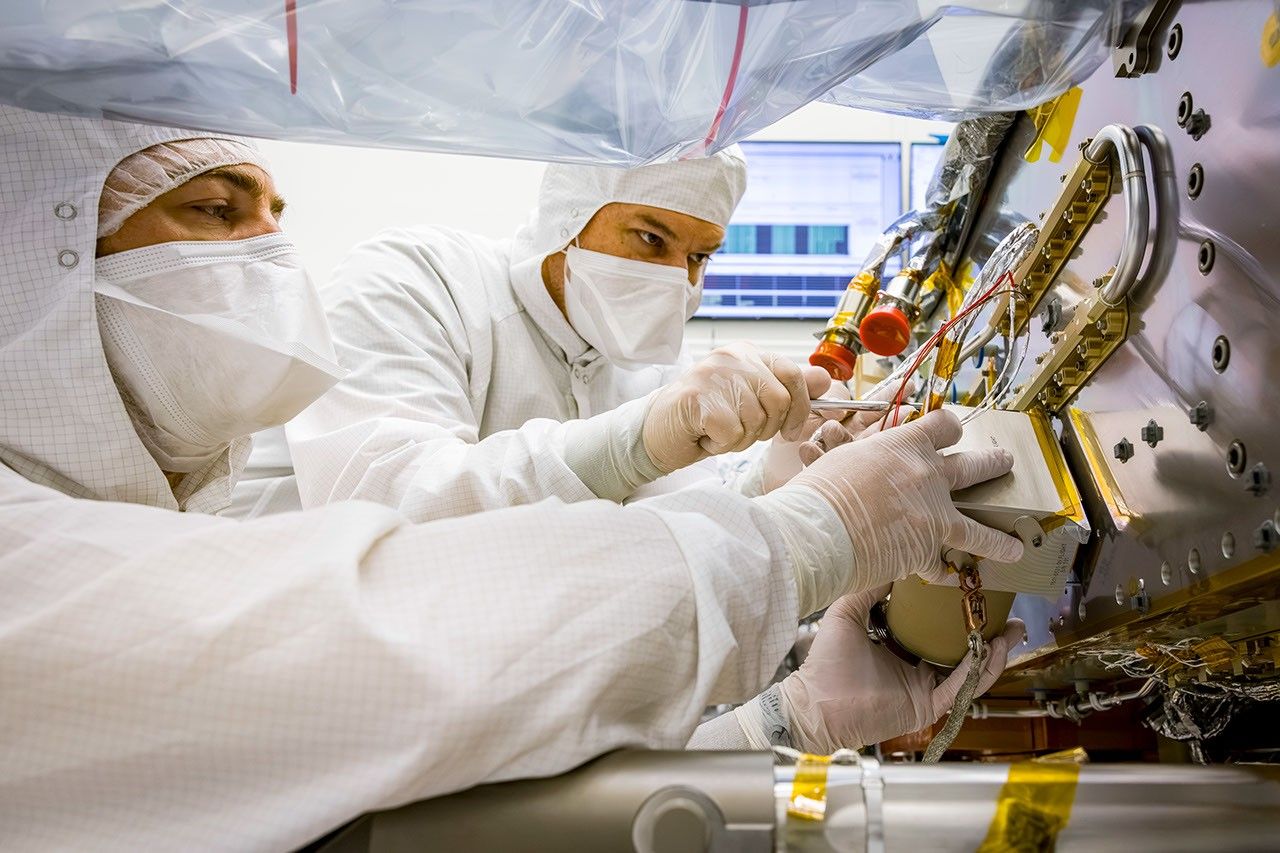
Seven cameras are now fixed to NASA’s car-sized Dragonfly rotorcraft, giving the future explorer its first set of eyes for Saturn’s moon Titan. At Johns Hopkins Applied Physics Laboratory in Laurel, Maryland, the cameras have been installed, tested and joined to the spacecraft as it takes shape for a journey to a world of frigid plains and unfamiliar landscapes.
Dragonfly is designed to fly from place to place on Titan, studying its surface and the materials there. Its seven DragonCam cameras will record the terrain both in flight and from the ground. That matters because pictures taken from different heights can help scientists connect small details, such as grains of sand, to the wider landscape around them.
Built by Malin Space Science Systems, all seven science cameras were installed by mid-November in insulated housings. Each will look through a window in a foam enclosure that protects the cameras and the rotorcraft’s interior from Titan’s extreme cold. Temperatures there can reach minus 290 degrees Fahrenheit.
DragonCam combines several views. A forward wide-angle camera sees 90 degrees of terrain, while a medium-angle camera overlaps its view at higher resolution. Together, they can produce a stereoscopic view, similar to how two eyes help people judge depth. Two cameras mounted on the sides add panoramic views. Two more point down to inspect the ground beneath Dragonfly, helping the team decide whether a landing site is safe for deploying its sample-collecting drill, DrACO, and a seismometer. A high-resolution microscopic imager will examine millimeter-sized sand grains near the drill site.
Light will also help the cameras tell scientists what they are seeing. A configurable LED array built at APL spans wavelengths from infrared to ultraviolet. Its illumination can reveal the colors of surface materials, helping researchers make guesses about their makeup. Titan’s long night lasts nearly eight Earth days. During that darkness, ultraviolet light may help DragonCam spot organic molecules that glow, or fluoresce. The lighting can also show Titan in colors closer to how human eyes would see it.
“With the capability to take images when Dragonfly is on the surface as well as while flying, DragonCam will give us both detailed views and sweeping panoramas of Titan's landscape,” said Elizabeth Turtle, Dragonfly’s principal investigator at APL. She said the images will also offer clues about the processes that shaped the moon. DragonCam instrument scientist Carolyn Ernst added that the pictures will give context to samples collected at several sites, helping researchers relate them to Titan’s broader landscape and geology.
Two navigation cameras, also built by Malin, were installed during the summer. Other instrument packages are due to arrive for integration and testing over the next several months. They include DraGNS, a gamma-ray and neutron spectrometer; DraGMet, for geophysics and meteorology; DraMS, a mass spectrometer; and DrACO.
Dragonfly is scheduled to launch in July 2028 and reach Titan in late 2034. The cameras are already installed, but their most extraordinary views remain years away: the first close-up images from a world that has never been explored by a flying laboratory.