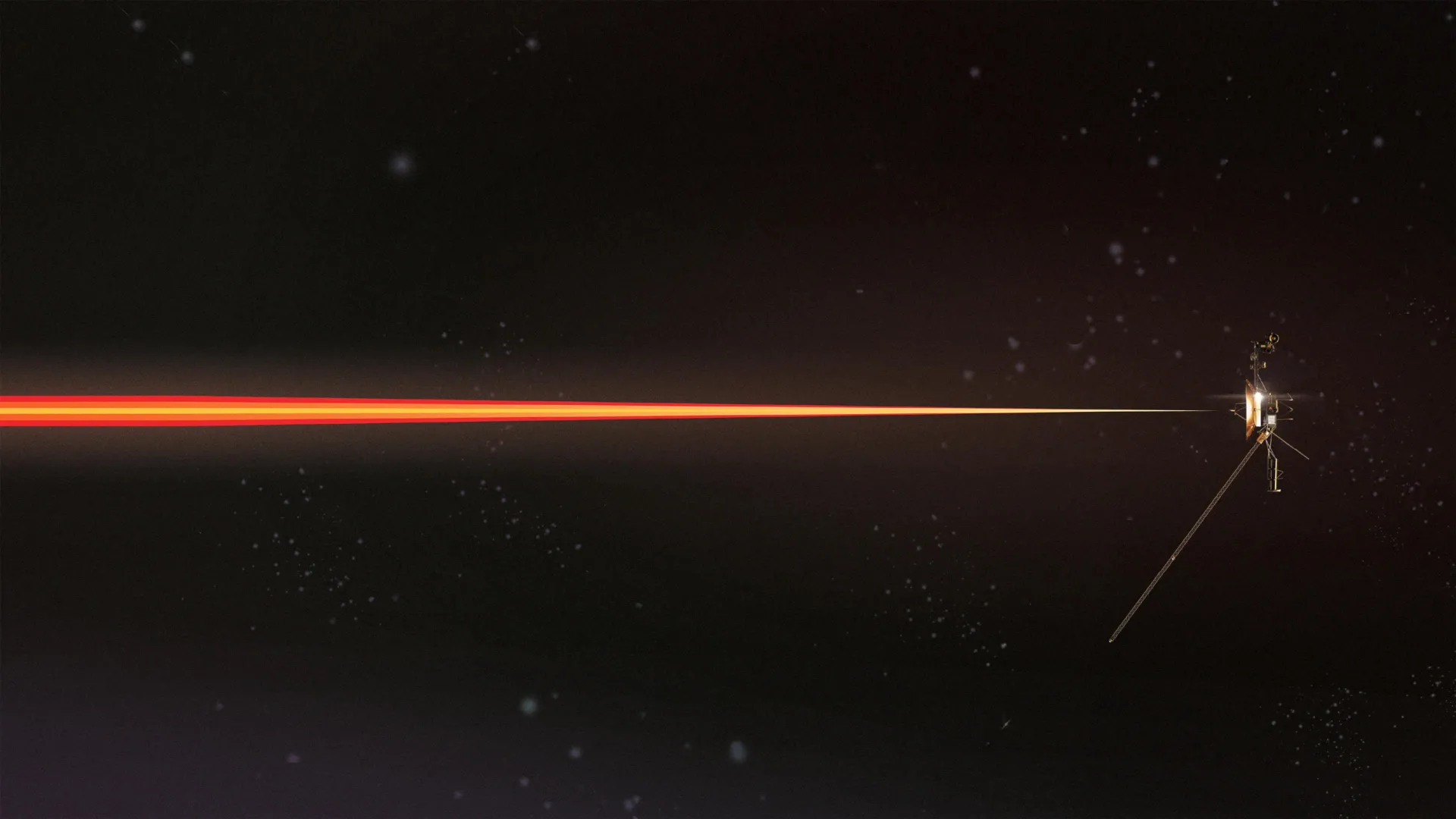
At 2:16 a.m. Pacific time on November 18, Voyager 1 crossed a distance few human-made objects can even approach: one light-day from Earth. The spacecraft was about 16.1 billion miles away, so a signal traveling at the speed of light would need a full 24 hours to reach it or return to us.
Launched in 1977, Voyager 1 has spent more than 49 years moving through space. It is now the most distant human-made object, exploring a region beyond the Sun’s protective bubble that no spacecraft had reached before. Its new milestone is a striking measure of that journey—and a practical challenge for the people still operating it.
A light-day is the distance light travels in 24 hours, about 16.1 billion miles, or 25.9 billion kilometers. Light moves through empty space at roughly 186,000 miles per second. For comparison, sunlight takes about 1.3 seconds to reach the Moon and around four hours to reach Neptune. From Neptune, the signal still needs about 20 more hours to reach Voyager 1.
NASA’s Jet Propulsion Laboratory in Southern California received a signal from the probe exactly 24 hours after it passed the milestone. The team confirmed the distance by tracking Voyager 1’s carrier signal, a radio signal that continues even when it is not carrying the science and engineering information controllers expect.
That distinction matters because NASA has not received scientific or engineering data from Voyager 1 since November 14. Engineers are investigating the problem. The spacecraft is still transmitting its carrier signal, and its trajectory can be calculated, but the missing data has left the team working to understand why the expected information is not coming through.
At this distance, even routine contact takes patience. A command sent to Voyager 1 takes 24 hours to arrive, and a reply takes another 24 hours to get back. Each exchange spans two days. Engineers must plan around that delay as they work to keep a spacecraft launched nearly half a century ago in contact with Earth.
Voyager 1 and its twin, Voyager 2, set out in 1977 to explore the outer planets during a rare alignment that let them use planetary gravity to travel between worlds. The probes became the third and fourth spacecraft to visit Jupiter and Saturn and sent back the first high-resolution images of those planets. Voyager 2 later became the first spacecraft to explore Uranus and Neptune up close. Both spacecraft now travel through interstellar space, where their instruments monitor changes in the Sun’s magnetic field.
Each Voyager also carries a Golden Record: a gold-plated copper record with images and sounds representing life on Earth, intended as a message that an advanced civilization might someday find. For now, Voyager 1’s milestone is also a reminder of the teams still listening from home. NASA engineers are continuing to investigate the data problem, while the probe’s carrier signal confirms that the distant traveler remains reachable across an ever-growing gulf.